PHILIP
Philip is a surname that traces its roots to the ancient Greek personal name Philippos, meaning “friend of horses”. The name combines the Greek elements philos, meaning “friend” or “lover”, with hippos, meaning “horse”. This etymology is the basis for all later forms and variants of the surname.
In the medieval period the surname was recorded under more than one hundred spellings – from Philip, Phillip and Filip, to Lippi, Filippeli, Filipichov and Khilkov – reflecting its widespread adoption across Europe. Early documentary evidence includes Wernherus Philippi of Worms, Germany, 1274, and Henry Philip in the 1275 Hundred Rolls of Norfolk, England.
The surname also enjoys a presence in the British Isles, particularly Scotland, where it appears in Gaelic contexts. The Scottish usage is generally associated with Christian families and can be linked to the Norman influence in the 11th century, when settlers introduced many Latinised names. The term “Celtic” in this setting denotes the broader linguistic heritage of the region, rather than a specific etymological source for the name itself.
During the 11th and 12th centuries a large number of Crusader expeditions were launched from Christian Europe to regain the Holy Land. Soldiers returning from these campaigns often chose biblical or saintly names for their children, thereby reinforcing the Christian record of the surname. Although the name Philip is linked more romantically than theologically to ancient authorities – notably Philip II of Macedon, father of Alexander the Great – the Crusader period helped cement its popularity in western Europe.
In more recent centuries the surname has become common in the United Kingdom, the United States and Canada. In the UK it is among the top twenty surnames, with the highest concentration in the east and south‑east of the country. In the United States it features prominently in states such as California, Texas and Florida, reflecting nineteenth‑century immigration from southern and eastern Europe. The Canadian iteration is often seen among French‑Canadian families and is frequently connected to the Latin form Philippus, which again means “one who loves horses”.
Philip is technically a patronymic surname, formed from the given name Philip or one of its variants. Other spellings that have been historically recorded include Paulys, Philips, Phillips, Philipson, Phillipps, Philipson, Philipsen and Philippon. These variants stem from the same Greek root and indicate the linguistic diversity of families bearing the name.
Across languages and cultures the surname has been adapted to fit local phonology and orthography. For example, in Germany it is often written Philipps or Philipp; in Spain it appears as Felipe or Filipo; in Italy, the form Filippi is common. Despite these differences, the core meaning – “lover of horses” – remains identifiable by linguists and genealogists alike.
Thus the surname Philip exemplifies a name with deep antiquarian roots, a clear Greek etymology, and a widespread geographical spread. Its historical presence in both the medieval and modern eras underscores the enduring nature of patronymic surnames within the English‑speaking world and beyond.
Typical given names associated with the Philip surname
Male
- Alexander
- Andrew
- David
- George
- Ian
- James
- John
- Michael
- Robert
- William
Female
- Anne
- Barbara
- Catherine
- Elizabeth
- Jane
- Joanne
- Linda
- Margaret
- Mary
- Nicola
- Sarah
- Susan
Similar and related surnames
- Filip
- Fillip
- Filipe
- Filipp
- Filipi
- Filippo
- Filippi
- Philpott
- Phipps
- Philipp
- Philippe
- Phippen
- Philips
- Phillipp
- Philps
- Phillipps
- Phillips
- Phillipson
- Philpotts
- Phillpotts
- Philp
- Philpot
- Phillpott
- Filipo
- Fillips
- Filippa
- Phili
- Philipe
- Phiilips
- Phiillips
- Philiips
- Philipas
- Philiphs
- Philipin
- Philipon
- Philipose
- Philipou
- Philippa
- Philippas
- Philippi
- Philippo
- Philippou
- Philipps
- Philipse
- Philipsz
- Philis
- Phillip
- Phillipa
- Phillipe
- Philliph
- Phillipi
- Phillipo
- Phillipou
- Phillippa
- Phillippe
- Phillippi
- Phillippo
- Philllips
- Phlip
- Phylip
- Phylips
- Phyllips
- Phelips
- Philippin
- Philippon
- Philippot
- Philliphs
- Phillippou
- Phillis
- Phillp
- Philpp
Related and similar names are generated algorithmically based on the spelling, and may not necessarily share an etymology.
How to communicate the surname Philip in...
Braille
⠏⠓⠊⠇⠊⠏
Morse
.--........-.....--.
Semaphore


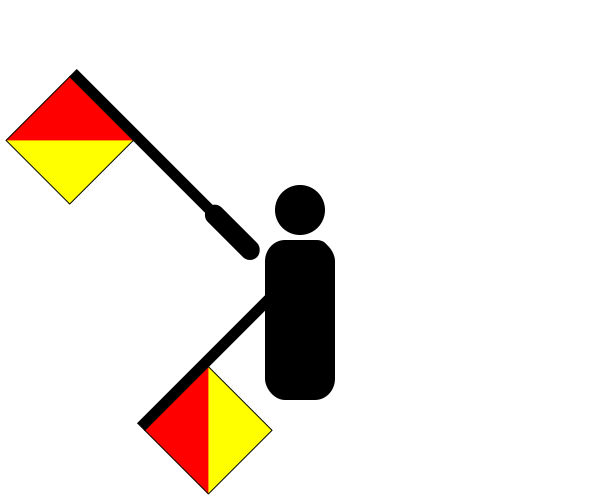

There are approximately 4,583 people named Philip in the UK. That makes it roughly the 2,049th most common surname in Britain. Around 70 in a million people in Britain are named Philip.
Surname type: From given name or forename
Origin: Celtic
Region of origin: British Isles
Country of origin: Scotland
Religion of origin: Christian
Language of origin: Gaelic

Famous people named Philip
- Prince Philip, Duke of Edinburgh - Member of the British Royal Family, consort to Queen Elizabeth II
- Felipe VI or Philip - The King of Spain
- Shakka Philip - Singer
- Asha Philip - Sprinter
- Tom Philip - Scottish rugby union football player and coach, and rugby league football player
- James "Scotty" Philip - American politician (1858 to 1911)
- John Philip - Missionary (1775 to 1851)
- David Butt Philip - Singer
- William Philip - Rugby union player (1928 to 2018)
- Ian Philip - Scottish cricketer
- Alexander Philip - (1858 to 1932)
- Archibald Philip - Cricketer (1867 to 1953)
- Robert William Philip - (1857 to 1939)
- Flora Philip - Scottish mathematician (1865 to 1943)
- Rosalind Birnie Philip - (1873 to 1958)
Names and descriptions courtesy of Wikipedia, and may contain errors. This is not intended to be an exhaustive list of every famous person with this name.