PHILPOT
The surname Philpot is of English origin, traditionally classified as a diminutive form. It is derived from the Old English word philpott, which translates literally as “lover of horses.” In the Middle Ages the name would have been applied to an individual who worked with horses or who displayed horse‑like qualities such as strength and speed.
In a separate but overlapping tradition the name is understood as a patronymic meaning “the son of Philip.” The personal name Philip comes from the Greek Philippos, a compound of philein “to love” and hippos “horse.” Latinised forms such as Philipus are recorded in the Gilbertine houses of Lincolnshire c.1150, and a Henry Philip appears in the 1275 Hundred Rolls of Norfolk. Pet forms including Phielipot and Philiopot survive in the thirteenth century, while the spelling Philpot is first preserved in the Calendar of Letter Books of London in 1378.
The earliest unambiguous instance of the spelling Philpot is that of John Philipot, dated 1327 in the Subsidy Rolls of Sussex during the reign of Edward I, who is described as a medieval pot‑maker. By 1378 a Philipot had been granted the right to bear the arms of a black shield with a bend ermine, an emblem later associated with a John Philpot who served as Lord Mayor of London.
In later centuries the name survived in numerous spellings. Variants such as Phillpott, Philipol, Philipotte, Philpott, Philpots and Philpotts are all attested. The geographical distribution of the surname remains largely within the former British Empire. In England it is concentrated in the South West, especially Gloucestershire, Somerset and Wiltshire, with smaller concentrations in the Midlands and North East. In the United States the name is most common in the Southern states of Arkansas, Mississippi and Tennessee. In Australia, clusters appear in Queensland and South Australia, though the surname is also found across other states. The spread of the surname into Ireland, New Zealand, South Africa and Canada reflects the historical diaspora of English families.
While some 20th‑century sources suggest an alternative derivation from an Old French term meaning “pot‑maker,” the evidence for this linguistic pathway is considerably weaker than the Old English and Greek origins. No primary documents support the theory that the name was originally associated with pottery vessels; rather, the more firmly documented heritage relates to the Greek word for horse and the Old English occupational nickname.
Overall, the surname Philpot exemplifies the confluence of linguistic, social and occupational practices in medieval England. It illustrates how a single name can reflect both inherited patronymic heritage and specific occupational or characteristic attributes, while its persistence through centuries of migration demonstrates the endurance of family identity within the English-speaking world.
Typical given names associated with the Philpot surname
Male
- Alan
- Anthony
- Christopher
- David
- James
- John
- Mark
- Michael
- Peter
- Richard
- Stephen
Female
- Claire
- Elizabeth
- Jacqueline
- Jean
- Joanne
- Julie
- Kelly
- Linda
- Margaret
- Sarah
- Susan
Similar and related surnames
Related and similar names are generated algorithmically based on the spelling, and may not necessarily share an etymology.
How to communicate the surname Philpot in...
Braille
⠏⠓⠊⠇⠏⠕⠞
Morse
.--........-...--.----
Semaphore


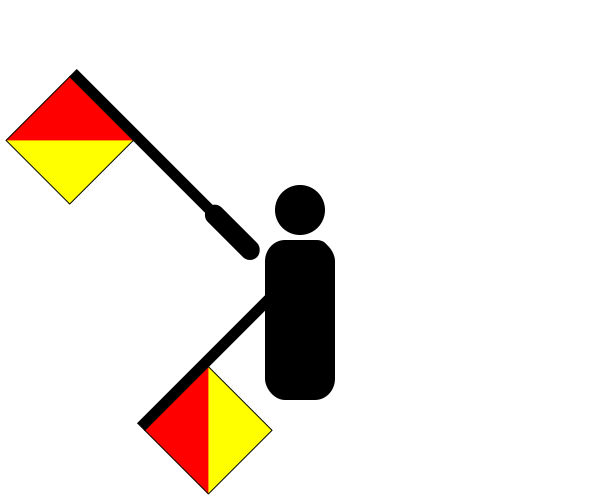

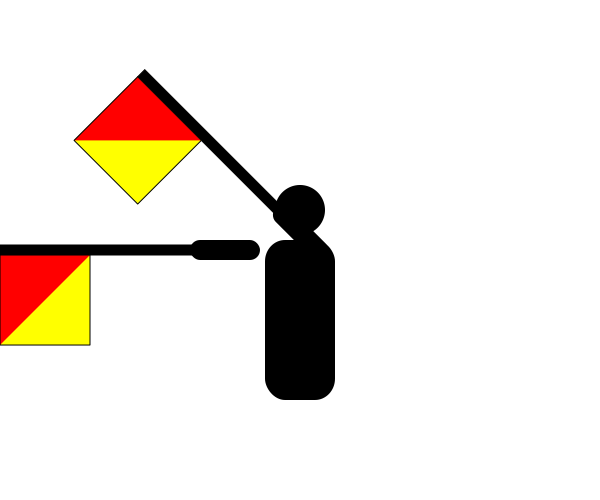
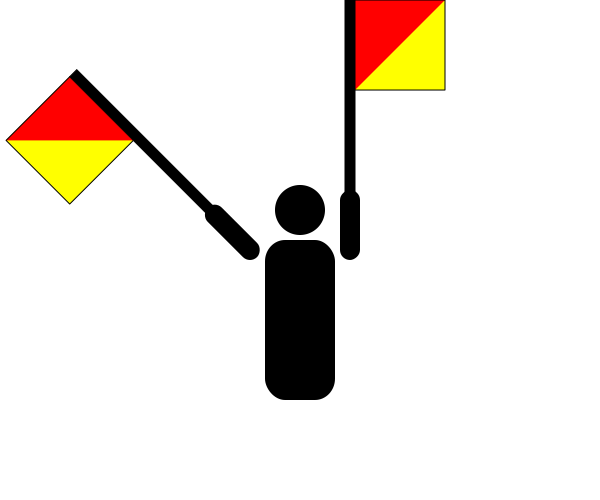
There are approximately 2,006 people named Philpot in the UK. That makes it roughly the 4,207th most common surname in Britain. Around 31 in a million people in Britain are named Philpot.
Surname type: Diminutive
Origin: English
Region of origin: British Isles
Country of origin: England
Religion of origin: Christian
Language of origin: English

Famous people named Philpot
- Oliver Philpot - RAF officer (1913 to 1993)
- Glyn Philpot - Portrait artist (1884 to 1937)
- Jamie Philpot - Football player
Names and descriptions courtesy of Wikipedia, and may contain errors. This is not intended to be an exhaustive list of every famous person with this name.