PHILLIP
Phillip is a surname of ancient Greek origin, derived from the personal name Philippos, which means “lover of horses” or “friend of horses.” The name is composed of the Greek elements phílos meaning “friend” or “lover” and hippos meaning “horse.” Consequently, the surname historically described individuals connected to horses, or those known for an affinity towards these animals.
In the British Isles, the name was adopted as a surname within England in the Middle Ages, becoming primarily a derivation from the given name. It was recorded among Christian families and frequently appeared in official documents such as the Hundred Rolls of Norfolk in 1275. The adoption of biblical and classical names during the 11th and 12th centuries, particularly after the Crusades, reinforced the use of the name Philip and its derivatives as a family surname across Europe.
The surname has survived in many different spellings—including Philip, Phillip, Filio, Filip, Filippos, Filippelis, Filipichov, Phelineux and Khilkov—reflecting its use across a broad geographical range from Spain to the Russian steppes. Early references include the German record of Wernherus Philippi of Worms in 1274 and the English entry of Henry Philip in the 1275 charters. These attestations demonstrate a long tradition of the name within ecclesiastical and secular records.
In contemporary times, Phillip remains widespread in English‑speaking populations. It is among the five hundred most common surnames in the United States and ranks forty‑third in the United Kingdom, with more than one hundred and twenty thousand bearers. In Australia it is the one hundred and twenty‑seventh most common name, and in Canada it is the two‑hundred and forty‑eighth. Such prevalence reflects the name’s enduring appeal and its penetration into diverse communities through migration and cultural continuity.
Variants of the surname include Philip, Philips, Phillips, Phipps, Filippi, Fillip, Philippe and their derivatives with prefixes such as McPhillip or MacPhillip, and suffixes such as Phillipson or Philipsen. These forms appear in France, Spain, Portugal, the Netherlands, Germany, Poland and Estonia, often adapted to local phonetics and orthographic conventions. The continued usage of the surname worldwide attests to the strength and stability of its historical roots and to the importance attached by generations to this concise, robust family name.
Typical given names associated with the Phillip surname
Male
- Andrew
- Anthony
- David
- Ian
- James
- John
- Mark
- Michael
- Richard
- Robert
- Stephen
Female
- Alison
- Ann
- Anne
- Carol
- Deborah
- Jennifer
- Karen
- Linda
- Lydia
- Margaret
- Mary
- Patricia
- Sarah
- Susan
Similar and related surnames
- Filip
- Filipe
- Filipi
- Filipo
- Filipp
- Fillip
- Fillips
- Phelips
- Phiilips
- Phiillips
- Phili
- Philiips
- Philip
- Philipas
- Philipe
- Philiphs
- Philipin
- Philipon
- Philipose
- Philipou
- Philipp
- Philippa
- Philippas
- Philippe
- Philippi
- Philippo
- Philippou
- Philipps
- Philips
- Philipse
- Philipsz
- Philis
- Phillies
- Phillim
- Phillin
- Phillipa
- Phillipe
- Philliph
- Philliphs
- Phillipi
- Phillipo
- Phillipou
- Phillipp
- Phillippa
- Phillippar
- Phillippe
- Phillippi
- Phillippo
- Phillippou
- Phillipps
- Phillips
- Phillis
- Philllips
- Phillp
- Philly
- Philp
- Phlip
- Phylip
- Phylips
- Phyllips
Related and similar names are generated algorithmically based on the spelling, and may not necessarily share an etymology.
How to communicate the surname Phillip in...
Braille
⠏⠓⠊⠇⠇⠊⠏
Morse
.--........-...-.....--.
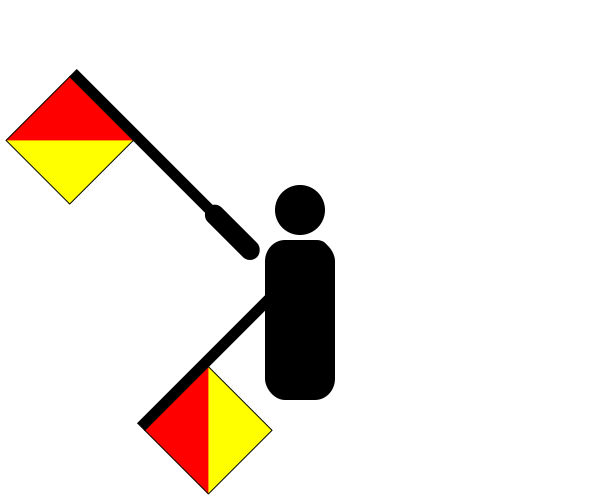
Semaphore



There are approximately 1,446 people named Phillip in the UK. That makes it roughly the 5,509th most common surname in Britain. Around 22 in a million people in Britain are named Phillip.
Surname type: From given name or forename
Origin: English
Region of origin: British Isles
Country of origin: England
Religion of origin: Christian
Language of origin: English

Famous people named Phillip
- Mary Phillip - Association football player
- Phillip - Scientist
- Darren Phillip - American basketball player
- Iain Phillip - Football player
- Phillip - Speedway rider
Names and descriptions courtesy of Wikipedia, and may contain errors. This is not intended to be an exhaustive list of every famous person with this name.