PHILIPP
The surname Philipp traces its roots to both German and Greek origins.
In Greek, the name derives from the ancient personal name Philippos, which is itself a compound of philein, meaning "to love," and hippos, meaning "horse." Consequently, Philippos translates literally as "lover of horses" or "friend of horses" and was traditionally associated with wealth and status, as ownership of horses was a sign of noble standing.
Through linguistic evolution, the Greek Philippos gave rise to the Latinised form Philippus, which entered the Germanic languages as Philipp. The surname therefore has a dual heritage, reflecting both its Greek etymology and its adoption in Germanic contexts.
Historically, the name became a patronymic surname, indicating descent from an ancestor named Philipp. It is widely recorded in England from the mid‑1150s, first appearing as Philipus in the Gilbertine Houses Charters of Lincolnshire. The first documented instance of the surname itself dates to the late 13th century, with the name of Henry Philip found in the 1275 Hundred Rolls of Norfolk.
In the same period, the name was also noted in France in a form influenced by the Old French Phalip, exemplified by the record of Elizabeth Phalpe marrying Rafe Quarterman at Great Milton, Oxfordshire, in 1586.
Over the centuries, the surname has spawned more than twenty recognised variants, including Philip, Philipp(s), Phelips, Phelp, Phillott, Philpott, Philippot, Philippe, and Filipp. Such diversity reflects the name’s wide geographical spread and linguistic adaptation.
Statistically, Philipp remains one of the most common surnames in Central Europe. In Germany it occupies the 29th position in commonality with a substantial number of bearers; it ranks 43rd in Austria and 57th in Switzerland, where approximately 12,600 individuals carry the name. Its presence in the Netherlands and Belgium is less frequent, with 201st and 304th rankings respectively, and the figures for Luxembourg are similar to those of its neighbours.
Outside of Europe, the surname appears less frequently but still noticeably in several other nations. In the United Kingdom it is the 763rd most common surname, reported at 3,455 records. In the United States it ranks 983rd, with around 6,500 individuals named Philipp. Canada records 642 bearers, while France lists 504 and South Africa 7,200, placing it 412th in that country.
Globally, the surname is held by approximately 143,800 people, making it the 6,091st common name worldwide. This figure is a cumulative result of its spread through Christian tradition, historical mobility, and the prevalence of the patronymic naming convention.
Owing to its widespread adoption, Philipp retains a rich cultural footprint, and its many spelled variants—such as Filippo, Filippi, Philippa, and Philippp—are found across different languages and regions, reflecting both linguistic particularities and the enduring legacy of the original Greek root.
Similar and related surnames
- Philip
- Philips
- Phillipp
- Phillipps
- Phillips
- Phillipson
- Philippa
- Philippe
- Philippi
- Philippo
- Filip
- Filipe
- Filipp
- Filippa
- Filippi
- Filippo
- Filippou
- Fillip
- Phiilips
- Phiillips
- Phili
- Philiips
- Philipas
- Philipe
- Philipose
- Philipou
- Philippas
- Philippin
- Philippon
- Philippot
- Philippou
- Philipps
- Philipse
- Philipsz
- Phillip
- Phillipa
- Phillipe
- Philliph
- Phillipi
- Phillipo
- Phillipou
- Phillippa
- Phillippe
- Phillippi
- Phillippo
- Philllips
- Philpp
- Phylip
- Phylips
- Phyllips
- Philp
Related and similar names are generated algorithmically based on the spelling, and may not necessarily share an etymology.
How to communicate the surname Philipp in...
Braille
⠏⠓⠊⠇⠊⠏⠏
Morse
.--........-.....--..--.
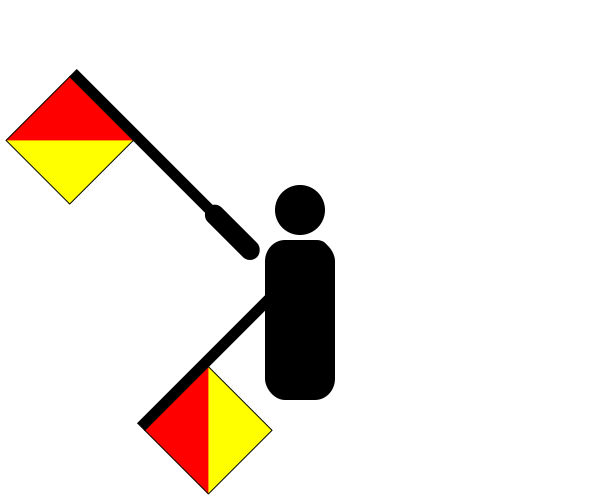
Semaphore



There are approximately 78 people named Philipp in the UK. That makes it one of Britain's least common surnames. Only around one in a million people in Britain are named Philipp.