FILIP
The surname Filip is traceable to its roots in Ancient Greek, forming part of the wider category of patronymic names derived from given names. Its Greek origin is substantiated by the linguistic composition of the word *philein* – meaning “to love” – and *hippos* – meaning “horse”, which together denote a “lover of horses”. This etymology is preserved in the earliest surviving references to the family name across a diverse array of European languages and spellings.
In medieval registries the name appears in many orthographic configurations, ranging from the simple Philip and Phillip to variations such as Filip, Lippi, Filippeli, Filipichov and Khilkov. These different forms have been documented from the Iberian Peninsula on one hand to the Russian Steppes on the other, evidencing a pan-European spread that was especially pronounced during the High Middle Ages.
One of the earliest definite records in Europe is that of Wernherus Philippi, cited in an authentic register from Worms, Germany, in 1274. The following year, in the English legal document known as the Hundred Rolls for the county of Norfolk, a man named Henry Philip is mentioned. These entries confirm that the name had already achieved a certain level of recognisability across distinct linguistic communities earlier in the 13th century.
Historical analysis links the adoption of Christian christening names in Europe to the Crusade movements of the 11th and 12th centuries, when soldiers returning from campaigns in the Holy Land often chose biblical or Hellenic names for their offspring. While the name Filip is associated more with its classical roots than with any specific Christian saint, the broader trend of Christianisation influenced its continued use throughout the continent. The name subsequently secured a place in noble pedigrees, especially within Eastern European societies, where it is regarded as reflecting a lineage of brave, resolute individuals who displayed a readiness to confront challenges and embrace new opportunities.
In contemporary demographics the surname is most frequently encountered in Slavic countries such as Slovakia, the Czech Republic, Poland, Romania, Hungary, Austria, Croatia and Serbia. According to recent statistics it ranks 168th among the 50,000 most common surnames in France, 1,047th in the United States, and 268th out of 100,000 in Canada. It also enjoys a modest frequency in South Africa and the Philippines, positioned at 69 and 98 respectively, and is noted in Israeli records at rank 123 among the 500 most common family names.
Beyond its Greek heritage, the nomenclature Filip may also trace back to the Latin imperial name Philippus, a Roman family name that propagated through the Roman Empire. Comparative studies show that it shares kinship in form and meaning with a multitude of surnames in Romance and Germanic languages. These include the Italian Filippo and its variants such as Filippini and Filippazzo; the French Philippe, Philippet and Philippot; the Greek Philippidēs, Philippopoulos and Filippakos; and the Spanish Filipe, Filipeaux and Filippo. All of these forms are recognisably derived from the root phil, meaning “love”, and therefore carry connotations of affection, loyalty and goodwill.
The name is known for its versatility and the sense of dignity and honour it conveys. While many noble families that bore it have since become extinct, the surname remains a testament to a proud heritage and a connection to family identity that is valued across generations. It remains a common surname, seen not only in Europe but also in North America, South Africa and the Philippines, reaffirming its lasting appeal and widespread cultural resonance.
Typical given names associated with the Filip surname
Male
- Bogdan
- Bryan
- Daniel
- Gabriel
- Krzysztof
- Marcin
- Marius
- Misha
- Pawel
- Tomas
- Victor
Female
- Ana
- Aneta
- Anna
- Elena
- Ewelina
- Joanna
- Katarzyna
- Laura
- Maria
- Phyllis
Similar and related surnames
Related and similar names are generated algorithmically based on the spelling, and may not necessarily share an etymology.
How to communicate the surname Filip in...
Braille
⠋⠊⠇⠊⠏
Morse
..-....-.....--.
Semaphore
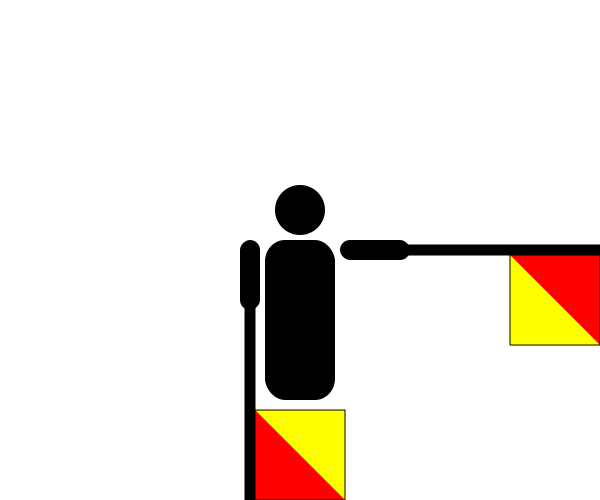
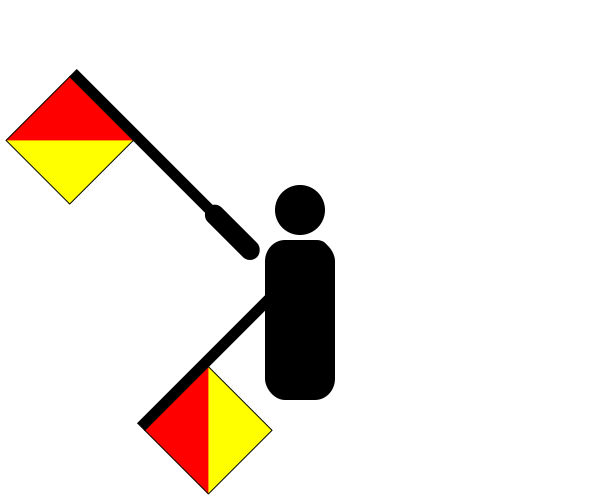


There are approximately 127 people named Filip in the UK. That makes it one of Britain's least common surnames. Only around two in a million people in Britain are named Filip.
