BRUN
The surname Brun originates from Germanic languages, derived from the Old High German word brun which means “brown.” It entered medieval Europe as a descriptive nickname for a person with a brown complexion, brown hair or who regularly wore brown clothing, a trait that could indicate a monk or cleric wearing the traditional monk's robe.
In addition to the Germanic root, the name has cognates in Old Norse, where the personal name Bruni was recorded, and in Old French, where the noun brun held the same colour sense. Consequently the surname has appeared in numerous spelling variants such as Brown, Broune, De Bruyn, Brauner, Bruni and Brunet, reflecting its adaptation to different linguistic contexts.
Historic documentation attests to a wide geographic spread. The earliest known spelling, William le Brun, appears in the Northumberland Pipe Rolls of 1169, during the reign of Henry XI. Subsequent mentions include Hugh Bron of Stafford in 1274, Hugo Brun of Erfurt in 1407, and Christopher Browne among the first settlers of the New England colonies in 1623. In Ireland, descendants of the surname entered the island through 12th‑century Norman migration, establishing lineages in Galway and Killarney.
In continental Europe, the name remains commonplace. In Germany it can be found as Braun, Brunner or Bruegger; in France as Brun, Le Brun, De Brun or Du Brun; in Italy it appears as Brandi or Brandirossi; in Spain as Briones. The surname is among the most frequent in the Czech Republic, ranking thirteenth‑sixteenth depending on the source, and is especially common in Alsace where French and Germanic cultural overlap.
Beyond continental Europe, bearers of the surname are also recorded in the United States, particularly in Louisiana, Mississippi, Maryland and Massachusetts, as well as in the Dutch‑influenced colony of Suriname. The name has persisted across centuries, transcending its original descriptive function to become a family identifier common to people of diverse ethnic backgrounds.
Prominent individuals with the surname include the Swiss novelist Charles‑Ferdinand Brun, whose literary work has secured the name a place in cultural history. Other notable bearers arise in France, the Netherlands and elsewhere, although these are typically identified by the broader surname families, such as the Browne clan of Galway, one of the ancient “Tribes of Galway.”
The etymology of Brun is well‑documented; it remains a reminder of an early medieval practice of naming individuals after visible physical characteristics. In contemporary society, people of assorted racial and ethnic backgrounds may carry the surname, yet its origin retains the historical association with brown‑haired or brown‑complexioned persons.
Typical given names associated with the Brun surname
Male
- Andre
- Christian
- David
- Didier
- Frederick
- Grant
- Henrik
- Javier
- Jean-claude
- Johann
- Mark
- Martin
- Michael
- Peter
- Pierre
Female
- Alexis
- Amelie
- Ana
- Christina
- Colette
- Elizabeth
- Jean
- Michelle
- Stephanie
- Tamara
Similar and related surnames
- Barone
- Birnie
- Birrane
- Bourne
- Brain
- Braine
- Bran
- Bren
- Brenn
- Breun
- Brewn
- Bron
- Bronn
- Brons
- Broone
- Broun
- Bround
- Broune
- Brouns
- Brount
- Brown
- Browne
- Bru
- Brua
- Bruen
- Bruhn
- Bruhns
- Bruin
- Bruines
- Bruins
- Brum
- Bruna
- Brunas
- Brunce
- Brunck
- Brund
- Brunde
- Brunds
- Brune
- Bruneau
- Brunes
- Bruney
- Bruni
- Brunie
- Brunk
- Brunke
- Brunn
- Brunne
- Brunney
- Brunni
- Brunny
- Bruno
- Brunow
- Bruns
- Brunt
- Brunts
- Bruntz
- Bruun
- Bruuns
- Burn
- Burne
- Byron
Related and similar names are generated algorithmically based on the spelling, and may not necessarily share an etymology.
How to communicate the surname Brun in...
Braille
⠃⠗⠥⠝
Morse
-....-...--.
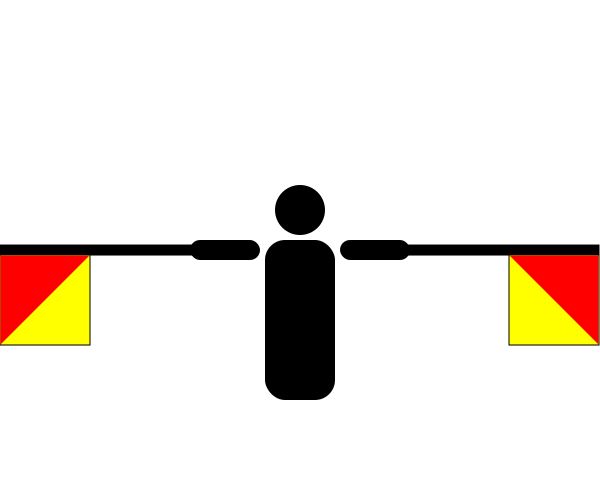
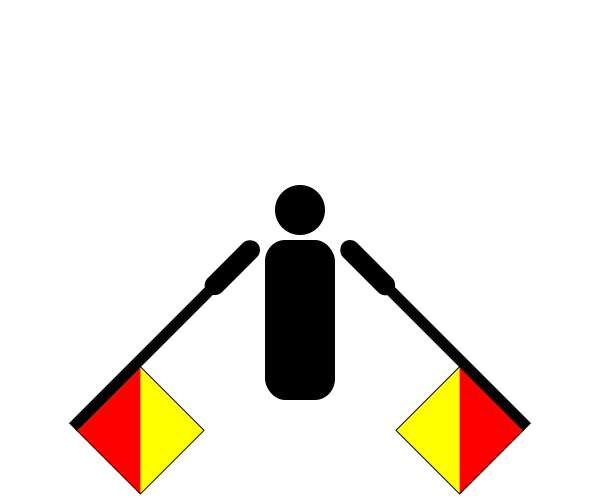
Semaphore


There are approximately 186 people named Brun in the UK. That makes it one of Britain's least common surnames. Only around three in a million people in Britain are named Brun.
