BRUHN
Bruhn is a surname of German provenance. It originates from the Middle‑High German word brun and its variant brunne, both of which translate into English as “brown”. As a topographic name it was applied to a person who lived near a brown‑coloured stream or who possessed a brown hair or complexion.
The name is present in a variety of medieval spellings, including Brown, Broune, De Bruyn, Brauner, Bruni and Brunet. These forms record a long tradition that stretches back to the pre‑seventh‑century Germanic and Anglo‑Saxon word brun or the Old Norse personal name Bruni. In medieval documentation the baptismal name Brun (Latinised as Brunus) was common until surnames were formally adopted in the twelfth century.
Some early attestations of the surname include the record of William le Brun in the Pipe Rolls of Northumberland dated 1169, the earliest known instance of the family name anywhere in the world. The name appears again in 1274 in the case of Hugh Bron of Stafford, England, and in 1407 in the record of Hugo Brun of Erfurt, Germany. The first appearance of the surname in the New World is that of Christopher Browne among the early settlers of New England, with a documented residence in Virginia on 16 February 1623.
Although primarily associated with Germany, the Bruhn surname has spread globally. In the United States it is especially prevalent in the state of Wisconsin, a pattern that reflects nineteenth‑century German immigration. Canadian, Australian and other North‑American dwellings of Bruhn families likewise stem from similar migration flows. Within Germany today the name is almost as common in the north, particularly in Rhineland‑Palatinate, Saarland and North Rhine‑Westphalia, and is recorded in major cities such as Berlin, Hamburg, Munich, Cologne and Hannover. Modern estimates suggest that roughly fifty thousand Germans bear the surname.
Historical accounts link the Bruhn name with military service, notably within Prussia. The von Bruhns formed a distinguished Prussiann military family, and many of their descendants have served in the German armed forces. This tradition of martial association remains recognisable in contemporary German society. Other interpretations propose that the name might derive from a place‑name in northern Germany, such as Bruhna or Brünn, meaning “from the spring” or “from the brook”, or from an occupation such as a herder of sheep or a maker of brushes. Some authors note a possible Slavic root meaning “strong” or “bold”, though such linguistic connections remain less firmly established.
Current research lists a range of variations linked to the Bruhn surname, including Bruehn, Bruen, Bruening, Brune, Bruhnke and Brueninger. These variants are found in different regions; for example, Brúning or Brünne are common in former Prussia, while Brun, Bruning and Bruni appear in the Low Countries and in Denmark as Brøn.
Thus, the Bruhn surname encapsulates a rich German heritage, reflected in its etymological roots, medieval documentation, geographical distribution and historical associations with both civilian and military life. Its continued prevalence in contemporary Germany and the diaspora around the world attests to its enduring legacy.
Typical given names associated with the Bruhn surname
Male
- Chris
- Jonathan
Female
- Kirsty
Similar and related surnames
- Barone
- Birnie
- Birrane
- Bourne
- Brain
- Braine
- Bran
- Bren
- Brenn
- Breun
- Brewn
- Bron
- Bronn
- Broone
- Broun
- Broune
- Brouns
- Brown
- Browne
- Bruen
- Bruh
- Bruha
- Bruhns
- Bruin
- Bruines
- Bruins
- Brun
- Bruna
- Brund
- Brune
- Bruneau
- Brunes
- Bruney
- Bruni
- Brunie
- Brunk
- Brunn
- Brunne
- Brunni
- Brunny
- Bruno
- Brunow
- Bruns
- Brunt
- Bruun
- Bruuns
- Burn
- Burne
- Byron
Related and similar names are generated algorithmically based on the spelling, and may not necessarily share an etymology.
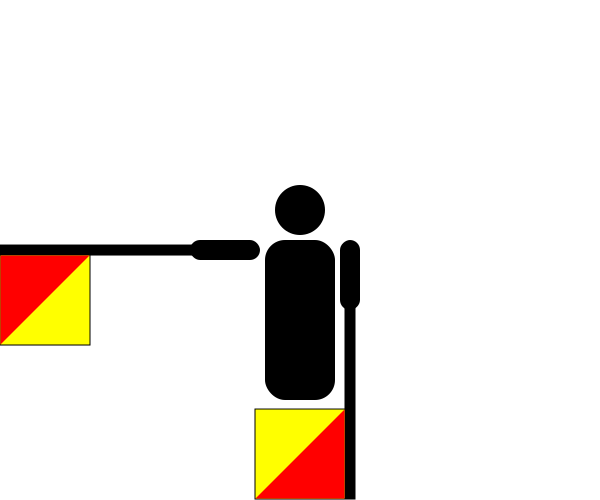
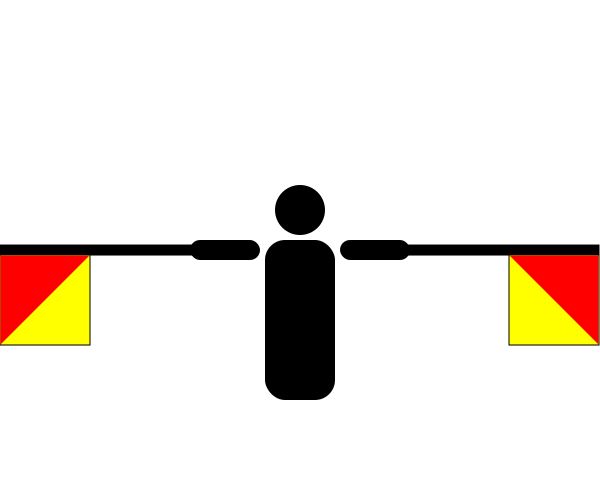
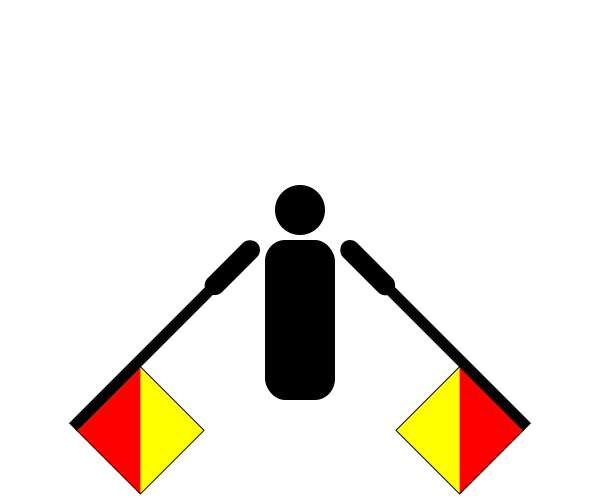
How to communicate the surname Bruhn in...
Braille
⠃⠗⠥⠓⠝
Morse
-....-...-....-.
Semaphore


There are approximately 36 people named Bruhn in the UK. That makes it one of Britain's least common surnames. Only around one in a million people in Britain are named Bruhn.
