BRUM
Brum is an English surname that finds its origins in the Old English word brōm, meaning “broom” or “shrub”. As a topographic name it was applied to individuals who lived near abundant growths of broom shrubs or who were involved in the manufacture of brooms. The semantic connection between the plant and the occupation is typical of medieval surnames associated with natural features.
In addition to its topographic roots, Brum is regarded as a variant of the more familiar surnames Broom and Broome. The latter form is frequently found in historical records from the Anglo‑Saxon period, and both names derive from the Old English pre‑7th-century word brom. These variants serve as evidence of a shared etymology and a common naming practice based on locality or occupation.
The locational use of the surname derives from several places in the British Isles named Broom, Brome, or Broome. Such places are recorded in the Domesday Book of 1086, where they appear as Brume or Brom. The surname consequently denotes a person originating from one of these settlements, which themselves were named for the presence of broom or gorse shrubs. The name’s evolution can be traced through early spellings such as Brom (1221) and Brume (1275).
Documentary evidence for the surname reaches back to the late 12th century. The first recorded instance of the name appears in the Leicestershire Pipe Rolls as Robert de Brome in a dated entry from 1193, made during the reign of King Richard I, known as the Lionheart (1189–1199). A further notable record is the marriage of Rebecca Brum to John Woolnough, which was officially recorded in Hoxne, Suffolk, on 31 August 1668.
Variations of the spelling are plentiful, and historical records show forms including Broom, Broome, Brome, Brume, and Brum itself. The surname has also been seen in compound forms such as Brum‑Smith or Brum‑Jones, although these are less common and typically reflect later matrimonial or occupational unions.
While most scholarship identifies the surname as of English origin, some sources note a possible German influence. In that context, Brum could be a variant of the German patronymic Brumm, linked to the Middle High German personal name Bruno meaning “brown”, or it could derive from the Germanic word brum meaning “broom” or “gorse”. This alternative explanation accounts for the presence of the name in Germany, Portugal and its former colonies, Brazil, and the United States, where migration has spread the surname beyond its original English confines. However, the German derivation should be regarded as an adjunct hypothesis rather than a primary explanation.
Today, the surname Brum remains relatively uncommon but is documented across several countries. In the United Kingdom it is confined largely to the south‑eastern counties where historic place‑names survive. In the United States, Brazil, and Canada, the name occurs in communities that have experienced significant European migration, with its Germanic and Iberian versions appearing alongside the English variant. The distribution of the name remains an intriguing case study of how a surname rooted in a specific natural landmark can evolve, diversify, and disperse through time and across borders.
Typical given names associated with the Brum surname
Male
- Anthony
- Christopher
- Edward
- James
- John
- Jonathan
- Leslie
- Michael
- Paul
- Richard
- Robert
- Roy
- William
Female
- Amanda
- Claire
- Colette
- Eileen
- Elaine
- Emma
- Evelyn
- Florence
- Jacqueline
- Katina
- Kirstie
- Paula
- Sandra
Similar and related surnames
- Broom
- Browm
- Broome
- Bru
- Brooms
- Berum
- Breu
- Borum
- Broomes
- Barum
- Brou
- Brue
- Broum
- Breum
- Burm
- Brua
- Bruma
- Brume
- Bahram
- Bahrami
- Bairam
- Bairami
- Baram
- Barima
- Barm
- Barma
- Barmi
- Barom
- Barram
- Barrom
- Bayram
- Beeram
- Behram
- Behrami
- Beram
- Berimi
- Berm
- Berme
- Bermeo
- Bermi
- Bermie
- Berrima
- Bierrum
- Biram
- Birem
- Birom
- Boerm
- Boerma
- Boram
- Borm
- Borme
- Borom
- Borrom
- Borromeo
- Braam
- Braem
- Brahm
- Brahma
- Brahme
- Brahmi
- Braim
- Braime
- Bram
- Brama
- Brame
- Brami
- Bramm
- Bramma
- Bramo
- Braum
- Brayme
- Bream
- Breame
- Breem
- Brehm
- Brehme
- Brem
- Briam
- Briem
- Brim
- Brima
- Brime
- Brimm
- Brimo
- Broam
- Brohm
- Brom
- Brome
- Bromm
- Bruman
- Brumby
- Brumen
- Brumer
- Brumet
- Brumit
- Bruml
- Brumly
- Brumm
- Brumme
- Brummy
- Brumpe
- Brun
- Brus
- Bryme
- Buraimo
- Buram
- Burema
- Burima
- Burma
- Burmi
- Burmo
- Burram
- Buurma
- Byram
- Byrim
- Byrme
- Byrom
- Byrum
Related and similar names are generated algorithmically based on the spelling, and may not necessarily share an etymology.
How to communicate the surname Brum in...
Braille
⠃⠗⠥⠍
Morse
-....-...---
Semaphore
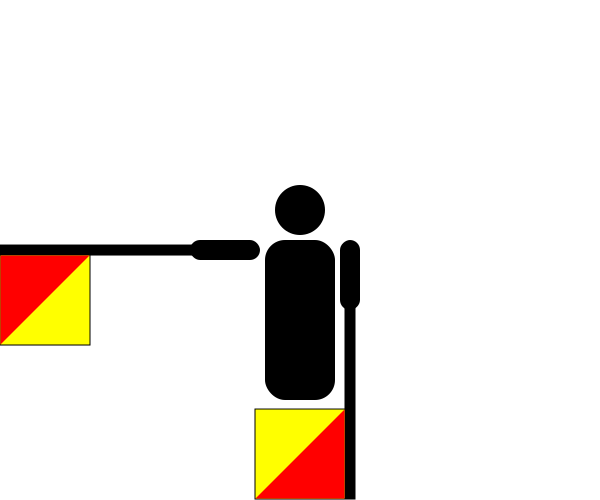
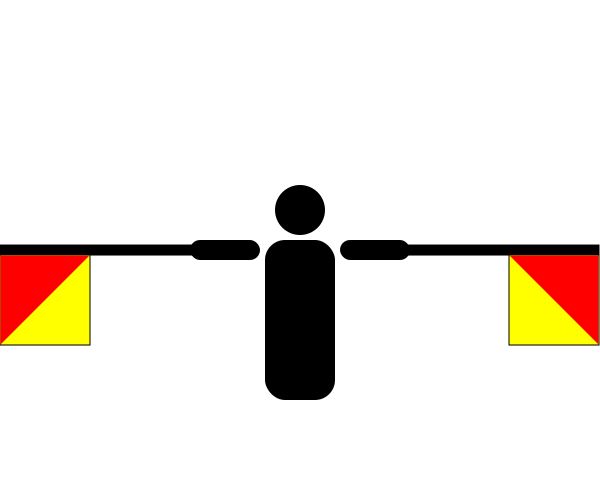

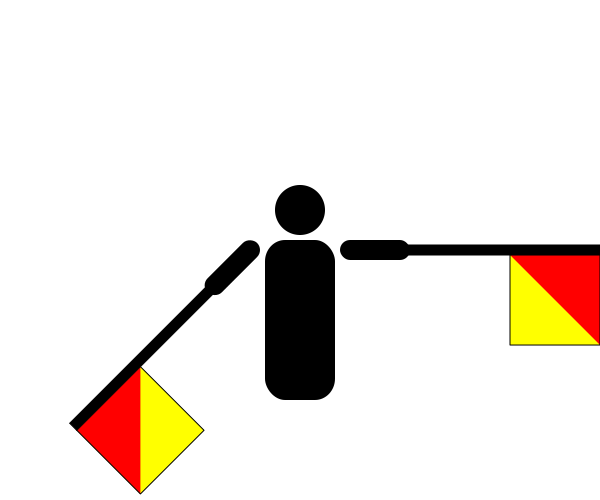
There are approximately 248 people named Brum in the UK. That makes it one of Britain's least common surnames. Only around four in a million people in Britain are named Brum.
Origin: English
Region of origin: British Isles
Country of origin: England
Religion of origin: Christian
Language of origin: English
