LINDE
Linde is a surname of Germanic provenance, deriving from the Middle High German word linde, meaning «lime tree».
The name is fundamentally a topographic surname. It would have been conferred upon a person dwelling near a lime tree, or in a locality bearing the tree’s name. Lime trees were highly esteemed in Germanic culture for their attractive form and their medicinal properties; for this reason the surname may also have been bestowed on those associated with the tree’s reputed virtues.
Historical records show that the surname was recorded in over forty spelling variations, including Lind, Linde, Linden, Line, Lyne, Lingner, Verlinden, Van Lint, Terlinden and Lindman. These variants reflect the diverse orthographic practices of Middle‑High German, Dutch and early modern Germanic dialects.
There are two recognised origins for the name. Firstly, as mentioned, it is a topographical designation for those living beside a lime tree, a tree that held symbolic importance in Germanic mythology and was commonly planted at the heart of a village. Secondly, for some families the surname derives from the medieval female given name Line, an aphetic form of Catherine and related to names such as Emmeline and Adeline. Line was of Frankish and later Norman French origin, and the surname may thus have arisen from a personal name rather than a landscape feature.
Earliest documentary evidence of the name appears in German sources from the twelfth and thirteenth centuries. The first recorded spelling is that of Hainrich Linde in the city register of Konstanz for the year 1254. In England, a person named Lina appears in the 1181 Pipe Rolls of Oxfordshire, and the surname is documented as early as the marriage of John Line and Joan Withy on 6 August 1549 at St. Lawrence Jewry in London. Further early mentions include Cunrad Linde of Beuren, noted in the town charters of 1305, and Christopher Line, an early setteller in the New World who owned 272 acres in Barbados on 23 December 1679.
The distribution of the surname today is largely centred in German‑speaking countries, the Netherlands, and Scandinavia. In Germany the name remains common, while in Sweden the variant Lind is frequently encountered. Significant concentrations can also be found in the United States, predominantly among descendants of German, Dutch and Scandinavian immigrants. In contemporary contexts, the surname is well known internationally through Linde AG, a German multinational chemical company, which has helped raise the name’s profile beyond its purely genealogical confines.
Variants that incorporate prefixes such as van der Linde and von der Linde denote a geographic or noble association, whereas suffixes like -man (Lindman), -son (Lindson) and -berg (Lindberg) are characteristic of German and Scandinavian naming patterns. Compound surnames that combine linde with other elements, for instance Lindholm (lime‑tree island) or Lindgren (lime‑tree branch), demonstrate the flexibility of the root word within the broader naming tradition.
Overall, the surname Linde encapsulates a connection to natural landscape, mythological symbolism and family heritage. Its persistence across centuries and borders attests to the enduring influence of the lime tree within European cultural history and the resilience of topographic and given‑name origins in surname development.
Similar and related surnames
Related and similar names are generated algorithmically based on the spelling, and may not necessarily share an etymology.
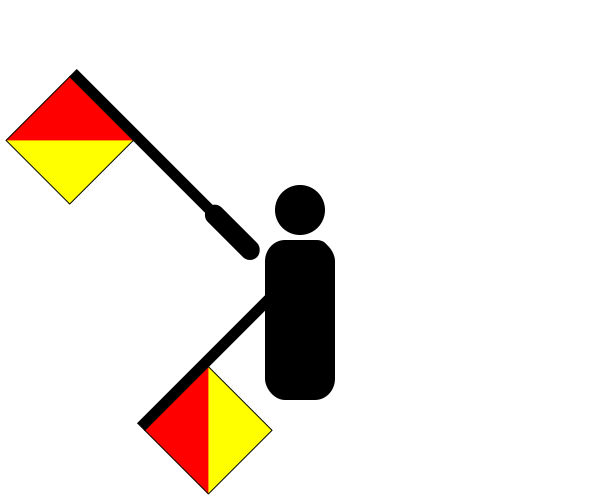
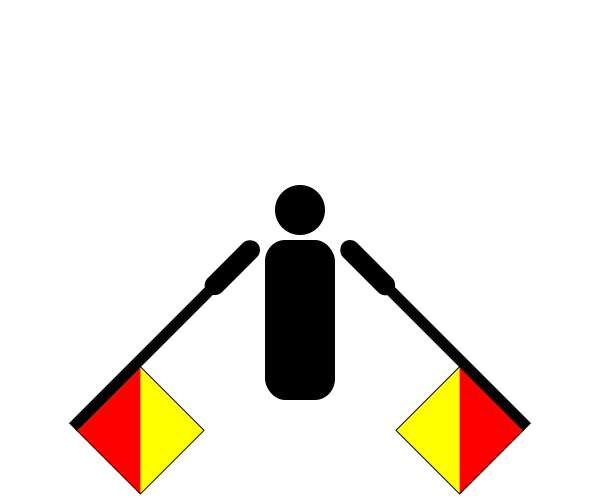
How to communicate the surname Linde in...
Braille
⠇⠊⠝⠙⠑
Morse
.-....-.-...
Semaphore



There are approximately 145 people named Linde in the UK. That makes it one of Britain's least common surnames. Only around two in a million people in Britain are named Linde.
