LINDLEY
Lindley is an English locational surname derived from the Old English words linde—meaning a lime or linden tree—and leah, denoting a woodland clearing, meadow or field. The literal interpretation of the name is therefore “lime‑tree clearance” or “flax meadow.”
The earliest documented use of the name appears as Linleia in the Dorsetshire Pipe Rolls of 1204, during the reign of King John (1199‑1216). By the late thirteenth century the name is recorded in several English counties: Linley in the Pipe Rolls or charters of 1166 for a village in Shropshire; Linleg in the Hundred Rolls of Wiltshire in 1225; and Linly in the Bedfordshire Hundred Rolls of 1273. These places, although now under different spellings, all share the same root elements that signify a clearing where lime trees grew or where flax was cultivated.
In Yorkshire, the surname is linked to two villages called Lindley. One lies near the town of Otley; the other is situated close to Huddersfield. Both villages were originally recorded with forms such as Line and Linley, the consonant d not appearing in the written record until the fourteenth century. An early example, Arthur Lindleye of Yorkshire, appears in the register of students at Oxford University in 1594, evidencing the spread of the surname beyond its place‑of‑origin locality.
Variant spellings of the name include Lindley, Lindly, Lindsley, and the rare dialectal Lindsley. These variations arose from regional pronunciation differences and from the evolution of orthographic practices in English over the centuries.
As families moved away from their native villages, they often carried the locational identifier with them, which over time became hereditary. This process explains why the surname, now most frequently found in England, has also made significant inroads into the United States, Australia, Canada and South Africa, reflecting broader patterns of English emigration during the twentieth century.
While a handful of sources sometimes mention a possible Swedish origin, the documentary evidence overwhelmingly supports an English derivation. The concentration of early records in English counties, coupled with the clear Old English linguistic roots, firmly places Lindley within the tradition of English locational surnames.
Today, the name remains most common in Yorkshire, where the original villages still bear the name. Its spread to other parts of the world has not altered the core meaning of the name, which continues to signify a person who once lived near a lime‑tree clearing or a flax meadow.
Typical given names associated with the Lindley surname
Male
- Andrew
- Christopher
- David
- James
- John
- Michael
- Paul
- Peter
- Richard
- Robert
Female
- Claire
- Elizabeth
- Emma
- Joanne
- Julie
- Linda
- Margaret
- Mary
- Rebecca
- Samantha
- Sarah
- Susan
Similar and related surnames
Related and similar names are generated algorithmically based on the spelling, and may not necessarily share an etymology.
How to communicate the surname Lindley in...
Braille
⠇⠊⠝⠙⠇⠑⠽
Morse
.-....-.-...-...-.--
Semaphore

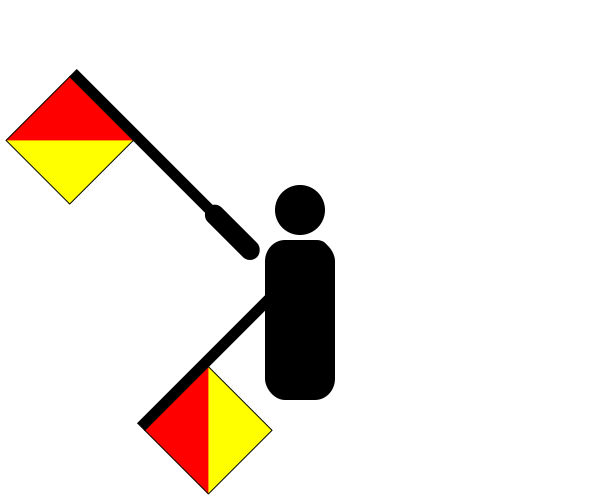
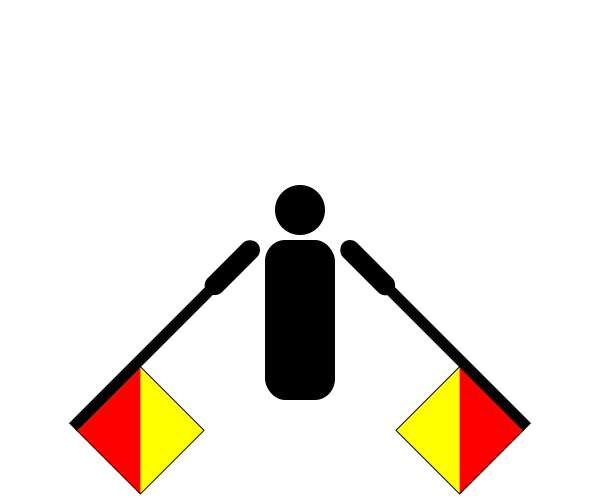


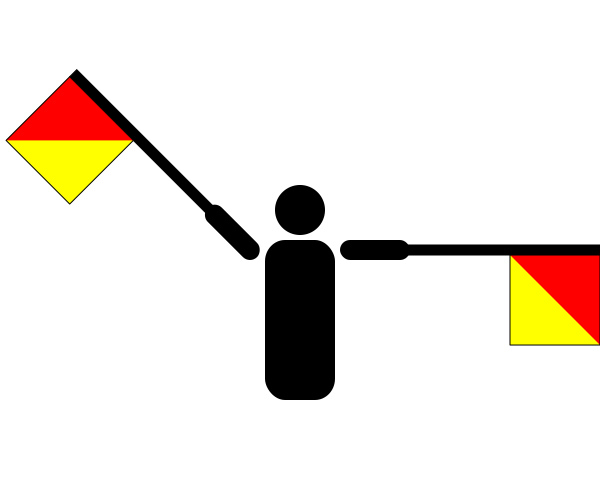
There are approximately 6,590 people named Lindley in the UK. That makes it roughly the 1,438th most common surname in Britain. Around 101 in a million people in Britain are named Lindley.
Surname type: Location or geographical feature
Origin: English
Region of origin: British Isles
Country of origin: England
Religion of origin: Christian
Language of origin: English

Famous people named Lindley
- Louis Burton Lindley Jr. - American rodeo performer, film and television actor (1919 to 1983)
- Dennis Lindley - Statistician (1923 to 2013)
- John Lindley - Botanist, gardener and orchidologist (1799 to 1865)
- Paul Lindley - Entrepreneur
- Nathaniel Lindley, Baron Lindley - Judge (1828 to 1921)
- Tinsley Lindley - Football player (1865 to 1940)
- Simon Lindley - Musician
- Francis Oswald Lindley - Diplomat (1872 to 1950)
Names and descriptions courtesy of Wikipedia, and may contain errors. This is not intended to be an exhaustive list of every famous person with this name.