LYND
Origins of the surname Lynd can be traced to a number of linguistic traditions. The name is rooted in English and Scottish antiquity, and it also appears in Germanic contexts before the seventh century.
The English form of the name derives from the Old English word lind, meaning a lime or linden tree. It was a topographic surname given to individuals who lived near such a tree or in a settlement that carried its name. Lime trees were highly valued in the Middle Ages for the wood used in making shields and other implements, which may have contributed to the spread of the family name.
In Scottish usage, Lynd is linked to place names. It may come from the Gaelic word lind, meaning a lake, pool or waterfall, indicating a person who dwelt near a watercourse. Another interpretation places the origin in the Scots word lynde or linde, meaning shield, implying a protective or defensive role. The ancient forms Lyndon or Lyntoun combine the Old English linde with tun (settlement) to denote a person living near a linden-tree settlement. Records of these forms date to the twelfth and thirteenth centuries in Scotland.
Germanic records show a wider array of spellings, including Lind, Linde, Linden, Line, Lynd, Lyne, Lingner, Verlinden, Van Lint, Terlinden and Lindman. The earliest documented instance in Germany is Hainrich Linde in the city register of Konstanz for the year 1254. Another early record is Cunrad Linde of Beuren, mentioned in the town’s charters in 1305.
In England, the first known recording is believed to be that of Lina in the 1181 Pipe Rolls of Oxfordshire, a document which contains no surname at that time. The surname appears in a marriage record in 1549 when John Line married Joan Withy at St. Lawrence Jewry in London. An early settler of the New World named Colonel Christopher Line is recorded as owning 272 acres of land in Barbados on 23 December 1679.
Variants of the surname are numerous. The most common transliterations across German, Scottish and English contexts include Lind, Lend, Lynde and Lint. Other related forms are Linc, Lynk, and Linke. Some forms reflect Scandinavian influence, such as Lind, while others have an Anglo‑Saxon flavour, such as Lynde. In Ireland, the surnames Lynn and Lyndon are sometimes anglicised as Lynd, with associations to County Antrim and Down.
In modern times, the surname Lynd is not among the most frequent surnames worldwide. It is infrequently found in the United Kingdom, the United States and Canada. Its limited distribution is consistent with its historical use as a topographic or locational identifier rather than a widespread occupational or patronymic name.
Similar and related surnames
Related and similar names are generated algorithmically based on the spelling, and may not necessarily share an etymology.
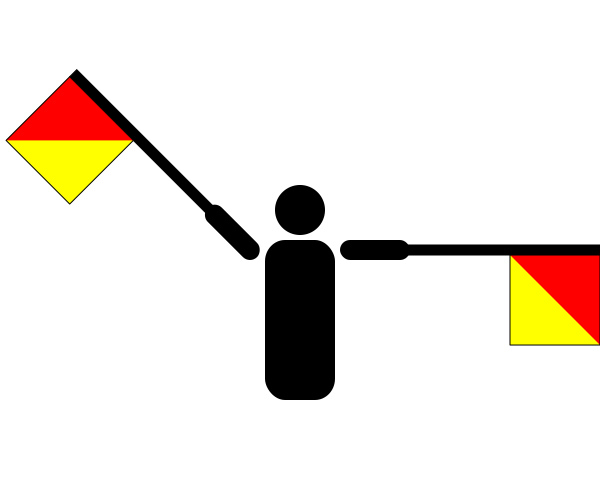
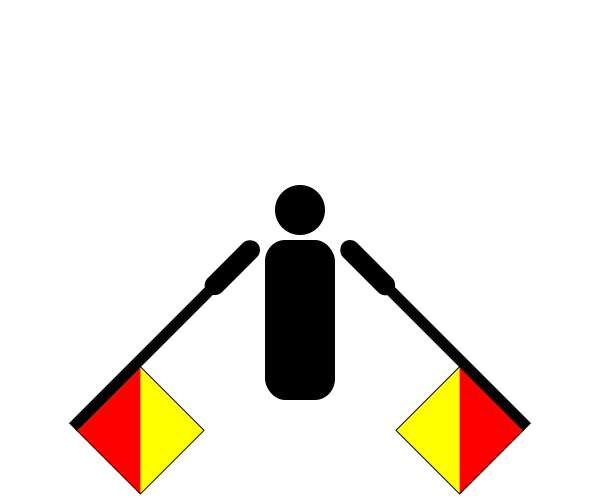
How to communicate the surname Lynd in...
Braille
⠇⠽⠝⠙
Morse
.-..-.---.-..
Semaphore


Sorry, we don't have any statistics on this name. That's probably because it's very uncommon in Britain.
