LINN
Linn is a hereditary surname that has attracted scholarly attention because of its multiple recorded spellings and its association with a variety of geographic and cultural contexts. The name appears in the historical archives of the British Isles under the forms Lin, Linn, Lyn, Lyne, Lynn and occasionally Linné. Each form reflects a distinct line of transmission, whether it be locational, topographic or patronymic.
The principal Irish and Scottish derivation centres on the Gaelic word linne meaning “pool” or “waterfall” (see Source 2). In this sense, the surname would originally have been assigned to individuals residing near a notable body of moving water; a common social practice was to adopt a topographic descriptor as a family name. The same Gaelic root can also be found in medieval English place names derived from the pre‑Roman term lenna, the ancestor of the Welsh llyn (“lake”). Accordingly, a number of English villages such as the hamlet south of Lichfield in Staffordshire and several localities within Norfolk (King's Lynn, South Lynn, West Lynn) supplied the locational basis for the surname in England (see Source 3).
Recorded medieval examples include Cecilia de Lynn of Devonshire in the Hundred Rolls of 1273 and John de Lynne, bailiff of Norwich, in the year 1396. Later toponymic references note that the Roman provincial name Lenna is first attested in 1177 in the Pipe Rolls of Norfolk, during the reign of Henry, the Builder of Churches. These early entries demonstrate that the name had already gained a degree of nuclear localisation by the late 12th century.
In Scotland the name is linked either to a manor of Lyne in Peebleshire or to the ancient castle of Lin in Ayrshire. A deed dated circa 1165‑1214 records that David, son of Robert de Lyne made a grant to Neubotle Abbey; further, William de Lyn is listed as holding lands in Perthshire in 1246. Such references illustrate the transition of the name from a place‑based marker into a recognised surname within the Scottish feudal system.
Another strand of the surname's development is a derivation from the Old Gaelic personal by‑name O' Fhloinn, itself sourced from the word flann meaning “ruddy complexion.” A prominent branch of that clan lived on the borders of Connacht and Ulster; the name eventually simplified to O' Loinn, and from there it evolved into O' Lynn or simply Lynn. The earliest surviving record of this line is the name Aedricus de Lenna in 1177.
Beyond the English‑Irish‑Scottish genesis, the surname has appeared in a handful of other European cultural traditions. A Scandinavian usage is that it functions as a feminine given name, while in Germany it is correlated with a short form of the Germanic personal name Lindo (meaning “soft” or “tender”). In some Jewish (Ashkenazic) contexts the name arose as an ornamental surname derived from German or Danish linde, meaning “lime tree” or “linden tree.” Despite these peripheral associations, the prevailing sense of the name remains tied to geographic features such as waterfalls, pools or lakes, a belief that is underpinned by the linguistic evidence of the Gaelic and pre‑Roman roots.
Contemporary distribution of the surname reflects its historical movements. It is common in the United Kingdom and the United States, and it also enjoys a notable presence in Germany, Sweden and Norway. In the United Kingdom the surname’s concentration can be traced to Scotland’s lowlands, parts of Northern Ireland, and specific English counties where the placename variants once existed.
Typical given names associated with the Linn surname
Male
- Andrew
- Charles
- Christopher
- David
- James
- John
- Michael
- Peter
- Richard
- Robert
- William
Female
- Carol-anne
- Catherine
- Christine
- Elizabeth
- Gillian
- Joanna
- Karen
- Margaret
- Patricia
- Rebecca
- Sheena
- Sheila
- Susan
- Tracey
- Wendy
Similar and related surnames
Related and similar names are generated algorithmically based on the spelling, and may not necessarily share an etymology.
How to communicate the surname Linn in...
Braille
⠇⠊⠝⠝
Morse
.-....-.-.
Semaphore

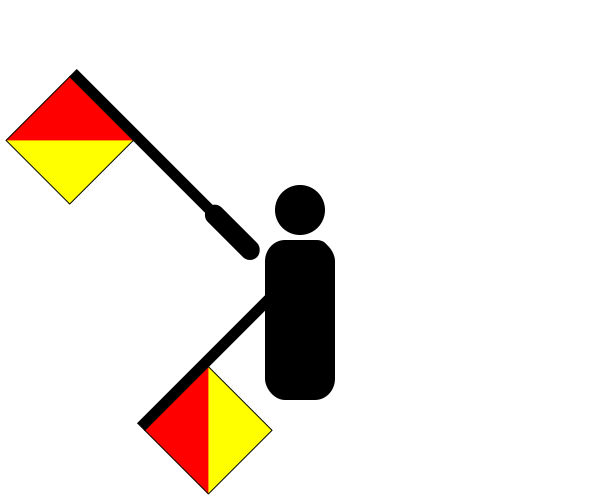
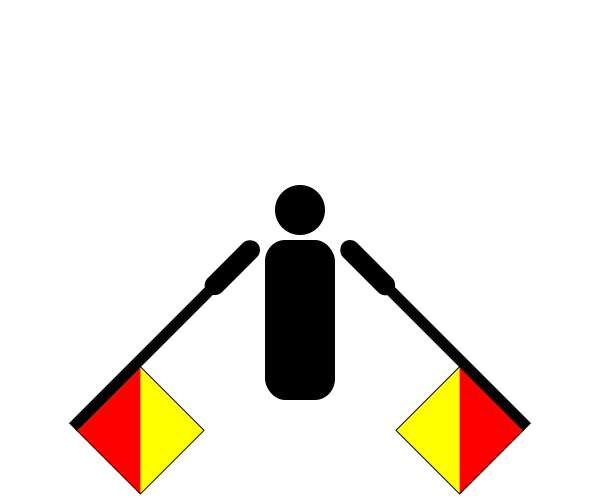
There are approximately 549 people named Linn in the UK. That makes it one of Britain's least common surnames. Only around eight in a million people in Britain are named Linn.
Surname type: From given name or forename
Origin: English
Region of origin: British Isles
Country of origin: England
Religion of origin: Christian
Language of origin: English

Famous people named Linn
- Bobby Linn - Scottish football player
Names and descriptions courtesy of Wikipedia, and may contain errors. This is not intended to be an exhaustive list of every famous person with this name.