KEEL
Keel is a surname of English provenance that, through the centuries, has appeared in several regions of the British Isles. Recorded in the Netherlands, and with varying spellings such as Kele and Kiel, its earliest attestation dates back to the late thirteenth century.
The name is believed to have several possible etymologies. One derivation is from the Old English cēol, which translates as “ship.” This origin would suggest that the initial bearer was associated with maritime activities, possibly a shipwright or proprietor.
Another possibility is a topographic interpretation. In this case Keel may denote a person who lived near a keel, a term used to describe a ridge or ridge‑shaped hill in the landscape.
A further lineage derives from Old Scandinavian influence. The placename Keal, recorded in the Domesday Book of 1086 as Westrecale and Estrecale, refers to West and East Keal in Lincolnshire. The place name is itself derived from Old Norse kiolar, meaning “keel” or ridge. This locational origin indicates that early bearers of the surname may have taken it from this North‑English locale.
Anglo‑Saxon origins are also attested. The village of Keele near Newcastle‑under‑Lyme in Staffordshire appears in the Pipe Rolls of 1169 as Kiel. The toponym arises from Old English cy (cow) combined with hyll (hill), suggesting a farmstead or hill frequented by cattle. Some families bearing the surname trace their ancestry to this site.
In an occupational sense, Keel can be viewed as a variant of Keeler, an occupational name for a boatman or boatbuilder. The name is formed from Middle English kele – a term for a ship or barge – itself borrowed from Middle Dutch kiel. The earliest documented spelling of the family name is that of Robert de Kele, dated 1273 in the Hundred Rolls of Lincolnshire during the reign of King Edward the First.
A Coat of Arms was granted to a Keel family in London: the shield is divided quarterly, crenellated, with silver and black fields, and the first quarter bearing a crescent of the second colour. This heraldic distinction was recorded in the seventeenth century.
In the early modern period, several individuals of note are recorded. The Oxford University Register of 1579 lists a Sebastian Keele of Buckinghamshire, and in 1685 a George Keel, a convicted Monmouth rebel, was transported from Taunton to the Barbadoes. The surname continued to appear in Yorkshire and Lancashire during the sixteenth and seventeenth centuries.
Today, Keel remains in use within the United Kingdom and Ireland. While the exact genealogical lineage of a particular bearer may vary, the surname’s multifaceted origins—maritime, topographic, locational, and occupational—provide a rich tapestry of historical context for those who carry it.
Typical given names associated with the Keel surname
Male
- Andrew
- Christopher
- David
- James
- John
- Martin
- Michael
- Richard
- Robert
- Stephen
Female
- Bridget
- Caroline
- Denise
- Elizabeth
- Gillian
- Helen
- Janine
- Lisa
- Margaret
- Mary
- Pamela
- Ruth
- Sara
- Sarah
- Susan
Similar and related surnames
- Keal
- Keele
- Kal
- Kahl
- Kail
- Kale
- Kall
- Kaul
- Keala
- Kee
- Kealy
- Keall
- Keelay
- Keals
- Kaal
- Kele
- Keeley
- Keell
- Keelley
- Keelly
- Keels
- Keely
- Kehl
- Keil
- Keila
- Kel
- Kela
- Kelai
- Keles
- Keley
- Keli
- Kelie
- Kell
- Kella
- Kelle
- Kelles
- Kello
- Kells
- Kels
- Kelu
- Kely
- Kelz
- Khel
- Kiehl
- Kiela
- Kiell
- Kil
- Kill
- Kol
- Kyll
- Kael
- Keiley
- Keilley
- Keily
- Kelay
- Kelb
- Keld
- Kelf
- Kelley
- Kellie
- Kelloe
- Kelly
- Kelm
- Kelp
- Kelt
- Kelwe
- Keyl
- Keyley
- Khal
- Kheel
- Kheela
- Khela
- Khil
- Khol
- Kieley
- Kiely
- Kille
- Call
- Caul
- Clee
- Cool
- Coole
- Coyle
- Gale
- Galea
- Gall
- Gallie
- Gallo
- Gaul
- Gul
- Kalu
- Kyle
- Quail
- Quayle
- Quill
Related and similar names are generated algorithmically based on the spelling, and may not necessarily share an etymology.
How to communicate the surname Keel in...
Braille
⠅⠑⠑⠇
Morse
-.-...-..
Semaphore
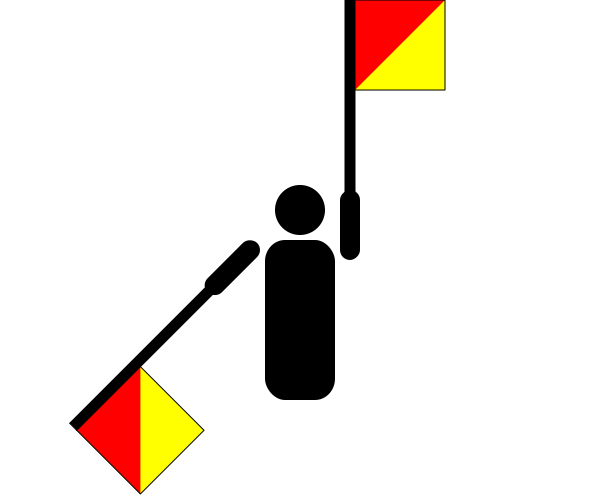


There are approximately 894 people named Keel in the UK. That makes it roughly the 8,069th most common surname in Britain. Around 14 in a million people in Britain are named Keel.
Origin: English
Region of origin: British Isles
Country of origin: England
Religion of origin: Christian
Language of origin: English

Famous people named Keel
- Frederick Keel - Singer-songwriter (1871 to 1954)
Names and descriptions courtesy of Wikipedia, and may contain errors. This is not intended to be an exhaustive list of every famous person with this name.