KEE
Kee is a surname that is found across several cultures, each with its own historical roots and meanings. Its presence is recorded from the British Isles to East Asia, and the name has evolved through various linguistic and geographical influences.
In British contexts, the surname Kee is sometimes considered an Anglicised form of the Gaelic patronymic Mac Aodh, meaning “son of Aodh” or “son of fire.” The personal name Aodh originally denoted a pagan god associated with flame. In Ulster, the variant MacKee is widespread today, especially in Counties Antrim, Down and Armagh, while the unmodified spelling Kee is most numerous in County Donegal. Historical records such as the Register of the Privy Seal in 1538 mention a “George McKe” of Myretoun, and Sir Patrick MacKee is listed as a prominent County Donegal servitor during the Plantation of Ulster.
The Gaelic surname Kee can also be traced back to the 11th‑century record of Cucail Mac Aedha, dated 1098. In the modern period, the name has acquired at least fifteen Anglicised forms, including McKay, McKee, McCay, McCoy, McEa, and McAy. An example in contemporary history is the marriage of Robert Kee and Anne Jane Wilson in Raphoe, County Donegal, on 24 April 1845, and the departure of James Kee, a famine emigrant, from Belfast aboard the Pontiac bound for New York on 17 May 1847.
Across the sea, Kee appears as a Chinese surname derived from the Mandarin ji or qi, meaning “to start” or “to begin.” It is relatively common in China and is especially found among the Hakka people. The name is thought to have originated as a nickname for an individual regarded as a community leader or initiator. The surname has a long history in southern China, particularly in Fujian Province, where it has been present for over 1,500 years. It is widely represented in Asian countries, including Japan, South Korea, Malaysia, Singapore, and Vietnam, as well as in the United States and Canada, where many bearers are of Chinese or Taiwanese descent.
In Korea, the name Kee is associated with a Sino‑Korean origin that emerged during the Goryeo dynasty (918–1392). The character used conveys the notion of a “pillar” or “ladder,” symbolising the Confucian idea that each generation upholds and sustains the family line. Holders of the name have occasionally been recorded as members of the yangban class, a rare noble distinction in Korean society. The symbolic meaning of the surname has been celebrated as a representation of strength and wisdom within families.
In addition to its Gaelic, Chinese, and Korean forms, the surname Kee is occasionally found in England, where it may derive from the Provencal word caic, meaning “key.” In this context, the name is considered part of the English surname tradition and is associated with Christian families in the British Isles.
The Kee surname occurs in a wide variety of variants across different regions. Common alternatives include King, Kie, Kye, Kaye, Key, MacKay, Mace, Mackey, Macquay, MacEochaidh, MacEochaigh, MacEogain, MacKeogh, and MacKeoghan. These spellings reflect the linguistic adaptation of the original Gaelic and Chinese forms as communities migrated and settled in new lands.
Globally, estimates place the number of individuals who bear the surname Kee between 400,000 and 500,000. Vietnam has the highest concentration, accounting for roughly 0.3 percent of the population, or over a million people, largely among the Chung Chia ethnic group and the Fujianese diaspora. In the United States, significant populations are found in California, Texas, New York, and Massachusetts, reflecting the migration patterns of Chinese and Korean immigrants.
Thus, the surname Kee exemplifies how a single family name can traverse continents, adapt to various languages, and carry distinct cultural significances—whether as a marker of leadership among the Hakka, a symbol of divine fire in Gaelic tradition, a pillar of Confucian heritage in Korea, or a key in English etymology.
The enduring presence of Kee across such diverse contexts underscores the ways in which surnames serve as living records of human history, migration, and cultural exchange.
Typical given names associated with the Kee surname
Male
- Alvyn
- Andrew
- Charles
- Christopher
- David
- George
- James
- Jason
- John
- Paul
- Robert
- Stephen
- William
Female
- Alison
- Amanda
- Eileen
- Elizabeth
- Jennifer
- Karen
- Kathleen
- Louise
- Margaret
- Mary
- Michelle
- Rebecca
- Sarah
- Susan
Similar and related surnames
Related and similar names are generated algorithmically based on the spelling, and may not necessarily share an etymology.
How to communicate the surname Kee in...
Braille
⠅⠑⠑
Morse
-.-..
Semaphore
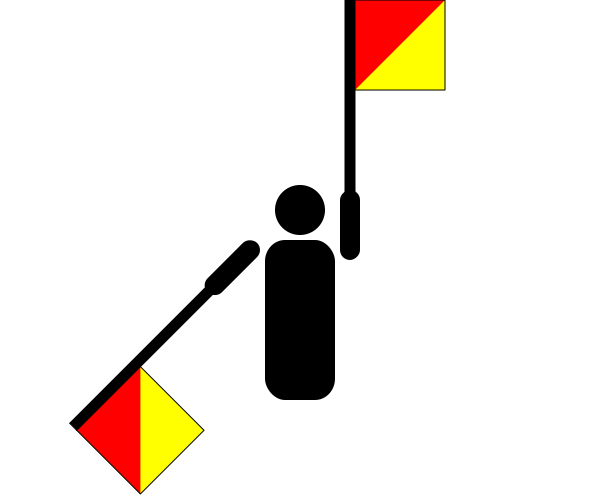

There are approximately 604 people named Kee in the UK. That makes it one of Britain's least common surnames. Only around nine in a million people in Britain are named Kee.
Origin: English
Region of origin: British Isles
Country of origin: England
Religion of origin: Christian
Language of origin: English

Famous people named Kee
- Billy Kee - Football player
- Robert Kee - Broadcaster, journalist and writer (1919 to 2013)
- Not to be confused with the real state developer Lee Shau-kee - Hong Kong actor and director (1949 to 2019)
- Paul Kee - Northern Irish football player
- Paul James Kee - Northern Irish football player
Names and descriptions courtesy of Wikipedia, and may contain errors. This is not intended to be an exhaustive list of every famous person with this name.