KELL
Kell is a surname of old continental and British origin, recognised as having roots in the English, Norse and Scottish traditions. It appears in the historical records of the British Isles from the late twelfth century onward, and has been transmitted across the English‑speaking world to the United States, Canada, Australia and beyond.
The primary etymology of the name is tied to the Old Norse personal name Ketill, which is translated as “cauldron” or “helmet”. In medieval Scandinavian society, it was common for a person to acquire a surname reflecting an object of personal or occupational significance; a maker or user of cauldrons, or a wearer of a helmet, might be dubbed Kell in the vernacular of the period. The name John Brentward offers an example of a clan name that evolved from Ketill, yielding forms such as Asketill, meaning “god’s kettle”, and Thorkell, incorporating the name of the thunder god Thor in Scandinavian mythology.
Other scholars have argued that Kell may also derive from a Middle English personal name Kelly, which itself may have come either from the Old English word ceolo, meaning “ship”, or from ceolle / cyll, meaning “spring” or “stream”. This interpretation implies that the surname was initially descriptive of a person who lived near a spring or who was associated in some capacity with water. The latter view also finds support in the Gaelic form ceall, signifying “strife”, which could appear in the Irish or Scottish contexts of the name.
The earliest known instance of the family name is recorded as Ansfredus Kelle in the Pipe Rolls of Hampshire dated 1176, during the reign of King Henry I. Early English chancery rolls later record surnames such as Reginaldus filius Chelle (1219), Chel filius Mabillae (1250), Isabella Kelle (1311) and Rogerus Kelle (1379). These documents confirm that the name was already established by the thirteenth century, and that it survived through successive periods of social and linguistic change.
In the Scottish tradition, the Kell family is thought to have arisen from clansmen dwelling in the lowlands who had adopted the name in its Latinised form. The Scottish burial register notes that members of the Kell clan were recognised in the borders region, and many were later listed as diplomats who negotiated between settlers and the native Celts that occupied Scotland during the Middle Ages. Furthermore, certain records show Kell families were involved in farming and landownership, reinforcing their prominence in the local agrarian society.
The heraldic tradition of the Kell name bears a distinctive blazon: a gold shield upon a green chevron, flanked by a lion passant in chief and two red mullets in base, with three gold garbs. This coat of arms is often cited as being historically associated with the earlyised Kell line, and its symbols propose a guild of martial strength, agricultural prosperity and a noble spirit.
Variations of the surname are numerous, including Kelley, Kelle, Kells, Kelleigh, Kelleighs, Kelli, Kelliise, Kellie, Kellei, Kellis and others. In Britain, the spellings Kell and Kelly are most common, while Kelle and Keller appear as rarer variants. In the United States the surname is most prevalent in the Mid‑Atlantic states, particularly Pennsylvania, Ohio, Indiana, Michigan and New York. Concentrations also appear in the western states of California, Oregon and Washington. In Canada, the highest frequencies are found in Ontario and Quebec, whereas in Australia the surname mainly occurs in New South Wales and Victoria. Wherever the name appears, it is usually borne by individuals of English, Scottish or Irish ancestry.
Today, the surname Kell continues to be found throughout Britain and the broader English‑speaking world, and retains its historical significance as a connection to a bygone era of Viking influence, Celtic religion, and medieval feudal society. Its survival through centuries attests to the durability of hereditary surnames, and the extant records illustrate a lineage that ranges from early medieval clerics to contemporary citizens across multiple continents.
Typical given names associated with the Kell surname
Male
- Christopher
- David
- John
- Michael
- Paul
- Peter
- Richard
- Robert
- Stephen
- William
Female
- Barbara
- Elizabeth
- Emma
- Helen
- Jacqueline
- Julie
- Karen
- Margaret
- Marion
- Nicola
- Patricia
- Sarah
- Susan
- Victoria
Similar and related surnames
- Call
- Keal
- Kall
- Kal
- Kale
- Kail
- Kaul
- Keala
- Kallo
- Kalla
- Kahl
- Kalloo
- Kallie
- Keall
- Kaal
- Kalli
- Kallu
- Kel
- Kela
- Kella
- Kelle
- Kello
- Kealley
- Keally
- Keals
- Keel
- Keell
- Keels
- Kehl
- Keil
- Keila
- Keill
- Keillah
- Keilley
- Keilly
- Kelai
- Kele
- Keles
- Keli
- Kelie
- Kellah
- Kellas
- Kellay
- Kelles
- Kelley
- Kellia
- Kellie
- Kellis
- Kellly
- Kelln
- Kelloe
- Kellow
- Kells
- Kelly
- Kellys
- Kels
- Kelu
- Kely
- Kelz
- Khall
- Khel
- Kiehl
- Kiell
- Kielly
- Kil
- Kill
- Kille
- Kills
- Kol
- Kyll
- Kallai
- Kallee
- Kalloe
- Kallou
- Kally
- Kealy
- Keelly
- Keely
- Keily
- Kelay
- Keley
- Kellte
- Kelwe
- Keyl
- Khal
- Kheel
- Khella
- Khil
- Khol
- Kiela
- Caul
- Clee
- Cool
- Coole
- Coyle
- Gale
- Galea
- Gall
- Gallie
- Gallo
- Gaul
- Gul
- Kalu
- Kelp
- Kyle
- Quail
- Quayle
- Quill
Related and similar names are generated algorithmically based on the spelling, and may not necessarily share an etymology.
How to communicate the surname Kell in...
Braille
⠅⠑⠇⠇
Morse
-.-..-...-..
Semaphore
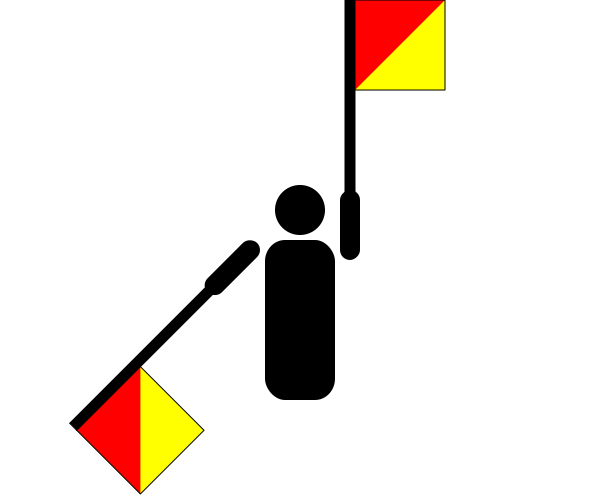


There are approximately 2,093 people named Kell in the UK. That makes it roughly the 4,056th most common surname in Britain. Around 32 in a million people in Britain are named Kell.
Surname type: From given name or forename
Origin: Celtic
Region of origin: British Isles
Country of origin: Scotland
Religion of origin: Christian
Language of origin: Gaelic

Famous people named Kell
- Vernon Kell - Army general (1873 to 1942)
- Douglas Kell - Biochemist from the United Kingdom
- Reginald Kell - Clarinettist (1906 to 1981)
- Richard Kell - Football player
- George Kell - Football player (1896 to 1)
- Allan Kell - Football player
Names and descriptions courtesy of Wikipedia, and may contain errors. This is not intended to be an exhaustive list of every famous person with this name.