KAIL
Kail is a surname that has been documented in several distinct linguistic and geographic contexts within the British Isles and beyond. Its appearance in English records is intertwined with its Gaelic and Old English counterparts, resulting in a complex web of etymology that has been preserved in parish registers, chronicles, and civil registries.
The Gaelic origin of the name derives from the word caol, which translates as “narrow” or “slender.” In a topographic sense, it was assigned to individuals who lived near a narrow passage or a slender strip of land, and it may also have served as a nickname for someone of a slim build. This Scottish derivation is cited in historical reference works that detail surnames of Gaelic origin in the Highlands and Islands.
A further lineage of the surname is traced to pre‑7th‑century Old English. Recorded spellings such as Call, Cail, Caile, Cale, Calle, and Cayle are associated with the river Cale, which rises in Somerset and Dorset. The river name itself is uncertain, but one hypothesis links it to the Old English word for cold. The occasional application of the prefix “win-”, derived from the Welsh gwyn meaning white, yields the recorded forms Cawel and Wincawel in the Anglo‑Saxon Chronicles of 956 a.d. These entries are believed to denote separate arms of the same river. The name Kail is well documented in Devon; early entries record the marriage of Richard Cale and Anne Swyne on 26 August 1583 in Barnstaple, and later christenings, such as Abell Calle at St Giles Cripplegate, London, 4 February 1589, and Christopher Cail at St Mary’s Battersea, 16 April 1856. The earliest extant case is William Call, dated 2 November 1539 at Barnstaple, recorded during the reign of King Henry V.
In an Anglo‑Saxon occupational context, the surname arises from the Old English word kale, meaning cabbage. It was likely a metonymic designation for a grower or seller of cabbages, a profession that gained prominence as the market economy emerged in the Middle Ages. Over successive generations, variations such as Kale, Kayle, and Kales appeared, reflecting the natural alteration of names through verbal use and transcription.
Additional, less common origins are documented. One source suggests that Kail may stem from the Old English Caele, describing a person who was bold or daring. A Germanic theory proposes derivation from the Middle High German kegel, meaning a bowling pin, or from locations named Kail in the Rhineland. These German naturalisations sometimes produced surnames such as Keil, Kehl, or Kyle, with further distant forms including Keill, Kuhl, or Kohl. Some records also note the surname as an anglicised version of the Jewish name Kahel.
Because the surname Kail appears with consistent variation across different regions – from Scotland to Devon, from England to the Rhineland – and within distinct linguistic traditions, a definitive single lineage cannot be asserted. Modern bearers of the name may therefore trace their ancestry to one of several credible sources, and the most accurate conclusions generally require the aid of specialised genealogical research rather than only probabilistic inference.
Typical given names associated with the Kail surname
Male
- Andrew
- David
- Grigorij
- James
- John
- Jonathan
- Leonard
- Mark
- Martin
- Matthew
- Michael
- Peter
- Terry
Female
- Alison
- Angela
- Audrey
- Barbara
- Caroline
- Diane
- Dianne
- Doris
- Gemma
- Helena
- Myriam
- Sharon
- Sheila
- Susan
- Tessa
Similar and related surnames
- Akil
- Cail
- Cails
- Cale
- Call
- Caul
- Cawl
- Clee
- Cool
- Coole
- Coyle
- Gale
- Galea
- Gall
- Gallie
- Gallo
- Gaul
- Gul
- Kaal
- Kaali
- Kael
- Kahil
- Kahl
- Kahla
- Kahli
- Kai
- Kaila
- Kailas
- Kailay
- Kaile
- Kailey
- Kaili
- Kailis
- Kaill
- Kailou
- Kaily
- Kal
- Kala
- Kalah
- Kalai
- Kalay
- Kale
- Kales
- Kaley
- Kali
- Kalia
- Kalie
- Kalies
- Kalil
- Kalio
- Kalis
- Kall
- Kalla
- Kallai
- Kallee
- Kalli
- Kallia
- Kallie
- Kallio
- Kallis
- Kallo
- Kalloe
- Kalloo
- Kallou
- Kallu
- Kally
- Kalo
- Kaloo
- Kalou
- Kalow
- Kals
- Kalu
- Kaly
- Kaul
- Kayl
- Kayla
- Kaylee
- Keal
- Keala
- Keall
- Keals
- Kealy
- Keel
- Keell
- Kehl
- Keil
- Keila
- Keily
- Kel
- Kele
- Kell
- Kelle
- Khail
- Khaila
- Khal
- Khale
- Khali
- Khall
- Khalo
- Khel
- Khil
- Khol
- Kial
- Kiehl
- Kiell
- Kil
- Kill
- Kille
- Kills
- Kils
- Kol
- Kyle
- Kyll
- Quail
- Quayle
- Quill
Related and similar names are generated algorithmically based on the spelling, and may not necessarily share an etymology.
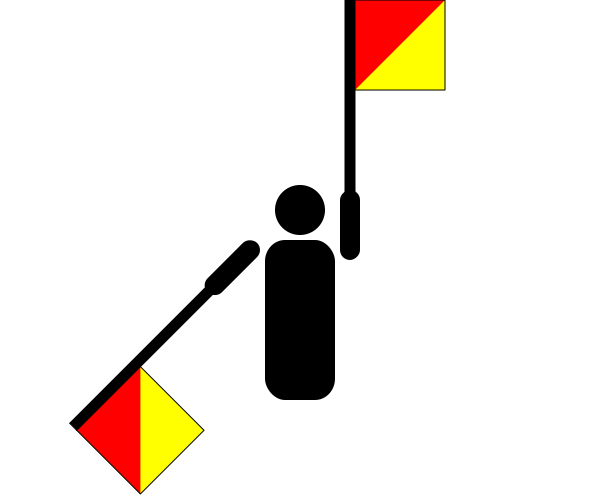
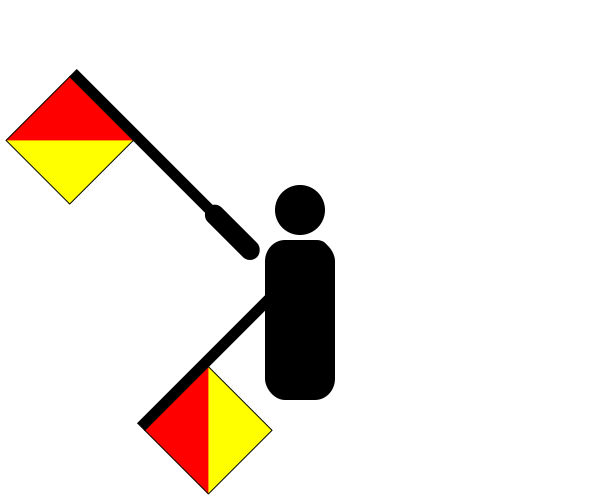
How to communicate the surname Kail in...
Braille
⠅⠁⠊⠇
Morse
-.-.-...-..
Semaphore


Did you know?
According to a survey carried out by Democracy Club, politicians and candidates with the surname Kail are most likely to say that their favourite biscuit is a Custard Cream.
There are approximately 181 people named Kail in the UK. That makes it one of Britain's least common surnames. Only around three in a million people in Britain are named Kail.
Origin: English
Region of origin: British Isles
Country of origin: England
Religion of origin: Christian
Language of origin: English
