DIGNAN
Dignan is an Irish surname of Gaelic derivation, historically linked to the ancient pre‑9th‑century sept known as Ó Duibhgeannáin. The prefix Ó, meaning “descendant of”, places the name firmly within the Celtic genealogical tradition of the British Isles.
The core element of the name, Duibhgeannáin, is often analysed as a composite of the Gaelic words dubh meaning “black” and geann meaning “cheek”. Consequently, the surname has been understood to originate as a nickname for an individual with a dark or swarthy complexion, or perhaps for a person noted for prominent or rosy cheeks.
Alternate interpretations suggest that Dignan may have arisen from the Old English personal name Digna, a combination of dignus (“worthy”) and anus (“lamb”). The suffix -an in this context would indicate descent from a forebear named Digna. Nevertheless, the bulk of documentary evidence supports the Gaelic origin outlined above.
In medieval times the Ó Duibhgeannáin clan served as poets and bards for the leading families of counties Leitrim, Roscommon and Longford. Their principal seat was Kilronan in County Roscommon, where they functioned as erenaghs, hereditary keepers of the church lands and collectors of tithes. By 1636 a bardic school associated with the clan had been established at Castle Fore in Leitrim, where Peregrine O‑Duigenan, a noted historian who died in 1664, is recorded as a resident.
Many members of the clan joined King James I’s Catholic army in the 1690 campaign, which culminated in the defeat at the Battle of the Boyne against William I of Orange. As a result, the kingdom dispossessed the clan of its lands, the patronymic O was abandoned, and the surviving surname survived without the prefix. The spelling took the form Duigenan, with popular variants including Deignan, Dignan and Dignam.
Throughout the 19th century the Dignan name suffered the profound socioeconomic impact of the Great Famine. Emigration records show Catholine Dignan, listed as a newborn, departing from Liverpool on 13 July 1846 aboard the Charles Humberton bound for New York. Such departures were common among Irish families seeking relief from famine conditions.
Presently the surname is largely concentrated in Ireland, particularly in the provinces of Connaught and Ulster, and in the western counties of Galway, Mayo, Clare and Limerick. In Scotland it occurs chiefly around east Fife and Perthshire, while diasporic communities can be found in the United States, Canada, Australia and England.
In addition to the spellings already mentioned, historical documents reveal further variants – Digen, Digs, Dignass, Anidig, Dineen, Dynan – reflecting regional pronunciations and the process of Anglicisation carried out by English authorities during the 18th and 19th centuries.
Typical given names associated with the Dignan surname
Male
- Andrew
- David
- Graeme
- James
- John
- Mark
- Michael
- Patrick
- Paul
- Peter
- Thomas
- William
Female
- Catherine
- Christine
- Eileen
- Elizabeth
- Fiona
- Helen
- Iris
- Karen
- Laura
- Margaret
- Mary
- Sarah
- Wendy
Similar and related surnames
Related and similar names are generated algorithmically based on the spelling, and may not necessarily share an etymology.
How to communicate the surname Dignan in...
Braille
⠙⠊⠛⠝⠁⠝
Morse
-....--.-..--.
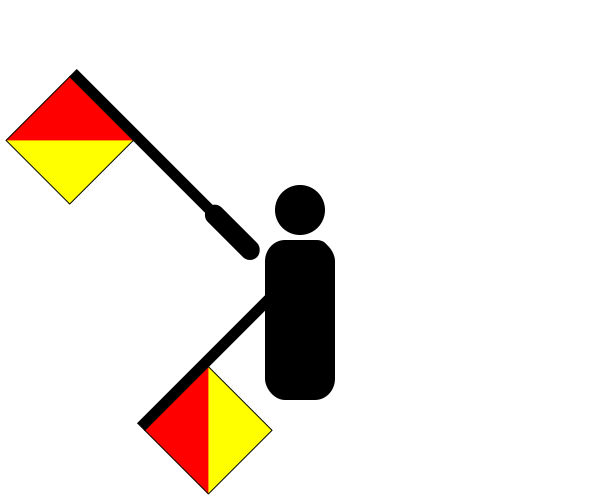
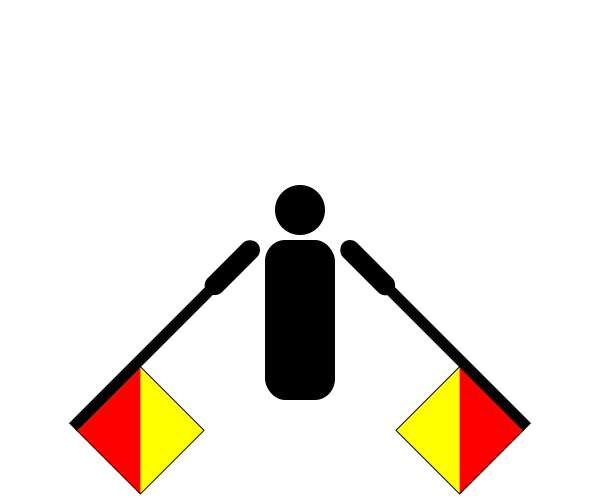
Semaphore



Did you know?
According to a survey carried out by Democracy Club, politicians and candidates with the surname Dignan are most likely to say that their favourite biscuit is a Hobnob.
There are approximately 813 people named Dignan in the UK. That makes it roughly the 8,655th most common surname in Britain. Around 12 in a million people in Britain are named Dignan.
Origin: Celtic
Region of origin: British Isles
Country of origin: Ireland
Religion of origin: Christian
Language of origin: Gaelic
