DEIGNAN
The surname Deignan derives from the Gaelic heritage of the Irish people and is one of the many surnames that survive from early medieval times.
Its roots lie in the ancient Gaelic language of Ireland, a Celtic tongue that once spread across the entire British Isles.
The name is an anglicised form of Ó Duibhgeannáin, where the prefix Ó indicates “descendant of”. In this original form the personal name *Duibhgeannáin* is composed of *dubh*, meaning “black”, and *geannán*, meaning “calf”, rendering the meaning “descendant of the black calf”. Other scholars translate the element *geannán* as a diminutive of *gean*, a word that can signify “love”, or as *gein*, “birth”, so alternative translations are “descendant of the black lover” or “descendant of the black-born”.
The Deignan family first appears in the north‑western region of Ireland, particularly in County Sligo, these counties of Leitrim, Roscommon and Longford, where they maintained a prominent presence through the pre‑modern period.
In the village of Kilronan, County Roscommon, the clan were hereditary Erenaghs, a title that conferred the duties of keeping church lands and collecting tithes for the ecclesiastical community.
Their reputation as poets and bards is recorded in the 17th‑century account of a school of bards at Castle Fore, Leitrim, where a Peregrine O’Duigenan (died 1664) is noted as one of the Four Masters who compiled the Annals of the Four Masters.
During the civil war of 1690 the clan served in King James I’s Catholic army, which ultimately failed to defeat William of Orange at the Battle of the Boyne.
Following the defeat the Deignan lands were suppressed, and the prefix Ó was commonly dropped, giving rise to the spelling patterns Duigenan, Deignan, Dignan, Dignam and others.
The earliest documented bearer is Magnus O’Duigenan, compiler of the Book of Ballymote in 1415, a work dating to the reign of Henry V of England (1413‑1422).
In the mid‑18th century the family suffered severely during the Great Famine (1846‑1848), with a Catholine Dignan recorded in the shipping registers as “nought years old” and emigrating from Ireland on 13 July 1846 aboard the *Charles Humberton*, bound for New York.
Later migration spread the name throughout the United Kingdom, the United States and Canada, where descendants can still trace their lineage back to the original Irish roots.
The surname presents a number of close orthographic variants, including Dignan, Dignam, Deegan, Deighan, Degnan, Dugan, Duggan, Doogan and the less common Deenan.
In recent years a small number of bearers have returned to the original Gaelic form, O’Duibhginn, as part of a broader resurgent interest in Irish heritage and linguistic tradition.
Typical given names associated with the Deignan surname
Male
- Alistair
- Andrew
- Desmond
- Gerald
- James
- John
- Joseph
- Martin
- Michael
- Patrick
- Paul
- Thomas
Female
- Alice
- Amy
- Anna
- Anne
- Eithne
- Hannah
- Jean
- Margaret
- Mary
- Michelle
- Olwyn
- Patricia
- Sarah
- Sharon
- Shelley
Similar and related surnames
Related and similar names are generated algorithmically based on the spelling, and may not necessarily share an etymology.
How to communicate the surname Deignan in...
Braille
⠙⠑⠊⠛⠝⠁⠝
Morse
-.....--.-..--.
Semaphore


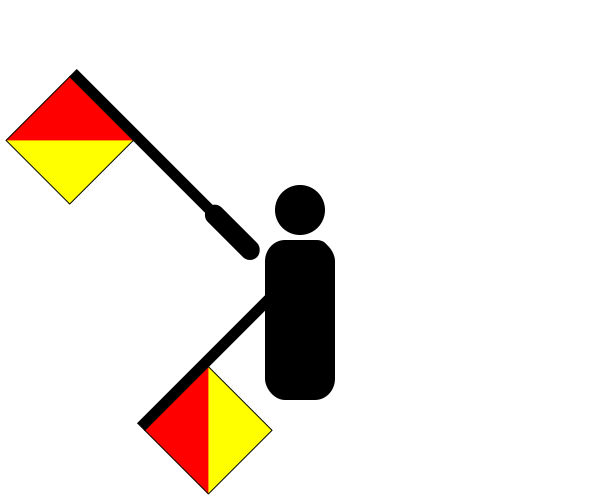

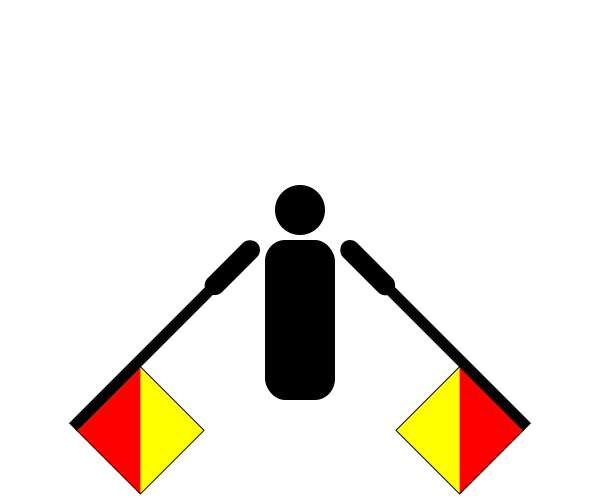

There are approximately 176 people named Deignan in the UK. That makes it one of Britain's least common surnames. Only around three in a million people in Britain are named Deignan.
Origin: Celtic
Region of origin: British Isles
Country of origin: Ireland
Religion of origin: Christian
Language of origin: Gaelic

Famous people named Deignan
- Lizzie Deignan - Track and road racing cyclist
Names and descriptions courtesy of Wikipedia, and may contain errors. This is not intended to be an exhaustive list of every famous person with this name.