DIGNAM
Dignam is a surname of Irish heritage, its roots traceable to the Gaelic patronymic Ó Duibhneáin. The prefix Ó signals a lineage from a male ancestor, and the element Duibhneán derives from the Gaelic noun dubh, meaning black or dark. Consequently, the surname has been interpreted as “descendant of the dark‑haired” or simply “dark descendant.”
In the early medieval period, the name appears in the form O’Dúibheannáin, a pre‑9th‑century designation that is believed to identify a clan of poets and bards allied with the leading families of south‑west Connacht, notably the counties of Leitrim, Roscommon and Longford. The clan’s principal seat was the village of Kilronan in County Roscommon where they held the hereditary office of erenagh – the custodians of church lands and collectors of tithes.
Historical records further indicate that the Dignam lineage maintained a bardic school at Castle Fore in Leitrim in the early seventeenth century. A notable figure of this period was Peregrine O’Dúigenan, who died in 1664 and is remembered for his contribution to the *Four Masters* manuscript tradition.
Throughout the seventeenth century the family was also involved in the military affairs of Ireland. Members served in King James II’s Catholic Army of 1690, an army that sought to resist the forces of William of Orange at the Battle of the Boyne. Following the defeat of the Jacobite cause, the Dignams were dispossessed of their lands, and the hereditary “O” prefix was permanently abandoned in the post‑battle period. The resulting Englishised spelling traditions produced varieties such as Duigenan, Deignan and Dignam.
A number of Dignam clerics have left their mark on Catholic historiography, yet the surname’s suffering during the Irish Famine of 1846‑1848 is well documented. Records show that Catharine Dignan embarked on the ship *Charles Humberton* from Liverpool on 13 July 1846, bound for New York, a movement that typified the mass emigration of many Irish families during this time.
The earliest extant record of the family can be traced to Magnus O’Dúigenan, who is noted in the Book of Ballymote as a compiler in approximately 1415. This work was produced during the reign of King Henry V of England (1413–1422), further underscoring the long-standing interweaving of Irish and English histories.
In the twentieth and twenty‑first centuries, the surname spread beyond its original western Irish strongholds into other parts of the United Kingdom, Australia and Canada. Today Dignam is most often encountered in the counties of Leitrim, Roscommon, Galway, Sligo, Tipperary, Wexford and Dublin, as well as within industrial regions of Lancashire, Greater Manchester, Merseyside and Yorkshire. The diaspora has kept the name alive in the Australian states of Victoria and New South Wales, and in Canadian provinces such as Ontario and British Columbia.
In England, the name’s distribution is scattered but notable in urban centres such as Greater London, where immigration from Ireland in the nineteenth and early twentieth centuries created a vibrant diaspora community. In these settings the surname is usually spelled in one of its standard forms with the leading O omitted; the variants Dignum, Dignham and Dignan are also in use, though less common.
Despite the variations, all spellings are recognisably linked through their shared Gaelic etymology. The confusion between Dignam and Damkin has been clarified by genealogical research, as the latter is a separate Scottish surname with a distinct lineage.
The persistence of the surname across several centuries offers a window into the social and cultural changes that have shaped Irish society. From the bardic traditions of the pre‑modern era to the upheavals of the Penal Laws, the Penal War and the Great Famine, the Dignams, in whatever orthographic form, have navigated a complex history that remains visible today through contemporary bearers of the name in the UK, Australia, Canada and beyond.
In terms of name frequency, Dignam remains relatively rare, largely confined to the Irish diaspora. Census data consistently shows that the surname is uncommon in Great Britain and Ireland but that it appears in small clusters in each of the four former British colonies in which Irish emigration was significant.
The collective narrative of the Dignam surname underscores the resilience of a people who have maintained their cultural identity, genealogical memory and linguistic heritage across different continents and epochs. Its evolution from Ó Duibhneáin to the diversified, geographically distributed forms recognised today reflects the broader story of Irish migration and the enduring power of family name and legacy.
Typical given names associated with the Dignam surname
Male
- David
- Ian
- James
- John
- Joseph
- Mark
- Michael
- Patrick
- Paul
- Peter
- Robert
- Stephen
Female
- Catherine
- Helen
- Irene
- Jacqueline
- Jane
- Jean
- Joanne
- Lucy
- Margaret
- Mary
- Michelle
Similar and related surnames
Related and similar names are generated algorithmically based on the spelling, and may not necessarily share an etymology.
How to communicate the surname Dignam in...
Braille
⠙⠊⠛⠝⠁⠍
Morse
-....--.-..---
Semaphore

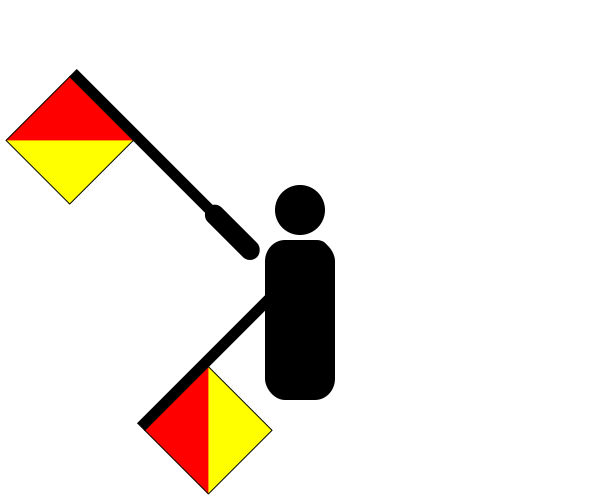

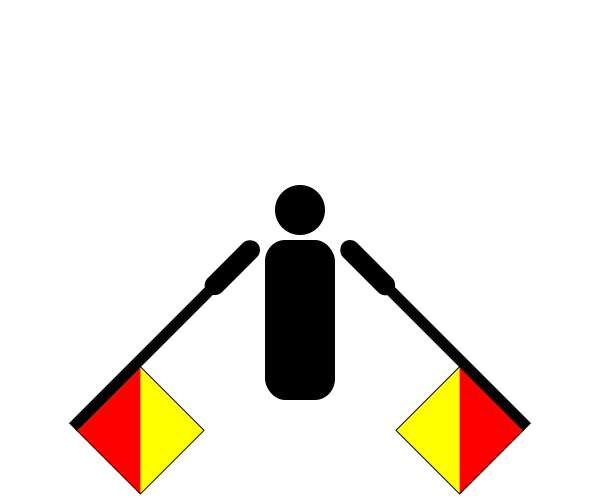

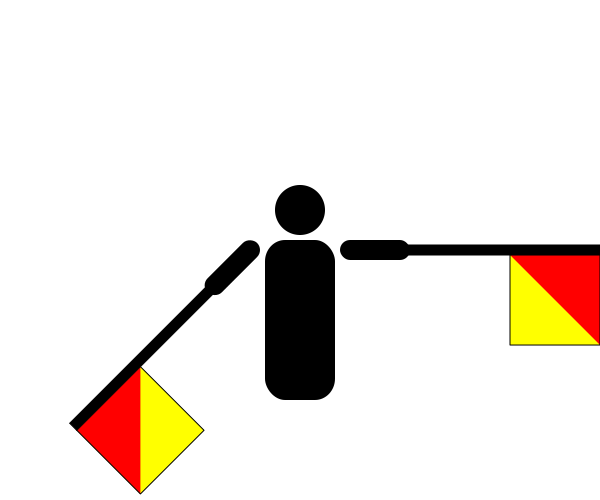
There are approximately 691 people named Dignam in the UK. That makes it roughly the 9,792nd most common surname in Britain. Around 11 in a million people in Britain are named Dignam.

Famous people named Dignam
- Basil Dignam - Actor (1905 to 1979)
- Mark Dignam - Actor (1909 to 1989)
- Joe Dignam - Football player (1931 to 1999)
Names and descriptions courtesy of Wikipedia, and may contain errors. This is not intended to be an exhaustive list of every famous person with this name.