BURG
Burg is a surname of Germanic origin, rooted in the Middle High German words burc or burg, which translate respectively to castle or fortress. Its earliest use was as a topographical identifier for individuals who resided near or within the confines of such fortified structures, and later it functioned as an occupational marker for those employed in the service of a castle.
In England, the name appears in the Domesday Book of 1086 in several spellings, including Burc, Burg and Burch. The Domesday entry for Burgh in Suffolk records it as Burc, while Burgh in Lincolnshire is noted both as Burg and Burch. These early attestations reflect the practice of deriving surnames from prominent landscape features, a common approach in medieval English communities where small populations could be distinguished by nearby fortifications or hill forts.
Notable early bearers of the name in England include Geoffrey de Burk of Herefordshire (1272) and Hubert de Burk of Somerset (1273). The surname entered Ireland through William de Burgo, a settler from Burgh in Suffolk who accompanied the Norman invasion led by Strongbow in 1170, subsequently becoming Chief Governor of the region. The first recorded spelling of an individual in the name is Ailricus de Burc, dated to the same Domesday year, during the reign of William I, known as William the Conqueror.
Variations of the surname that have emerged over time—such as Berger, Burger, Burgh, Burgs and Burge—maintain a shared etymological link to the concept of a fortified place. In German-speaking territories, extended forms like Burgmann and Burgman appear, while in Slavic contexts variants such as Burgin or Burgan may be observed. The Jewish community has adopted adapted spellings including Birk, Berk and Bergh, reflecting integration of the surname into diverse cultural settings.
In more recent history, the 19th century witnessed significant emigration of people bearing the surname Burg from Germany to North America. Consequently the name is now particularly common in the United States, with a notable concentration in the states of New York, Pennsylvania and Ohio. Other large populations can be found in Australia, Canada, South Africa and Israel, and a smaller, yet persistent presence remains in Germany, the Netherlands and the British Isles.
The use of Burg as a surname offers insight into early naming practices that linked individuals to their environment or occupation. By recording the proximity to or association with a defensive structure, the name preserves a snapshot of medieval life where fortification played a central role in community identity and security.
Similar and related surnames
- Brug
- Bur
- Bura
- Burga
- Burge
- Burgi
- Burgo
- Barg
- Barga
- Barge
- Bauge
- Berg
- Berga
- Berge
- Bergg
- Bergo
- Bergs
- Birg
- Birge
- Borg
- Borga
- Borge
- Borgo
- Borgs
- Bourg
- Bourge
- Bourges
- Burgas
- Burgaz
- Burges
- Burgey
- Burgg
- Burggy
- Burgh
- Burghe
- Burgos
- Burgow
- Burgs
- Burgss
- Burgui
- Burgus
- Burgy
- Burk
- Barrack
- Barrick
- Birk
- Borges
- Bourke
- Brack
- Bragg
- Brigg
- Brook
- Brooke
- Burgio
- Burr
Related and similar names are generated algorithmically based on the spelling, and may not necessarily share an etymology.
How to communicate the surname Burg in...
Braille
⠃⠥⠗⠛
Morse
-.....-.-.--.
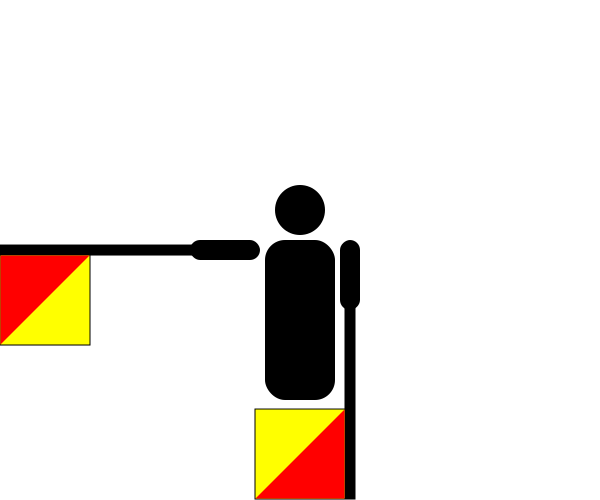
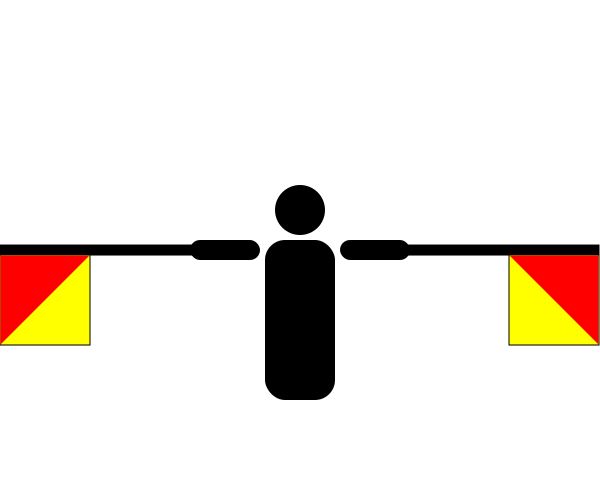
Semaphore


There are approximately 89 people named Burg in the UK. That makes it one of Britain's least common surnames. Only around one in a million people in Britain are named Burg.
Origin: English
Region of origin: British Isles
Country of origin: England
Religion of origin: Christian
Language of origin: English
