BORGE
Borge is a surname of Scandinavian origin, deriving from the Old Norse word borg, meaning “fortification” or “castle”. The name is traditionally a locational or topographical surname, indicating that the original bearer lived near or was associated with a fortified site such as a hill fort or a castle. The name later evolved into the form Borge in both Norwegian and Danish usage.
The earliest recorded forms of the surname include Berg, Borg, Borge, Burg, and Burgh. These variations appear in medieval documents across Europe, reflecting the transition from the Old Norse and Old Germanic elements beorg and burg (both meaning “fortress”) into the surnames adopted by local populations. In England, place-names such as Burgh in Suffolk and Burgh in Lincolnshire are documented in the Domesday Book of 1086, where they are recorded as Burc and Burg or Burch respectively.
In the British Isles, the surname appears in the earliest surviving records. Geoffrey de Burk of Herefordshire is noted in 1272 and Hubert de Burk of Somerset in 1273. The name was also introduced to Ireland by William de Burgo, who travelled with Strongbow during the Anglo-Norman Invasion of 1170 and later served as Chief Governor. The first documented instance of the family name in the Domesday Book is Ailricus de Burc, dated 1086, during the reign of King William the Conqueror.
In Denmark, Borge is interpreted as “fortified hill” and is thought to have been a toponymic surname for individuals residing near such a site. The Danish variant is currently less common than in the earlier centuries, yet it remains in use in several families throughout the country. Throughout Scandinavia – particularly in Norway, Sweden, and Denmark – the surname is often associated with Viking heritage, hinting at an origin in the Viking Age.
Beyond Europe, the surname has spread through emigration and can now be found in North America, Australasia, and South America. In the United States it is most commonly recorded in states such as Connecticut, Florida, Texas, Illinois, Pennsylvania, North Carolina, Virginia, New York, New Jersey, and Massachusetts. Canada, Australia, Mexico, Brazil and India also contain communities bearing the name. In Europe it continues to appear in Germany, France, Finland, Iceland and the United Kingdom, often with variants adapted to local linguistic conventions.
Other recognised variants of the name across the continent include Borga, Borggard, Borgeskor, Borjedal, Borgesson, Borgestron, Borgeln, Borgore and Borgoch. In Germany the form Borger may appear, derived from Old High German burga. Within Slavic nations, variants such as Borgo, Borga, Borgoff, and Borgoge are occasionally encountered. In Finland, surnames such as Borggren, Borglad, Borgman and Borgstrom may trace their roots to the same Norse origin, though they are often associated with farming or husbandry.
Overall, the surname Borge remains a living link to a past where fortified places formed the core of settlement identity. From its Old Norse roots to its modern diasporic presence across continents, it reflects a common European heritage of fortification and settlement that continues to inform the identities of those who bear it today.
Similar and related surnames
Related and similar names are generated algorithmically based on the spelling, and may not necessarily share an etymology.
How to communicate the surname Borge in...
Braille
⠃⠕⠗⠛⠑
Morse
-...---.-.--..
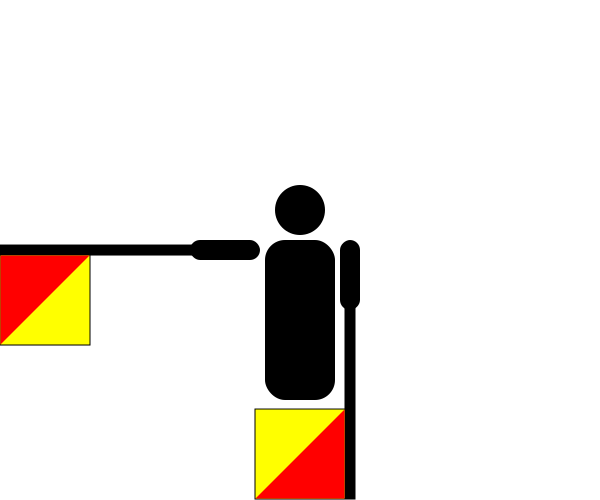
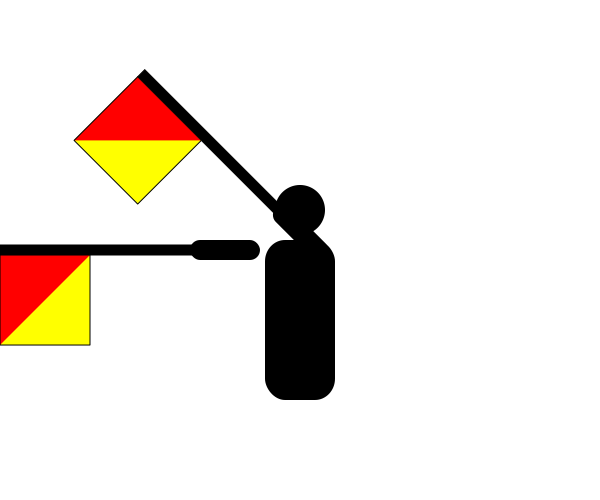
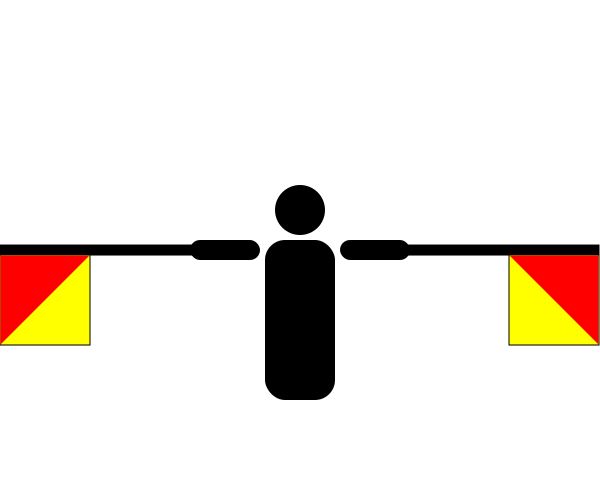
Semaphore


There are approximately 113 people named Borge in the UK. That makes it one of Britain's least common surnames. Only around two in a million people in Britain are named Borge.
