BUNT
Bunt is a surname of both English and German provenance, documented in records from the twelfth through the twenty‑first centuries. Its earliest attestation appears in the 1179 Pipe Rolls of Kent County, where a Hardwin de Bundy is recorded. The name is also found shortly thereafter in England, with the 1272 Pipe Rolls of Shropshire citing Robert de la Bende, and in Germany in 1286 by a record of Albert Bende in Bohringen, Province of Wurttemburg. Subsequent English entries include Adam del Bent of Staffordshire in 1327 and Henry del Bent of the same county in 1332, alongside Robert Le Bendare of Sussex in 1327. These early examples illustrate that the surname was independently established in both nations around the same period.
The surname has been ascribed several origins. In Old English, the word bunten meant “to paint or mark with spots or streaks”, suggesting a nickname for someone with a speckled or spotted appearance. Another Old English root, bunt, referred to a hill or mound, thereby presenting a topographical explanation for those who lived near such features. In Middle High German, the term bunt carried the sense of “colourful” or “variegated”, which could denote a person who dyed cloth or used colourful garments. Additionally, some scholars note a link to Middle English bunte, meaning “to bake”, which would render Bunt an occupational surname for a baker. The variety of derivations demonstrates the surname’s capacity to arise from both descriptive nicknames and trade occupations.
Historical context further refines these meanings. In medieval England, bakers were held to stringent guild regulations, and the appellation Bunt could signify a baker who practised honesty and quality. Likewise, in German and Dutch usage, bunten as “to paint” or “to colour” would align with a dyer or cloth preparer. The multiplicity of potential sources—topographical, descriptive, and occupational—explains why the surname appears among disparate medieval families, from rural landholders in Cornwall to urban guild members in London.
The surname has many orthographic variants, including Bente, Bint, Bont, Baden, Bend, Bundt, Bonte, Bontekoe, and Bunting. These forms reflect regional spelling differences and the natural evolution of language over time. In England, the form Bend was recorded in church registers: for instance, Nicholas Bend was christened at St Stephens, Coleman Street, London, on 25 February 1564. The name also appears in Cornwall, exemplified by Thamasyne Bunt (daughter of Richard and Joane Bunt) christened at Broadoak, Cornwall, on 26 September 1584.
In the contemporary period, the surname remains relatively uncommon but is still widely distributed. Estimates indicate that around 21,000 individuals worldwide bear the surname Bunt, with the bulk residing in Germany—approximately 1,700 people—followed by smaller communities in the Netherlands (roughly 300), Scandinavia, the United Kingdom, and the United States. In the United States, Bunt is recorded by fewer than five thousand people, the largest concentrations being in New York, Texas, California, and Illinois. The surname’s persistence across countries illustrates the long‑standing connections between English and German lineages.
Religious affiliation, as recorded in early sources, aligns with Christian norms prevalent in the British Isles during the Middle Ages. Contemporary bearers of the name are thus part of a broader Christian cultural heritage that spans centuries and geography.
In summary, the surname Bunt is rooted in both English and German linguistic traditions, with a multifaceted etymology that includes topographical, descriptive, and occupational elements. Early documentation from the twelfth century and the continued prevalence of the name in modern populations attest to its enduring historical significance.
Typical given names associated with the Bunt surname
Male
- Andrew
- Christopher
- David
- Gary
- Graham
- James
- John
- Jonathan
- Michael
- Philip
- Richard
- Stephen
- William
Female
- Abigail
- Alison
- Angela
- Carolyn
- Catherine
- Helen
- Joan
- Joanne
- Laura
- Margaret
- Sandra
- Sarah
- Sharon
- Susan
- Vanessa
Similar and related surnames
- Bun
- Bund
- Bant
- Buns
- Bune
- Bent
- Bunn
- Bunde
- Bount
- Bounts
- Bounty
- Buna
- Bunta
- Bunte
- Bunto
- Bagnato
- Bagnet
- Bagnett
- Baind
- Banait
- Banat
- Banati
- Banatt
- Band
- Banda
- Bande
- Bandee
- Bandi
- Bando
- Bandoo
- Bandoui
- Bandt
- Bandu
- Banet
- Banett
- Banit
- Banita
- Banitt
- Bannet
- Bannett
- Banta
- Bante
- Banti
- Bantu
- Baunet
- Baunt
- Beand
- Beant
- Begnet
- Begnett
- Beinat
- Beint
- Benad
- Benaddi
- Benade
- Benaida
- Benaouda
- Benat
- Benati
- Benatia
- Benato
- Benatt
- Benatti
- Bend
- Benda
- Bende
- Bendee
- Bendi
- Bendie
- Bendo
- Bendou
- Bendt
- Bendu
- Benet
- Beneteau
- Benett
- Benetta
- Benette
- Benetti
- Benetto
- Beneyto
- Benit
- Benita
- Benite
- Benito
- Benitt
- Bennadi
- Bennat
- Bennati
- Bennato
- Bennatt
- Bennatto
- Bennet
- Bennete
- Benneti
- Bennett
- Bennetta
- Bennette
- Bennetti
- Bennetto
- Benniett
- Bennit
- Bennitt
- Bennnett
- Bennott
- Bennt
- Benntt
- Benoit
- Benott
- Benta
- Bente
- Benti
- Bento
- Bentoua
- Bentu
- Beond
- Beugnet
- Biand
- Biant
- Bignotti
- Bind
- Binda
- Binde
- Bindea
- Bindi
- Bindo
- Bindu
- Binet
- Binett
- Binette
- Binetti
- Binieda
- Binitie
- Binnet
- Binnett
- Binotti
- Bint
- Binte
- Bionda
- Biondi
- Biondo
- Biundo
- Bnait
- Bognetti
- Bohnet
- Boinet
- Bonaddio
- Bonadei
- Bonadie
- Bonadio
- Bonaiuto
- Bonat
- Bonati
- Bonato
- Bonatt
- Bonatti
- Bond
- Bonda
- Bonde
- Bondi
- Bondo
- Bondt
- Bondu
- Boned
- Bonet
- Bonete
- Bonett
- Bonetta
- Bonette
- Bonetti
- Bonetto
- Bonit
- Bonita
- Bonito
- Bonitt
- Bonitto
- Bonnaud
- Bonnet
- Bonnett
- Bonnetta
- Bonnette
- Bonnetti
- Bonnetto
- Bonnitt
- Bonnot
- Bonotti
- Bonotto
- Bont
- Bonta
- Bonte
- Bonti
- Bonutto
- Boond
- Bound
- Bounde
- Bounet
- Bounett
- Bownd
- Boynett
- Boynette
- Buendia
- Bugnet
- Buignet
- Bunda
- Bundi
- Bundo
- Bundu
- Bunet
- Bunett
- Bunnet
- Bunnett
- Buntan
- Buntar
- Buntel
- Bunten
- Bunter
- Buntey
- Buntin
- Buntng
- Bunton
- Buntry
- Bunts
- Buntt
- Bunty
- Buntyn
- Buntz
- Buonaiuto
- Bynde
- Bynt
- Buntic
Related and similar names are generated algorithmically based on the spelling, and may not necessarily share an etymology.
How to communicate the surname Bunt in...
Braille
⠃⠥⠝⠞
Morse
-.....--.-
Semaphore
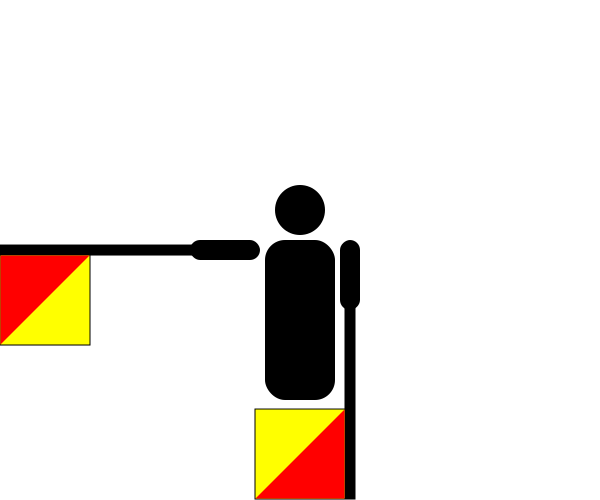

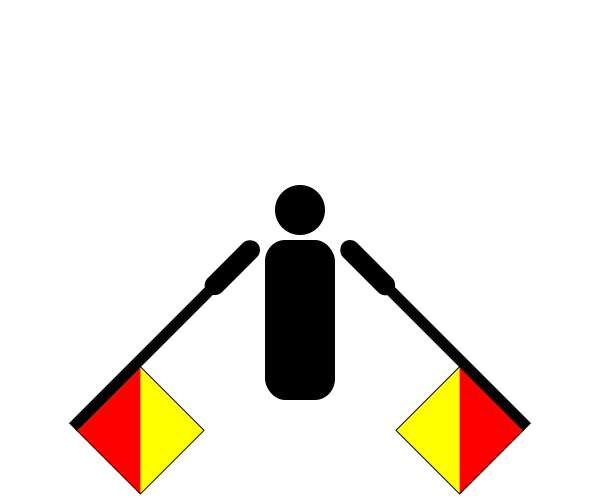
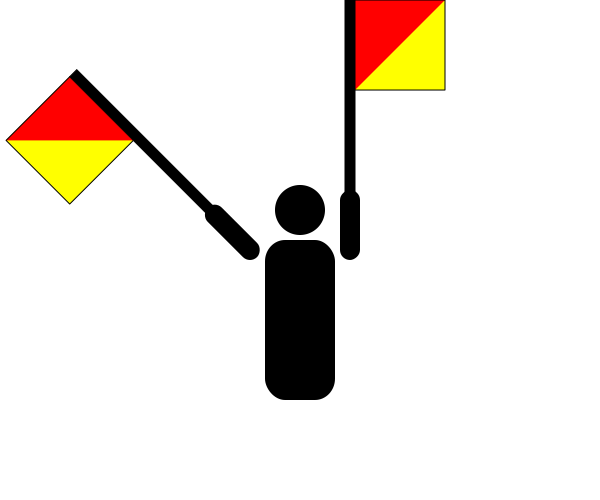
There are approximately 856 people named Bunt in the UK. That makes it roughly the 8,344th most common surname in Britain. Around 13 in a million people in Britain are named Bunt.
Origin: English
Region of origin: British Isles
Country of origin: England
Religion of origin: Christian
Language of origin: English