BONNETT
Bonnett is a surname of French origin. It is a diminutive form that originally denoted a good or fine character, derived from the Old French bon meaning “good”. Over time the name became associated with a particular element of personal dress.
The root of the surname is the French word bonnet, a soft, brimless cap usually tied under the chin. In England and Scotland it was adopted either as a metonymic occupational surname for a maker or seller of such hats or as a nickname for an individual who habitually wore a distinctive bonnet. The occupational use is recorded in medieval sources that reference hat‑making as a common craft among the lower classes.
Documents from the latter part of the 13th and the early 14th centuries provide the earliest definitive mentions of the name. The Hundred Rolls of 1273, compiled under King Edward I, record an Agne Bonye in Oxfordshire. In 1379 the Poll Tax registers of Yorkshire contain an Agnes Bonny and a Johannes Bunnay. Subsequent parish registers give further evidence, for example: Alice Bonnie was christened 26 June 1548 at Kirkham, Lancashire; Richard Bony was christened 20 October 1567 at St. Mary Whitechapel, London; and Elizabeth, daughter of Noye Bonney, was christened 29 December 1590 at St. Ann's, Blackfriars, London. Elizabeth Bonny later married Thomas Baker on 23 August 1656 at St. Gregory by St. Paul, London.
In the modern era, surname surveys show that Bonnett remains relatively uncommon, yet it retains a concentration within specific regions. In England the greatest density is found in Derbyshire, while within the United States it is most frequently recorded in Iowa and South Dakota. The name also appears in Australia and other English‑speaking countries, reflecting migration patterns that began after the Norman Conquest of 1066.
Numerous orthographic variants have arisen over the centuries. Besides the primary spelling of Bonnett, records include Bonnet, Bonett, Bonney, Bonniet, Bonnitt, Bonnet‑Blanc, and, following the influence of Scottish dialect, Bonnyson and Bainnett. The variety of spellings often corresponds to regional pronunciation and the natural evolution of spelling before the standardisation of English orthography.
Overall, the surname Bonnett illustrates the way in which a simple object of daily life – a bonnet – can give rise to a family name that travels across borders, adapts to local linguistic practices, and persists for more than seven centuries. Its enduring presence in parish, tax and census records attests to a genuine, well‑documented lineage rather than speculation or modern invention. The name remains a small but distinct element of the genealogical tapestry of both the British Isles and their historical diaspora.
Typical given names associated with the Bonnett surname
Male
- Andrew
- Christopher
- David
- James
- John
- Mark
- Nigel
- Paul
- Richard
- Robert
- Stephen
Female
- Catherine
- Claire
- Emma
- Jean
- Karen
- Linda
- Lisa
- Lynda
- Margaret
- Pamela
- Sarah
- Susan
Similar and related surnames
- Bonnet
- Bonett
- Bonet
- Bohnet
- Bennett
- Bonati
- Bannett
- Bennette
- Bonat
- Bognetti
- Bonnetta
- Bonnette
- Bonnetti
- Bonnetto
- Bonato
- Bonatt
- Bonatti
- Bonete
- Bonetta
- Bonette
- Bonetti
- Bonetto
- Bonety
- Bonit
- Bonnetty
- Boynett
- Boynette
- Benniett
- Bennnett
- Binnett
- Boinet
- Bonnee
- Bonneton
- Bonnitt
- Bonta
- Bounett
- Bunnett
- Band
- Bint
- Bunt
Related and similar names are generated algorithmically based on the spelling, and may not necessarily share an etymology.
How to communicate the surname Bonnett in...
Braille
⠃⠕⠝⠝⠑⠞⠞
Morse
-...----.-..--
Semaphore
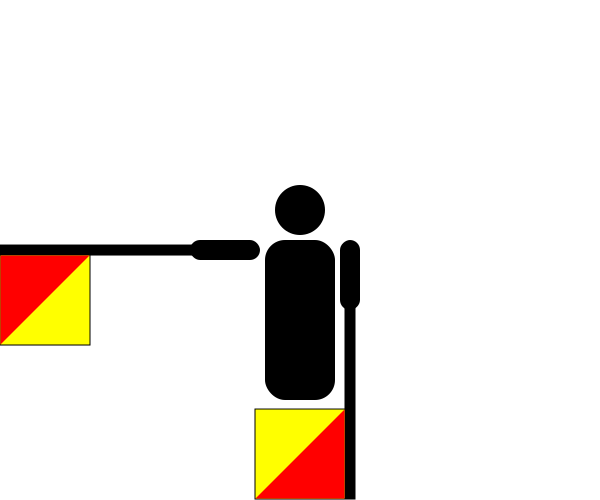
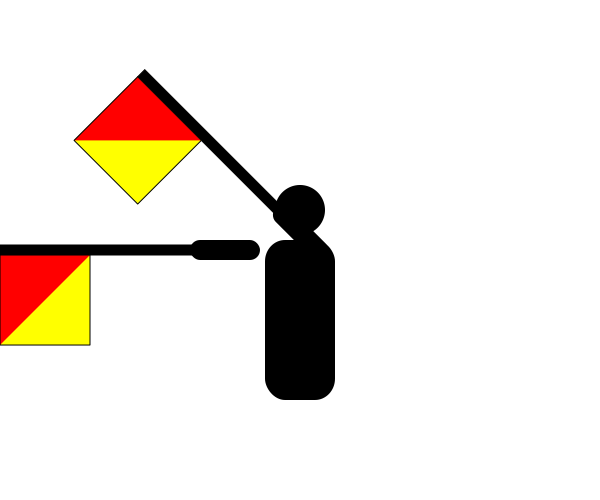
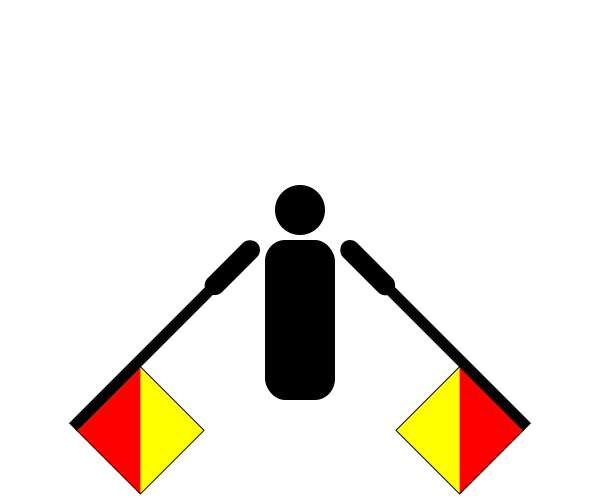

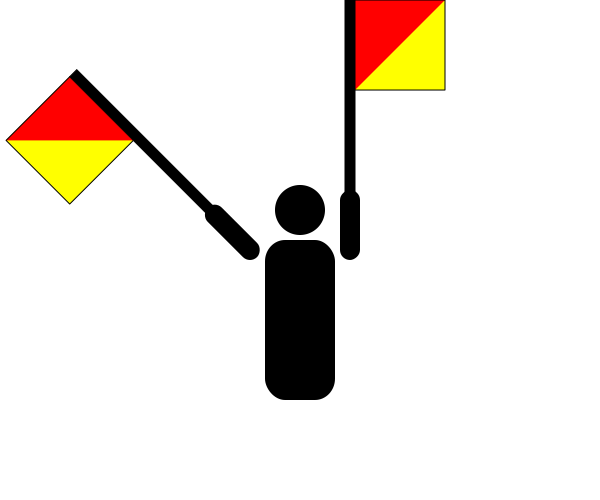
There are approximately 1,430 people named Bonnett in the UK. That makes it roughly the 5,574th most common surname in Britain. Around 22 in a million people in Britain are named Bonnett.
Surname type: Diminutive
Origin: English
Region of origin: British Isles
Country of origin: England
Religion of origin: Christian
Language of origin: English

Famous people named Bonnett
- Alec Bonnett - Sportsperson
Names and descriptions courtesy of Wikipedia, and may contain errors. This is not intended to be an exhaustive list of every famous person with this name.