BOUND
Paragraph Bound is a surname of English provenance, with its earliest attestations returning to the late twelfth century. The name has been linked to a range of etymological sources, many of which point towards a topographic or occupational origin. It is commonly believed that the designation derives from the Anglo‑Saxon word bund, meaning a boundary or limit, or from bonda and its Scandinavian cognates, meaning a farmer or landed husbandman who held land under obligation to a lord.
Historical records show the surname in a number of variant forms, including Bownd, Bownde, Bounde and Bond. These variations are the result of differences in dialect and the phonetic interpretation of clerks and scribes. Earliest evidence of the family name appears in the “Pipe Rolls of Warwickshire” for the year 1180, where an individual is identified as Norman le Bonde. This early instance is dated to the reign of King Henry the Eleventh, who ruled from 1154 to 1189.
In the fourteenth, fifteenth and early nineteenth centuries, the surname occurs in parish registers. For example, the marriage of Elsabeth Bownde and John Goodeyere was recorded on 5 August 1549 at St. Margaret’s, Westminster, London. Another such entry notes the union of John Bound and Jane Jenison on 30 October 1858 at St. John the Baptist, Chester, Cheshire.
One early interpretation of the name emphasises its status connotation: it was first applied to a peasant farmer or husbandman who possessed land that was bound, in the sense that it was held under oaths of loyalty to a lord. After the Norman Conquest of 1066, the term acquired a further association with the concept of bound servitude, reflecting the social changes that followed the incursion of Norman feudalism. Over time, the sense of the word also evolved to include the notion of a boundary marker, or a dweller situated on or near the outermost part of a settlement.
The surname’s evolution is further reflected in its possible association with the Old English term buan, meaning “to dwell.” From this root, buende could denote “a dweller,” which aligns with the notion of living at a boundary. However, most scholars consider the derivation from bindan, meaning “to bind,” a more likely source for the emphasis on contractual or feudal bonds that the name originally implied.
In contemporary usage, the surname Bound remains relatively uncommon, yet it is most frequently encountered within the United Kingdom, and especially in England. It has also migrated abroad through empire and emigration, attaining small but notable populations in the United States, particularly in the states of Utah and Wisconsin. Comparatively, the name is still quite rare worldwide; it is less common than many other surnames arising from similar topographic or occupational roots.
Because of the historical tendency for surnames to change spelling under the influence of regional dialects, phonetic transcription, and differing orthographic standards, variant spellings such as Bounds, Bown, Boune, Boun and Bounde have come to be recognised as related forms of the same family name. In particular, those with the variant Bounds are often identified with individuals who lived near a boundary or landmark. The occasional use of Bown seems to stem from the Middle English bowne, a word associated with the making of bowls or cups, but this interpretation is less widely accepted.
Finally, scholarly discourse often draws parallels between Bound and surnames such as Bourn or Bourne, which share topographic origins in references to intermittent streams that frequently served as boundary lines. Likewise, the name Bundy has been suggested as a variant of Bound, particularly in contexts where the meaning of “bond” or “bonding” was intended. These connections underscore the complex network of linguistic and social factors that have shaped the history of the Bound surname over the centuries.
Typical given names associated with the Bound surname
Male
- Alan
- Andrew
- Christopher
- David
- John
- Jonathan
- Kenneth
- Mark
- Michael
- Richard
- Ryan
- Simon
- William
Female
- Claire
- Elaine
- Emma
- Hannah
- Helen
- Jillian
- Joanne
- Lynn
- Margaret
- Mary
- Nicola
- Sarah
- Susan
Similar and related surnames
Related and similar names are generated algorithmically based on the spelling, and may not necessarily share an etymology.
How to communicate the surname Bound in...
Braille
⠃⠕⠥⠝⠙
Morse
-...---..--.-..
Semaphore
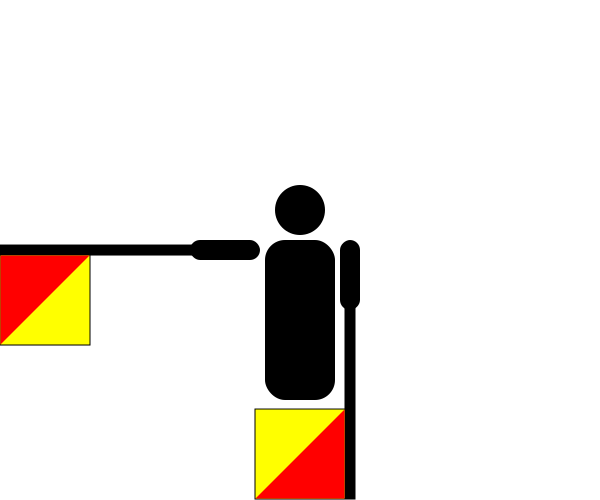
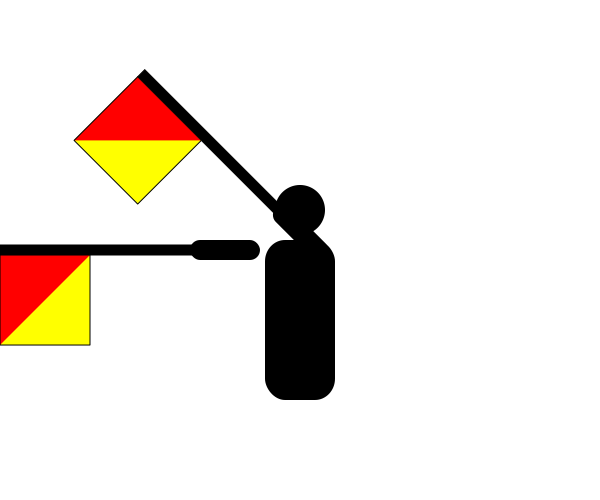

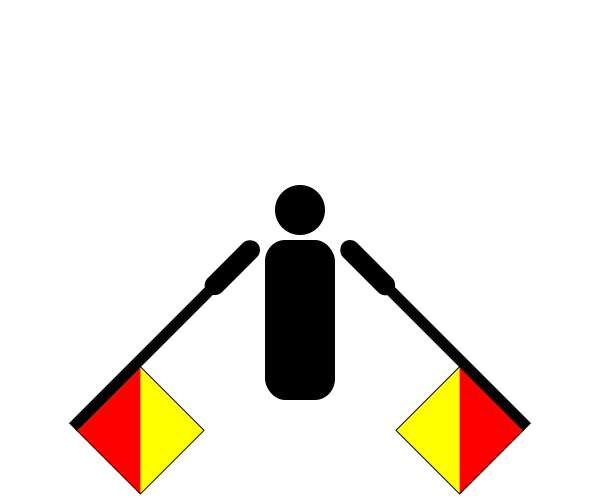

There are approximately 800 people named Bound in the UK. That makes it roughly the 8,773rd most common surname in Britain. Around 12 in a million people in Britain are named Bound.
Origin: Celtic
Region of origin: British Isles
Country of origin: Wales
Religion of origin: Christian
Language of origin: Welsh

Famous people named Bound
- Mensun Bound - Archaeologist
- Matthew Bound - Football player
Names and descriptions courtesy of Wikipedia, and may contain errors. This is not intended to be an exhaustive list of every famous person with this name.