BRIM
Origin and etymology of the surname Brim lie firmly in England, with its roots in the Old English language that once ruled the British Isles. The name is generally interpreted as *brym*, meaning “edge” or “brink”. Consequently, it was frequently applied to individuals who resided on the periphery of a settlement, a geographical feature, or a riverbank. It may also be considered a variant of *Bream*, itself derived from *bremel* with a fish‑related sense, indicating that some bearers were involved in the fishing industry.
Early records show the name in a variety of spellings such as Bream, Breem, Brim, Brims, and Brimm, attesting to its widespread use in medieval England. The earliest known entry appears in the Domesday Book of 1086, where *Breme of Suffolk* is recorded. Following the Norman invasion of 1066, many Saxon surnames underwent alteration, yet Brim survived largely due to its association with East Anglia, a region that retained a distinct Saxon identity through the Middle Ages.
Subsequent documentary evidence includes the court rolls of Warwick in 1221, which mention a Hugo Brem, and the Hundred Rolls of County Cambridgeshire in 1279, recording a Simon Brim among landowners. These references confirm that the surname persisted in both northern and eastern parts of England into the thirteenth century.
The distribution of the surname in later centuries has remained largely within the United Kingdom, with concentrations historically in Yorkshire, Lincolnshire, and historically adjacent counties. In contemporary times, the name is also found in the United States, particularly in the southeastern states of Georgia, North Carolina, and Virginia. Such spread is a natural consequence of migration, intermarriage, and the general dispersal of English surnames across the English‑speaking world.
Variants that have emerged over the centuries include Brimm, Breme, Breem, Brem, and Bram. Compound surnames derived from place names, such as Brimfield, Brimble, Brimley, and Brimington, also share a common linguistic ancestry. These variants often reflect differences in regional dialects, the lack of standardised spelling, and the phonetic rendering of the name by scribes who recorded it in diverse administrative contexts.
In summary, the surname Brim is a historically well‑documented English name that originated as a topographic label for those living at the edge of a village or natural feature. Its endurance through the Norman conquest and beyond, as well as its various spelling forms and geographical spread, attest to its early prevalence and continued relevance in English onomastics.
Typical given names associated with the Brim surname
Male
- Colin
- Haim
- Jeremy
- Nigel
- Richard
Female
- Beth
- Edna
- Natalie
Similar and related surnames
Related and similar names are generated algorithmically based on the spelling, and may not necessarily share an etymology.
How to communicate the surname Brim in...
Braille
⠃⠗⠊⠍
Morse
-....-...--
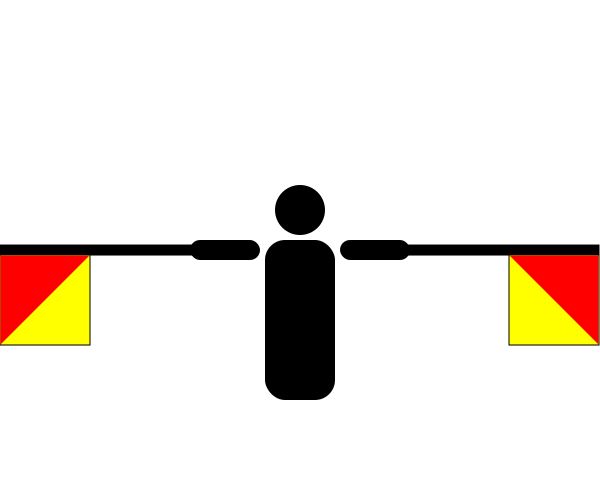
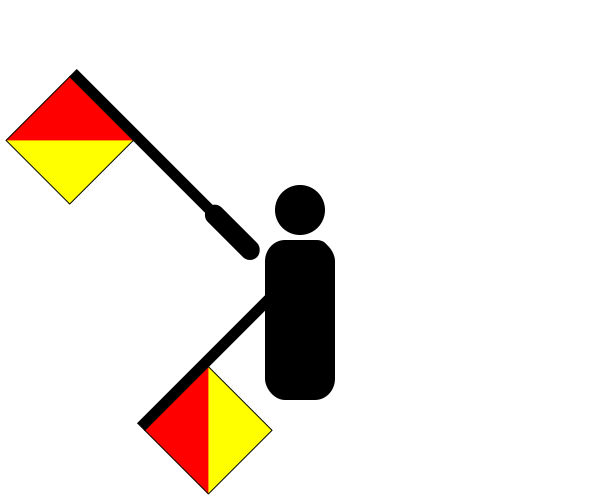
Semaphore


There are approximately 52 people named Brim in the UK. That makes it one of Britain's least common surnames. Only around one in a million people in Britain are named Brim.
Origin: English
Region of origin: British Isles
Country of origin: England
Religion of origin: Christian
Language of origin: English
