BRAM
The surname Bram is of English origin and its earliest roots lie in the Old English word brom, which denotes a wild plant of the broom family, a shrub also known as gorse, or a thicket of brambles. This lexical element carried both a descriptive botanical meaning and a geographic one, rendering it suitable as a descriptor for a place or a dwelling situated near such vegetation.
As a topographic surname, Bram was traditionally bestowed upon individuals who resided in proximity to a flourishing broom or bramble plant, or upon those whose homes were surrounded by such a thicket. The same root is also found in several place‑names recorded in the Domesday Book of 1086, for instance Brume or Brom, which in turn are tied to locales such as Broom in Bedfordshire, Durham and Worcestershire, Broome in Norfolk, Shropshire and Warwickshire, and Brome in Suffolk. Each of these toponyms shares a common etymology, signalling a landscape where broom grew abundantly.
Historical documentation attests to the surname in documents dating back to the late twelfth century. The first recorded spelling is that of Robert de Brome, appearing in the Pipe Rolls of Leicestershire in 1193, during the reign of King Richard I, the Lionheart. This early instance indicates that the family had established a recognition within the English legal and fiscal records within a few decades of Norman conquest.
Parallel to the topographic derivation is a personal‑name origin. In the Anglo‑Saxon period the personal name Brom or a variant such as Bram existed as a short form of the Hebrew name Abraham. The biblical name Abraham had entered English usage through Christian ecclesiastical channels and subsequently appeared among Jewish households. Thus, a segment of bearers of the surname Bram may be linked to an antecedent person named Bram, stemming from Abraham, rather than to the plant itself. The mutability of the name is reflected in the range of spellings that have been preserved: Brame, Brom, Brome, Bramme, Broom, Broome and Brahim, among others.
In the early modern period the surname is documented in parish registers, for example the christening of Thomas Broom at All Hallows, Honey Lane, London, in 1618. The surname also travelled across the Atlantic, with Roger Broome, an early emigrant, leaving London on the ship Truelove in September 1635 bound for New England. These records illustrate both the domestic sustenance of the name within England and its early overseas dissemination.
Contemporary distribution of the surname remains relatively sparse. In the United Kingdom it remains chiefly a rare name, with few concentrated clusters in the South East and Midlands. Across the Atlantic the United States holds a modest population of individuals carrying the surname, with larger out‑of‑home presence in the Netherlands, Germany and Israel, a distribution that reflects historic migration, Jewish diaspora, and the attraction of Biblical nomenclature. Exhaustive statistical data indicate that the name continues to be uncommon when compared with more widespread English surnames.
In addition to the canonical spelling Bram, the name exhibits a spectrum of orthographic variants that arose through regional pronunciation, literacy levels and administrative recording practices. These include Bramh, Brahm, Brahms, Bramms, O’Bram, Bramson, Abram, Abrahamson and, in Dutch and German contexts, Van den Braam and Braambos. In each instance the underlying stem either refers back to the same Old English plant root or to a personal name of Biblical origin, yet the morphological variations reproduce the surname’s adaptability to linguistic and cultural milieus.
Overall, the surname Bram encapsulates a layered historical narrative that integrates patronymic, topographic and Biblical influences. The continual appearance of the name in legal, ecclesiastical and genealogical records across five centuries underscores its resilience and the rich heritage it imparts to contemporary bearers.
Typical given names associated with the Bram surname
Male
- Adam
Female
Similar and related surnames
Related and similar names are generated algorithmically based on the spelling, and may not necessarily share an etymology.
How to communicate the surname Bram in...
Braille
⠃⠗⠁⠍
Morse
-....-..---
Semaphore
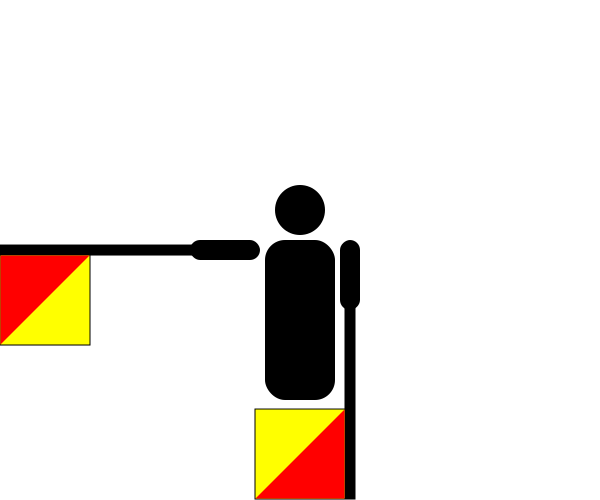
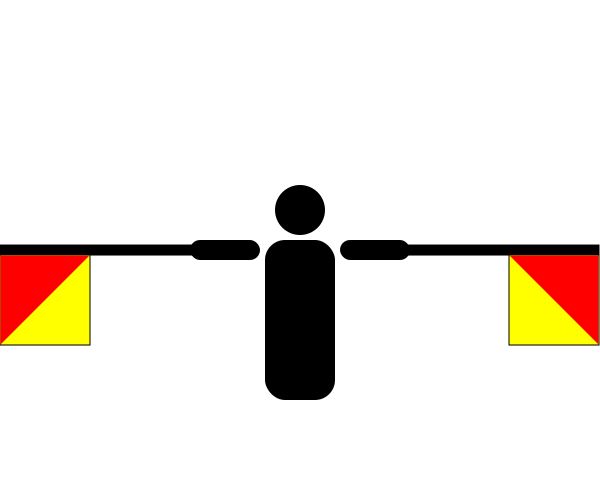

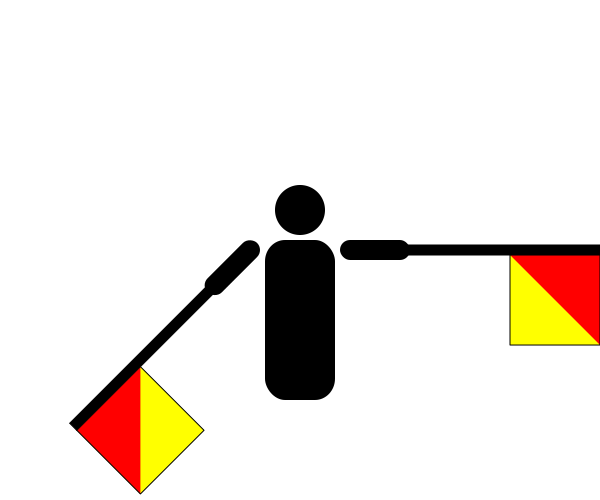
There are approximately 129 people named Bram in the UK. That makes it one of Britain's least common surnames. Only around two in a million people in Britain are named Bram.