ANDRES
Andres is a surname of Greek origin, derived from the personal name Andreas, which translates to “manly” or “warrior”. It is a patronymic surname, indicating descent from an ancestor bearing the given name Andreas. The Greek root of the name, ἀνήρ (aner), signifies a man, while the derivative ανδρεῖος (andreios) conveys the quality of being manly or brave.
The surname has a long history in Europe and has spread to numerous countries. In Spain and Portugal it is especially common, and it has a significant presence in the Philippines and in Spanish‑speaking parts of the Americas. Within Spain it is predominantly found in Catalonia and Aragon, and it also appears in French regions such as Moselle and Nord‑Pas‑de‑Calais. The name is recorded under more than two hundred and fifty different spellings, reflecting its adoption across a variety of linguistic traditions.
Historical evidence of the surname appears in a 1086 entry in the English Domesday Book, where a monk named Andreas is noted. A later early attestation is that of William Andreu, dated 1237 in the ancient charters of Buckinghamshire. During the early colonial period in America, the surname was recorded in Virginia in 1623 with the name Anthony Andrew. These entries demonstrate the surname’s continuity and its early presence in both European and colonial records.
Following the 12th‑century Crusades, the name gained further prominence in Europe. Emerging from the practices of returning soldiers, it became customary to name children after Christian saints. Saint Andrew, the patron saint of Scotland and Russia, became a familiar reference, and a legend states that his relics were brought to the town now known as St. Andrew’s in Scotland around the year 900. The esteem associated with the saint helped to sustain the popularity of the surname in these regions.
There are many variants of the surname, depending on linguistic and cultural context. Common forms include Andrias, Andrew, Andresen, Andreson, Andre, Andreas, Andreux, Andreu, Andresent, and Andresen. In Spanish‑speaking countries, additional forms such as D'Andres, DeAndres, and De Andres are occasionally seen. These variations generally adhere to the same patronymic principle, signifying “son of Andrew” or “descendant of Andreas.”
Today, the surname remains common in Spanish‑speaking societies and the Philippines, and it can still be found across Europe and in the United States. Its historical depth and semantic connection to the classical concept of masculinity contribute to its enduring presence in contemporary genealogical records and cultural discussions.
Typical given names associated with the Andres surname
Male
- Antonio
- Arthur
- Carlo
- Christopher
- Danilo
- David
- Donald
- James
- John
- Juan
- Manuel
- Mark
- Peter
- William
Female
- Angela
- Anne
- Debra
- Diane
- Elaine
- Elizabeth
- Jennifer
- Karin
- Lynn
- Margaret
- Maria
- Sarah
- Simona
Similar and related surnames
- Anderes
- Andes
- Anders
- Andre
- Andrea
- Anderews
- Andra
- Andrade
- Andrades
- Andrae
- Andraos
- Andraous
- Andras
- Andrasi
- Andrasz
- Andrawes
- Andraws
- Andreac
- Andreade
- Andreades
- Andreae
- Andrean
- Andreaou
- Andreas
- Andreazzi
- Andrece
- Andred
- Andrede
- Andree
- Andreev
- Andrei
- Andreis
- Andrej
- Andrejs
- Andrell
- Andren
- Andrens
- Andreo
- Andreos
- Andreou
- Andreozzi
- Andresen
- Andreski
- Andreson
- Andress
- Andreu
- Andreus
- Andrew
- Andrewes
- Andrews
- Andrey
- Andrez
- Andri
- Andrici
- Andridge
- Andrie
- Andries
- Andriescu
- Andriese
- Andriesz
- Andrieu
- Andrieux
- Andris
- Andriss
- Andrius
- Andrle
- Andro
- Androde
- Androne
- Andros
- Andross
- Androu
- Androus
- Andru
- Andrus
- Andrws
- Andry
- Andrys
- Andurs
- Andreias
- Andreiu
- Andriesei
- Andrious
Related and similar names are generated algorithmically based on the spelling, and may not necessarily share an etymology.
How to communicate the surname Andres in...
Braille
⠁⠝⠙⠗⠑⠎
Morse
.--.-...-.....
Semaphore

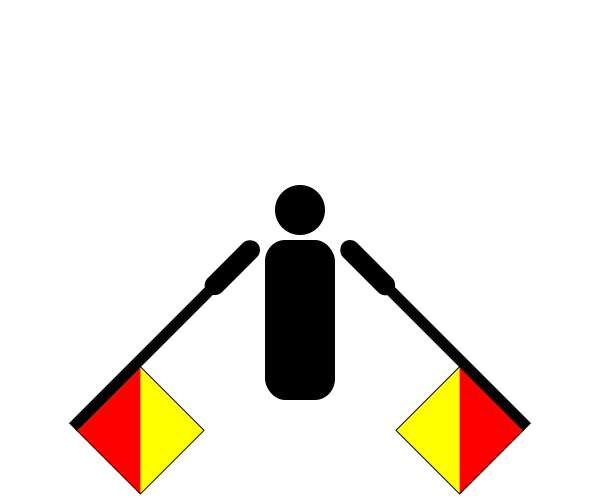

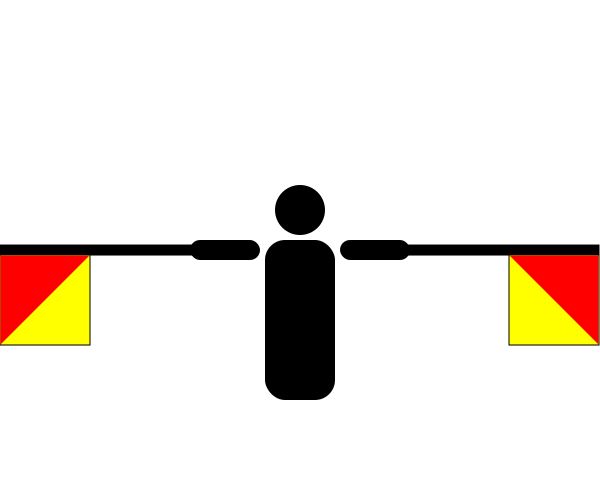


There are approximately 217 people named Andres in the UK. That makes it one of Britain's least common surnames. Only around three in a million people in Britain are named Andres.
Origin: Iberian
Region of origin: Europe
Country of origin: Spain
Religion of origin: Christian
Language of origin: Spanish