ANDREE
The surname Andree traces its roots to the ancient Greek given name Andreas, which in turn is derived from the Greek word aner meaning man or warrior. The name gained widespread recognition through the apostle Saint Andrew, the first disciple of Christ, whose veneration made Andreas a popular personal name throughout Europe. As the name was adopted into various languages, it produced the French form André, the English variant Andree, and numerous other cognates across continental Europe.
The English spelling Andree is understood to signify a descendant of André or a son of Andrew, reflecting the patronymic traditions common in medieval society. The suffixes and forms that appear in contemporary records—such as Andre, Andrea, Andrey, Andresh, Andriss, Andri, and Anders—are all linguistic adaptations of this original Greek root.
Historical documents show that the surname was in use as early as the thirteenth century. The first documented spelling, belonging to Josep Andree, appears in the Calendar of the Close Rolls dated 1229, during the reign of King Henry XI, known as “the Frenchman” (1216‑1272). In 1279 the name Geoffrey Andre is recorded in the Calendar of Plea and Memoranda Rolls, preserved within the archives of the City of London. These early attestations demonstrate the long-standing presence of the name within English administrative records.
Following the Revocation of the Edict of Nantes in 1685, many French Huguenots fled to England to escape persecution. Their migration introduced additional French spelling variants such as André—sometimes with an acute accent over the final e—into the English record. Ecclesiastical registers from Westminster contain entries such as the christening of Anne, daughter of Pierre and Marianne Andre, on 13 February 1754, and the marriage of Charlotte Andre and Samuel Taylor on 8 May 1784. These examples illustrate the integration of the surname within the fabric of English parish life during the eighteenth century.
In modern times the surname has remained largely concentrated in Western Europe, with notable frequencies in France, Germany, Sweden, and the Netherlands. In the United States it is less common, yet it can still be found across the country, largely a consequence of the broad migration of Europeans during the nineteenth and early twentieth centuries. The global spread of the name has produced a wide array of spelling variations that reflect local linguistic and cultural conventions, such as Andreu in Spanish, Andrisenko in Russian, and Anderassen in Scandinavian contexts.
The etymological meaning of Andree retains an association with the attributes of manliness, bravery, and courage, attributes that were held in high esteem within both secular and religious communities that venerised the apostle Saint Andrew. While the precise significance of a surname can differ from family to family, the enduring legacy of the Greek root ensures that those bearing the name Andree carry a marker of an ancient tradition that values strength and honour.
Similar and related surnames
- Andere
- Andre
- Andrea
- Andar
- Ander
- Anderes
- Anderew
- Andor
- Andra
- Andrade
- Andrades
- Andrae
- Andras
- Andrau
- Andreac
- Andreade
- Andreades
- Andreae
- Andrean
- Andreaou
- Andreas
- Andrece
- Andred
- Andrede
- Andreen
- Andreescu
- Andreesen
- Andreetti
- Andreev
- Andreeva
- Andrei
- Andreis
- Andrej
- Andrejev
- Andrell
- Andreo
- Andreone
- Andreos
- Andreou
- Andres
- Andresen
- Andress
- Andreu
- Andreus
- Andrew
- Andrewes
- Andrews
- Andrey
- Andreyev
- Andrez
- Andri
- Andrie
- Andries
- Andriese
- Andriesz
- Andrieu
- Andrle
- Andro
- Andru
- Anders
- Andreadis
- Andren
- Andry
Related and similar names are generated algorithmically based on the spelling, and may not necessarily share an etymology.
How to communicate the surname Andree in...
Braille
⠁⠝⠙⠗⠑⠑
Morse
.--.-...-...
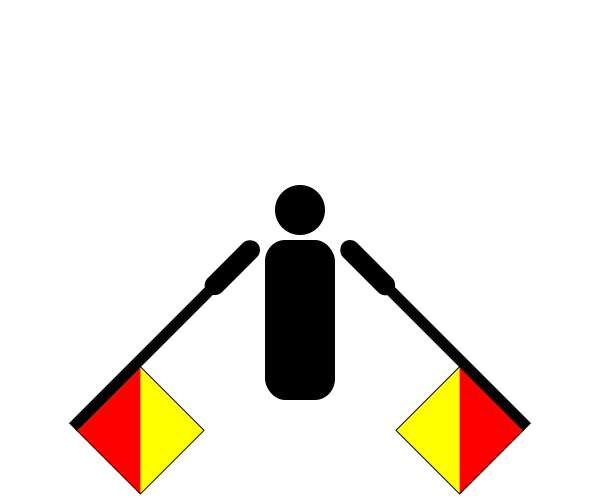
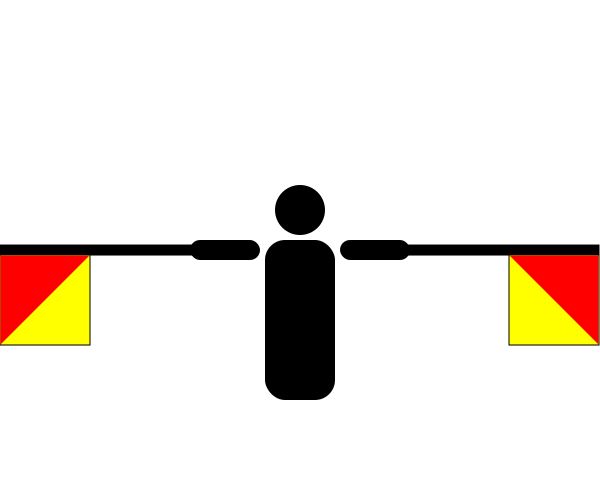
Semaphore



There are approximately 62 people named Andree in the UK. That makes it one of Britain's least common surnames. Only around one in a million people in Britain are named Andree.
