VICK
The surname Vick is a name of English provenance, with several historically documented derivations that reflect the linguistic and social diversity of the British Isles. The earliest English usage records the name as a patronymic form derived from the medieval given name Vic, itself a diminutive of the Latin Victor, a title meaning “conqueror” or “victorious.” Consequently, the surname could have originally served as a nickname for a person perceived as triumphant or successful in some respect.
In addition to the Latin derivation, documentary evidence shows a Norman‑French influence on the name. Spelling variations such as Veck and Vick are linked to the Old French phrase Le Eveske, meaning “the bishop.” This nickname was reportedly applied to individuals who either exhibited bishop‑like conduct or who performed the part of a bishop in medieval travelling theatres. By the thirteenth century, dialectal shifts had shortened the form to Vesk, a spelling that later stabilised as a hereditary surname. Other long‑form variants preserved in modern records include Levesque and Levick. Earliest annotations of the name appear in the Hundred Rolls of Worcestershire (1275) with Robert Vesk and in the Hundred Rolls of Cambridgeshire (1279) with Robert le Veck.
The Anglo‑Saxon tradition offers a further dimension to the name’s etymology. Some scholars date the surname to the personal name Vic, a shortened version of Vincentius. Vincentius, derived from the Latin verb vincere, means “conquering.” The popularity of St. Vincent of Saragossa during the medieval period may have influenced the adoption of the name. In this context, Vick has also been identified as a topographic surname, designating a person dwelling near a vicus, a Latin term for a rural settlement, or as an occupational surname pertaining to a vicar, the resident priest of a parish. Such occupational origins were not uncommon and often reflected the individual’s role within local communities.
In the United States, the name Vick appears most frequently in the southern region, particularly within the state of West Virginia where it is found in approximately 0.24 % of all households. Historical migration patterns trace the name to early settlers who moved from North Carolina to Virginia and subsequently to West Virginia in the mid‑eighteenth century, settling in counties such as Kanawha, Pocahontas and Monongalia. In other American states the surname is present at lower but still noticeable levels, with Pennsylvania recording 0.14 % of households bearing the name and additional concentrations in Kentucky, Virginia, Ohio, Maryland and Florida. Outside the United Kingdom, the surname is relatively rare, with limited presence in Ireland and a modest spread across the United States.
The Germanic branch of the name consists of the spelling Vicks, with variants including Vix, Vixen, Vicke, Vyck, Vycke and Wyck>. These forms were first documented in the thirteenth and fourteenth centuries in German‑ and Dutch‑speaking regions. While some early records suggest a nickname origin, possibly describing an individual noted for skill, the precise semantic lineage remains unconfirmed. In contemporary Germany the name is generally spelled Vicks or Vix, whereas in the United Kingdom its presence is noted mainly in counties such as Shropshire, Staffordshire and Northamptonshire. The name likewise appears in Canada, Australia, Ireland and Poland, reflecting patterns of European emigration over the past several centuries.
The multiplicity of derivations for the surname Vick illustrates how linguistic, cultural, and occupational factors intersected in the naming practices of medieval Europe. From a Latin stem denoting victory to a Norman‑French reference to ecclesiastical authority, and from an Anglo‑Saxon invocation of conquest to a Germanic connotation of skill, each variant has contributed to the heritage of families carrying the name today. The distribution of the surname across both the British Isles and abroad underscores its enduring relevance and the complex routes by which surnames have travelled through history.
Typical given names associated with the Vick surname
Male
- Andrew
- Anthony
- Christopher
- Daniel
- David
- James
- Michael
- Paul
- Peter
- Stephen
Female
- Alexandria
- Elizabeth
- Emma
- Joan
- Julie
- Margaret
- Mary
- Mildred
- Patricia
- Sandra
- Sarah
- Susan
Similar and related surnames
Related and similar names are generated algorithmically based on the spelling, and may not necessarily share an etymology.
How to communicate the surname Vick in...
Braille
⠧⠊⠉⠅
Morse
...-..-.-.-.-
Semaphore
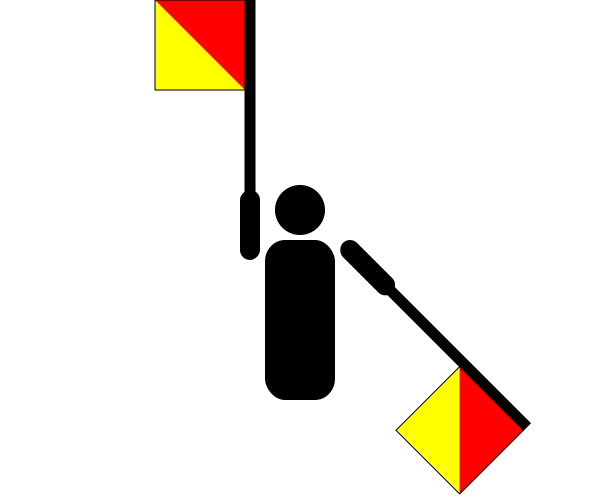
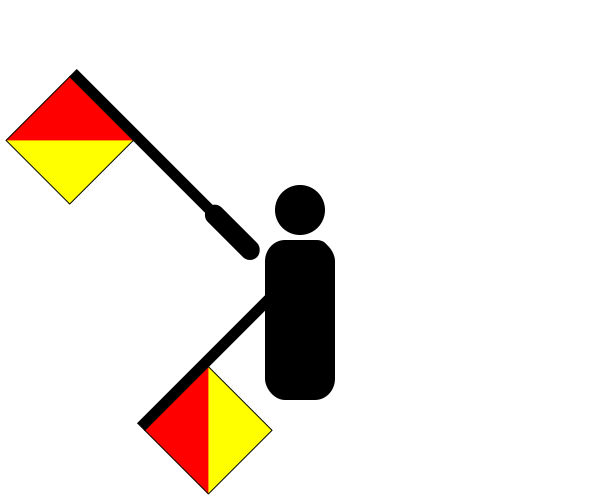

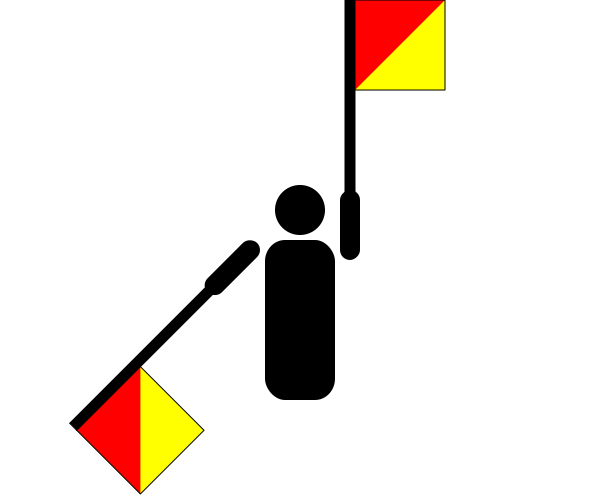
There are approximately 1,267 people named Vick in the UK. That makes it roughly the 6,141st most common surname in Britain. Around 19 in a million people in Britain are named Vick.
Origin: English
Region of origin: British Isles
Country of origin: England
Religion of origin: Christian
Language of origin: English

Famous people named Vick
- Michael Vick - American football player, quarterback, animal abuser
- Arthur Vick - Physicist and university administrator (1911 to 1998)
- Graham Vick - Opera director
Names and descriptions courtesy of Wikipedia, and may contain errors. This is not intended to be an exhaustive list of every famous person with this name.