FICK
Fick is a surname of German origin, with its earliest forms traced back to the Middle‑High German word vich or fich, meaning “to move” or “to travel.” The name is therefore understood as an occupational surname, originally given to an individual who frequently travelled or who served as a messenger or courier.
The surname has been recorded in a variety of spellings, including Feak, Feaks, Feakes, Feek, Fick and Fike, with diminutives such as Ficken and Feakins. The earliest surviving mention is that of Semann Fike, dated 1197 in the Pipe Rolls of Norfolk during the reign of King Richard I.
In medieval France, the surname appears to have an additional line of derivation from the Old French word fiche, meaning an iron point. This term was introduced into English after the Norman Conquest of 1066 and was used metaphorically to denote agricultural implements such as a harrow or a narrow ploughshare, or in a military sense to describe a spear or lance. Consequently, the name may have marked a maker of such implements or a spearman noted for his skill with a lance.
Records of the French line include individuals such as Richard Ficun in the Assize Rolls of York in 1219, James Feeke — a witness at St. Peters Church, Westcheap, on 2 April 1568, and Susan Fickins, who married Robert Christy at St. Gregory by St. Pauls on 5 May 1635. Ann Feakes is noted for marrying Will Stuckley at St. James Church, Dukes Place, on 22 April 1686. All of these entries are found in the surviving registers of the diocese of Greater London from the reign of Elizabeth I.
In German usage, the modern word ficken has acquired vulgar meaning in contemporary colloquial German, but as a surname it retains its historical connotations. It has long been understood to refer to a back‑and‑forth or rubbing motion, and may point to an occupation involving such a task.
Geographically, the surname is most prevalent in Germany, where it is especially common in the former Province of Westphalen in the north‑west, as well as in Schleswig‑Holstein, Bavaria, Saxony, Hesse, Lower Saxony, and Thuringia. In Austria and Switzerland the name also occurs, and a significant diaspora settled in the United States during the early 1700s, arriving as part of early German immigration to the colonies.
In the United States, the surname is most frequent in the states of Pennsylvania, New York and New Jersey. In the United Kingdom, it is chiefly found in London and the East Midlands. In France, the highest concentrations are in the Île de France region.
Outside of Europe, bearers of the name are found in South Africa (most commonly in the Free State and Northern Cape), Canada (notably in Ontario), Australia (primarily in New South Wales) and New Zealand, reflecting broader patterns of emigration from Europe.
Variant forms have also appeared in Scandinavia (Ficko, Fickstein, Ficker, Fickstad), in Spain among some Sephardic Jewish families as Fique, and in other contexts such as Fic in France, Fitzpatrick in Ireland, Ficker in Austria and Bulgaria, Fitzgerald in England and America, and Fycks in Sweden.
Throughout history, members of the Fick family have also been ennobled, with lines such as the Fick von Cartendorf and Ficke von Pradel in the 12th century, and later baronial families named Fick und Gügel and Fick und Nullhausen in the 16th century.
In sum, the surname Fick carries a multifaceted heritage that spans Germanic occupational roots, Norman linguistic influences, and widespread migration, yielding a surname that persists across diverse cultures and continents while retaining its historical significance.
Similar and related surnames
Related and similar names are generated algorithmically based on the spelling, and may not necessarily share an etymology.
How to communicate the surname Fick in...
Braille
⠋⠊⠉⠅
Morse
..-...-.-.-.-
Semaphore
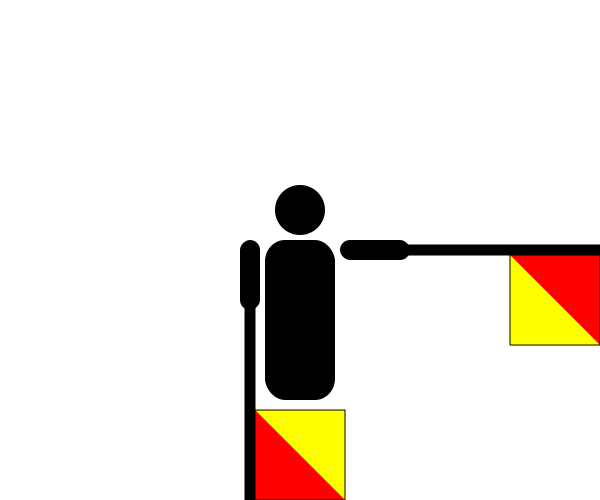
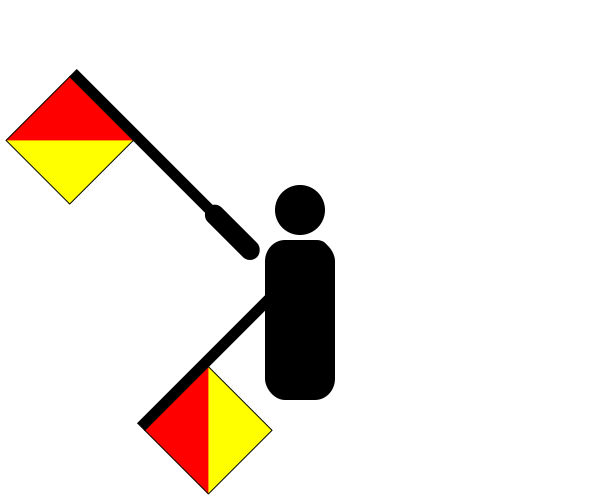

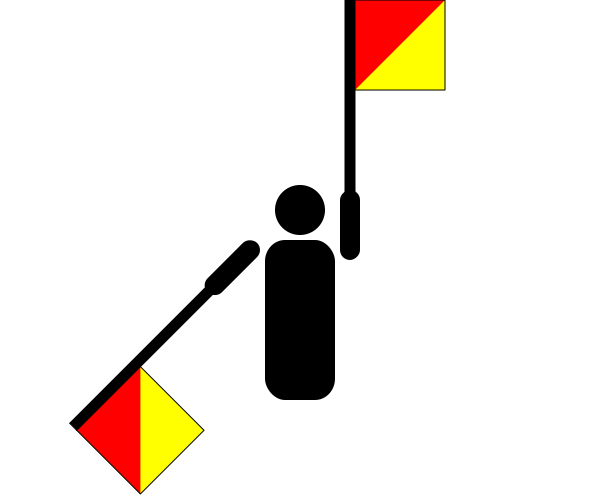
There are approximately 73 people named Fick in the UK. That makes it one of Britain's least common surnames. Only around one in a million people in Britain are named Fick.
Region of origin: Europe
Country of origin: France
Language of origin: French