TYE
Tye is an English surname that appears throughout the British Isles. It is associated with the Old English words tēag and tīe, which literally mean “a tie” or “a knot”. The name may originally have been a nickname for a person with skill in tying knots, or it may have denoted a maker or seller of ties. An alternative interpretation of the root suggests that it referred to a meeting point or junction, linking the name to a person who lived near a boundary or a crossroads.
The surname is also topographical in origin. It can describe someone who lived near lands known as “the tye”, a term used for common grazing areas close to a village where cattle were gathered, perhaps for slaughter. One theory holds that it may have developed from the pre-7th‑century Old English word titt, meaning a small hill or mound, as seen in the place name Tydd St Mary in Lincolnshire. The Domesday Book of 1086 records the name as Tite, Tid and Tit. The surname may also occasionally arise as a short form of a village name such as Tytherleigh in Devonshire, which is understood to mean the common lands in the wood.
Several variants of the name have been documented, including Tie, Tight, Tyt, Titt, Tittle, Tythe and Tyght. The earliest known records are Hugh de la Tye of Sussex and John Tye of Norfolk, both in 1273. The use of residential surnames became common when inhabitants moved from their place of origin; they were identified by the name of their former home. Examples from the early modern period include Raffe Tyte and Thomazine Tyght of London in 1588, William Tight of London in 1620, and Joan Tighte of Bedfordshire in 1621. Other early parish records cite Hestor Tyte, daughter of Lewis Tyte, christened at St Olaves, Hart Street, London, on 31 December 1644, and Hannah Titt, daughter of Thomas Titt, christened at St Margarets, Westminster, on 1 March 1667.
A notable bearer of the surname is Sir William Tite (1798 – 1873), a distinguished architect. He was responsible for the design and construction of the Royal Exchange in London in 1844 and played a major role in the planning of the Thames Embankment. His work cemented the surname’s association with engineering and architectural history in Britain.
Overall, the surname Tye exemplifies the complex ways in which English family names can arise from occupational nicknames, topographical features, or locational identifiers. Its recorded history, spanning from the 13th century to contemporary times, reflects a lineage that is firmly rooted in the linguistic and geographic heritage of England.
Typical given names associated with the Tye surname
Male
- Andrew
- Christopher
- David
- James
- John
- Michael
- Paul
- Peter
- Robert
- Stephen
Female
- Carol
- Caroline
- Catherine
- Deborah
- Elizabeth
- Helen
- Julie
- Karen
- Pamela
- Patricia
- Rebecca
- Sarah
- Susan
Similar and related surnames
- Tyes
- Tyers
- Tyas
- Tyer
- Toye
- Toy
- Tighe
- Tice
- Ty
- Tey
- Tie
- Tyo
- Ties
- Tyghe
- Tys
- Daay
- Dahy
- Dahya
- Daiya
- Dauya
- Dawy
- Day
- Daya
- Dayao
- Daye
- Dayi
- Dayo
- Deay
- Deehy
- Deey
- Dewy
- Dewye
- Dey
- Deya
- Deye
- Deyo
- Dieye
- Diy
- Diya
- Doey
- Dooay
- Dooey
- Douay
- Douey
- Dowy
- Doy
- Doye
- Duay
- Duey
- Duhy
- Duy
- Dy
- Dye
- Tahy
- Tay
- Taya
- Tayao
- Taye
- Tayo
- Teuy
- Teye
- Toay
- Toey
- Tooey
- Tooy
- Touey
- Touhy
- Touya
- Towy
- Toya
- Toyo
- Tuey
- Tuhy
- Tuohy
- Tuoyo
- Tuyau
- Tyte
- Whtye
Related and similar names are generated algorithmically based on the spelling, and may not necessarily share an etymology.
How to communicate the surname Tye in...
Braille
⠞⠽⠑
Morse
--.--.
Semaphore
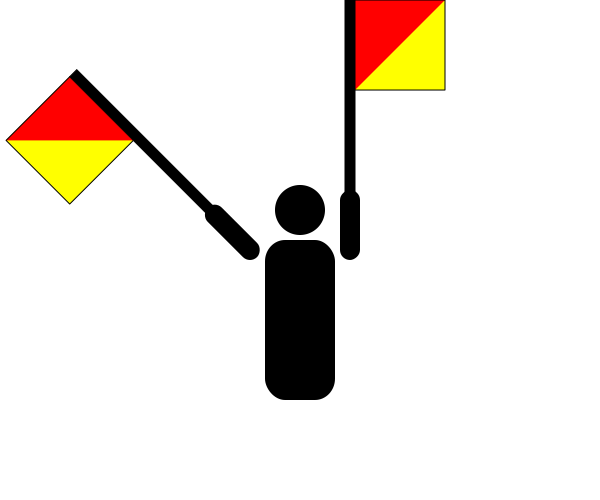
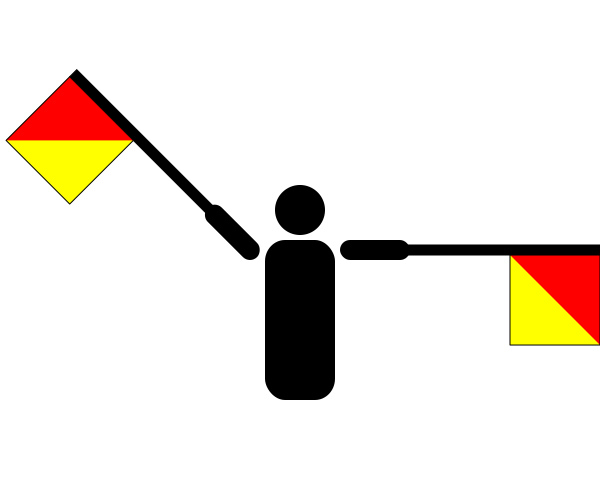

There are approximately 3,257 people named Tye in the UK. That makes it roughly the 2,791st most common surname in Britain. Around 50 in a million people in Britain are named Tye.
Surname type: Location or geographical feature
Origin: English
Region of origin: British Isles
Country of origin: England
Religion of origin: Christian
Language of origin: English

Famous people named Tye
- John Tye - Cricketer (1848 to 1905)
Names and descriptions courtesy of Wikipedia, and may contain errors. This is not intended to be an exhaustive list of every famous person with this name.