DAY
Recorded variant spellings include D'Ay, Day'
The surname Day is predominantly of English origin, with historical usage emphasised throughout the British Isles, particularly in England where it has been recorded in the early medieval period. Early documentary evidence places the name among Christian families, with its linguistic roots firmly embedded in the English language.
Within the onomastic tradition, the surname is classed as an occupational name, yet its etymological development incorporates several distinct pathways. One avenue derives from a topographic feature: individuals residing near a deer park were sometimes designated by the Middle English word daye, meaning “deer”. This appellation would have identified them by their proximity to such woodland enclaves, a common practice in medieval toponymy.
Another line of meaning pertains to personal character and social perception. The name may have arisen as a nickname for a person perceived as bright, cheerful, or active, comparable in conception to the notion of a “day” or “dawn”. Such descriptive surnames were typical in a period when social roles and temperaments were often memorialised in a family name.
In addition, the surname bears a clear connection to the biblical personal name David, the Hebrew word dāwīd meaning “beloved”. The adoption of Day as a shortened form of David can be traced to the proliferation of the personal name during the Middle Ages, itself introduced to Europe by crusaders of the 12th century. The name’s prominence was further reinforced by its association with the patron saint of Wales and with two Scottish monarchs, David I (reg. 1124–1153) and David II (reg. 1329–1371). In England, a clerical inhabitant of Lincolnshire was recorded as “Dauid clericus” in 1150, while a similar naming appears in 1278 at Cambridgeshire as “Davit”. These attestations illustrate the gradual linguistic contraction towards the form Day.
A separate hypothesis links the surname to the pre–7th‑century Old English personal name Daei. This name is derived from the word daeg, meaning “day”, and may serve as a diminutive or pet form of compound names such as Daegberht (‘day‑bright’) or Daegmund (‘day‑protection’). The earliest documented usage of a modern spelling appears in the form Dai or Dei in the 12th and 13th centuries: Aluric Dai of Berkshire in 1196 and Ralph Deie of Leicestershire in 1211. Later variations include Daye, Dey, Deye, and the distinctive spelling D'Eye.
Additional archival references provide context for the surname’s geographical spread and migration patterns. An example is Arthur de Yes, recorded at the church of St Gregory's by St Pauls, London, on 16 December 1619, illustrating the persistence of the name within ecclesiastical records. In the 17th century, Richard Day emigrated from London on the vessel “Plaine Joan” in May 1635, bound for Virginia, signalling the surname’s early appearance in the New World. The earliest documented spelling of the family name appears as Daia in 1095 within the feudal records of Bury St Edmunds Abbey, Suffolk, notably among the entries titled “Feudal Documents from the Abbey of Bury St Edmunds”.
Collectively, these strands reveal that the surname Day has evolved through a confluence of topographic, descriptive, and patronymic origins, with a strong foundation in English linguistic tradition while also retaining a substantive link to biblical nomenclature. The name’s endurance into the modern era across the English-speaking world attests to its robust etymological heritage and its capacity to adapt across centuries of social and cultural change.
Typical given names associated with the Day surname
Male
- Andrew
- Christopher
- David
- John
- Michael
- Paul
- Peter
- Richard
- Robert
- Stephen
Female
- Elizabeth
- Helen
- Jacqueline
- Karen
- Margaret
- Mary
- Nicola
- Patricia
- Rebecca
- Sarah
- Susan
Similar and related surnames
- Ady
- Da
- Daas
- Daay
- Dae
- Daee
- Dahy
- Dahya
- Dai
- Dais
- Daiya
- Daiz
- Dake
- Dao
- Das
- Dauya
- Daw
- Dawy
- Daya
- Dayah
- Dayao
- Dayas
- Daye
- Dayes
- Dayi
- Dayo
- Days
- Dayus
- Daz
- Dazs
- Dea
- Deas
- Deay
- Deehy
- Deey
- Dei
- Dewy
- Dewye
- Dey
- Deya
- Deye
- Deyo
- Dieye
- Diy
- Diya
- Doey
- Dooay
- Dooey
- Douay
- Douey
- Dowy
- Doy
- Doye
- Duay
- Duey
- Duhy
- Duy
- Dy
- Dye
- Tahy
- Tay
- Taya
- Tayao
- Taye
- Tayo
- Teuy
- Tey
- Teye
- Toay
- Toey
- Tooey
- Tooy
- Touey
- Touhy
- Touya
- Towy
- Toy
- Toya
- Toye
- Toyo
- Tuey
- Tuhy
- Tuohy
- Tuoyo
- Tuyau
- Ty
- Tye
- Tyo
- Whtye
Related and similar names are generated algorithmically based on the spelling, and may not necessarily share an etymology.
How to communicate the surname Day in...
Braille
⠙⠁⠽
Morse
-...--.--
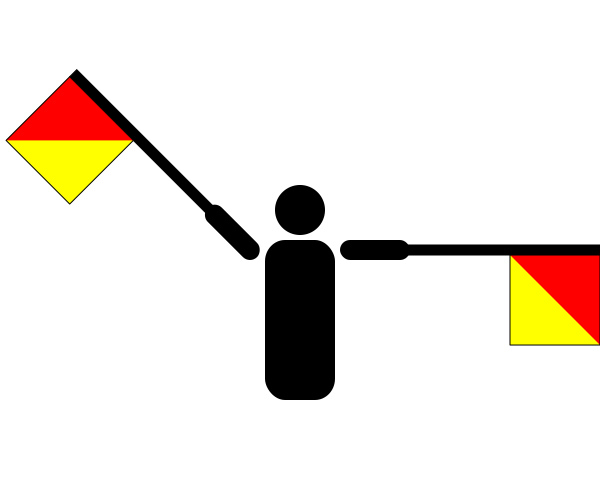
Semaphore


Did you know?
According to a survey carried out by Democracy Club, politicians and candidates with the surname Day are most likely to say that their favourite biscuit is a Digestive.
There are approximately 51,309 people named Day in the UK. That makes it the 132nd most common surname in Britain. Around 788 in a million people in Britain are named Day.
Surname type: Occupational name
Origin: English
Region of origin: British Isles
Country of origin: England
Religion of origin: Christian
Language of origin: English

Famous people named Day
- Alex Day - Musician
- Jamie Day - Football player; football manager
- Rosie Day - Actress
- Doris Day - American actress, singer, and animal rights activist (1922 to 2019)
- Charlie Day - American actor, musician, television producer and screenwriter
- Andy Day - Actor
- Darren Day - Actor
- Robin Day - Broadcaster (1923 to 2000)
- Felicia Day - American actress
- Paul Day - Designer and Vocalist
- Simon Day - Comedian
- Harry Day - Military officer (1898 to 1977)
- Vera Day - Actress
- Dominic Day - Welsh rugby union player
- Mervyn Day - Football player and manager
- Joe Day - Football player
- Corinne Day - Photographer (1962 to 2010)
- Martyn Day - Scottish politician
- Nicholas Day - Actor
- Robert Day - Film director (1922 to 2017)
Names and descriptions courtesy of Wikipedia, and may contain errors. This is not intended to be an exhaustive list of every famous person with this name.