POYNER
Poyner is a surname of English provenance, recorded in the British Isles from the early Middle Ages onward. Its earliest attestations appear in the 13th and 14th‑century fiscal and legal documents of England.
The most widely accepted derivation is occupational. In Middle English the word poyner described a “pan” or “pot”. The surname was therefore applied to individuals who manufactured or sold such cookware. Contemporary spellings that evolved from this base are Poynter and Pointer, reflecting regional variations in spelling and pronunciation.
Other sources indicate two distinct alternative origins. One is of Norman French derivation, whereby the medieval nickname poigneor – meaning “fighter” – was transferred into English following the Norman Conquest of 1066. A second possibility is a Welsh patronymic form, ab Ynyr (son of Ynyr). The personal name Ynyr itself has been linked to the Latin Honorius and the meaning “honoured”. Early documentary evidence, such as William le Poinur in the Herefordshire Pipe Rolls of 1230 and Richard Pownyer in the Suffolk Pinchbeck Register of 1327, demonstrates the surname’s presence across the country during the 13th century.
There is also a specific hypothesis that links the name to the Old English word paga (pagan) and to a topographic identification with a pagan shrine or altar. In this view Poyner would be a topographic name for a person living near such a sacred place, or an occupational name for a person who accepted or sheltered pagans. Although this derivation is not as prominently cited as the occupational explanation, it is recorded in the literature and reflected in variant spellings such as Pyner and Piner.
In terms of geographic distribution, the surname is common throughout the United Kingdom, with the highest concentrations historically recorded in Cornwall, Somerset, Devon, Kent, Oxfordshire and East Anglia. In contemporary statistics the name is observed most frequently in Cornwall; it also appears in East Anglia, the South‑West and the South‑East. Across the Atlantic, Poyner has retained substantial frequency; it was reported that over 17 000 individuals in the United States bear the name, and it is especially prevalent in Virginia, West Virginia, Texas, Alabama and Georgia, with rising numbers in California, Nevada and New York.
Variant forms of the surname – including Poynter, Pointer, Pyner, Paynter, Painter, Pointor, Ponner, Booner, Bowyer and others – have evolved through dialectal differences and orthographic errors in official records. The persistence of the surname in a wide array of contexts illustrates its enduring presence in the fabric of English nomenclature.
Typical given names associated with the Poyner surname
Male
- Andrew
- Anthony
- Christopher
- David
- James
- John
- Mark
- Michael
- Richard
- Robert
- Stephen
Female
- Amanda
- Ann
- Claire
- Debra
- Elaine
- Emma
- Helen
- Jane
- Joanne
- Linda
- Margaret
- Marie
- Nicola
- Patricia
- Sarah
Similar and related surnames
- Pagnier
- Painer
- Panar
- Panara
- Panario
- Panaro
- Paneer
- Paner
- Panerai
- Panero
- Panier
- Paniora
- Panner
- Pannier
- Payner
- Paynor
- Penar
- Pener
- Penera
- Pennar
- Penner
- Penoyre
- Penri
- Penrie
- Pienaar
- Pinar
- Pineiro
- Piner
- Pinera
- Pinero
- Pinner
- Pinor
- Poenaru
- Poiner
- Ponari
- Poner
- Ponner
- Ponur
- Pooner
- Powner
- Poynard
- Poynder
- Poyne
- Poynes
- Poynor
- Poynter
- Pyner
- Pynor
Related and similar names are generated algorithmically based on the spelling, and may not necessarily share an etymology.
How to communicate the surname Poyner in...
Braille
⠏⠕⠽⠝⠑⠗
Morse
.--.----.---...-.
Semaphore

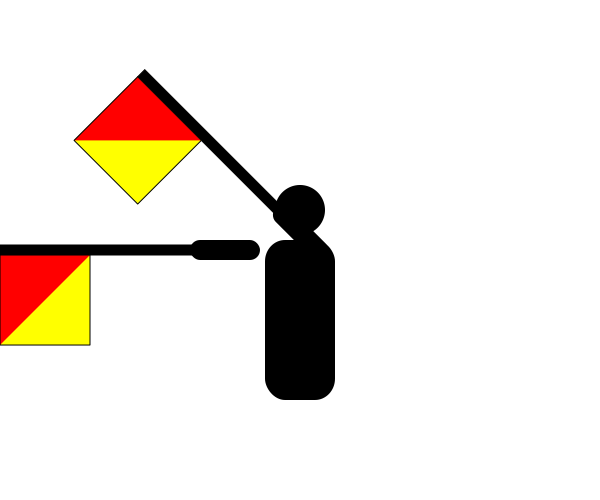
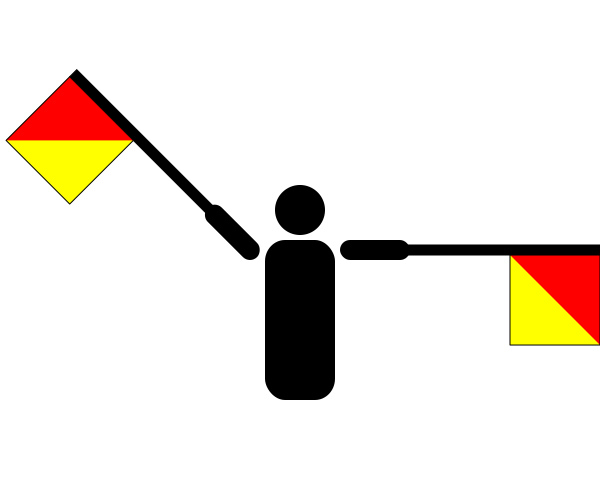
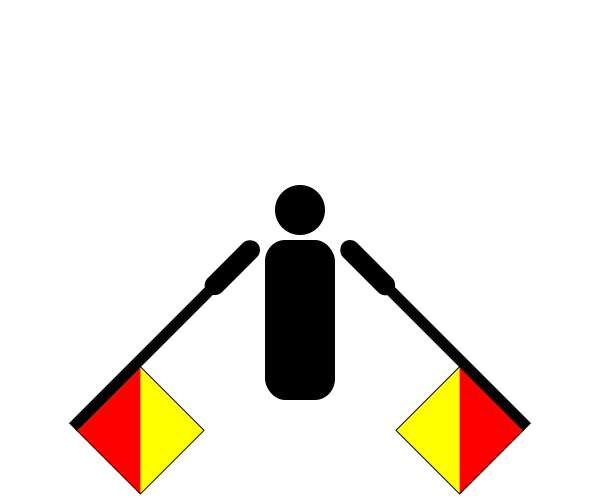

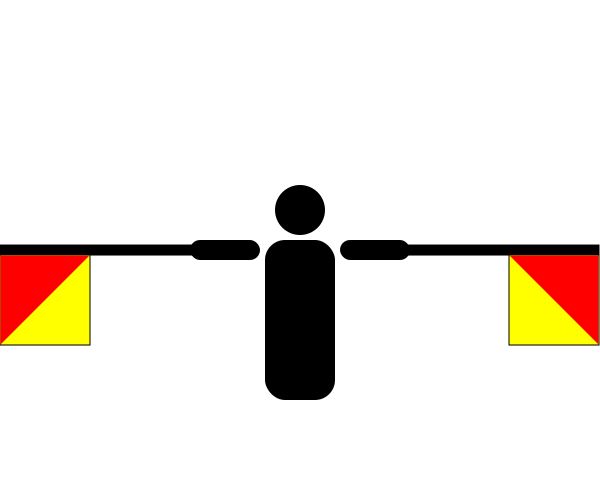
There are approximately 1,221 people named Poyner in the UK. That makes it roughly the 6,342nd most common surname in Britain. Around 19 in a million people in Britain are named Poyner.
Surname type: Occupational name
Origin: English
Region of origin: British Isles
Country of origin: England
Religion of origin: Christian
Language of origin: English