PENNER
Penner is a surname with roots that span several linguistic and cultural traditions. Although it is most often associated with Germanic origin, historical evidence indicates a complex tapestry of meanings and derivations.
In the Germanic tradition, the name derives from the Middle High German word penner, denoting a beggar or vagabond. This etymology suggests that the original bearer may have been identified by an itinerant lifestyle, a characteristic that was uncommon enough to become a distinguishing nickname and, later, a hereditary surname.
Concurrently, within the English linguistic heritage the surname arises from an occupational context. The Old English word pinn means a pin or needle, and by extension a pine tree. The term pinner referred to a highly skilled craftsman, not merely a maker of pins but also of wire articles such as baskets and bird cages. Thus, Penner could be viewed as a descendant of those skilled in needlework or basketry, especially given the varied forms recorded in medieval documents.
Some ancestors derived their surname from a place name. Villages such as Pinner in Middlesex produced early bearers, and the name there has been linked to the site of the pin makers or to the pine trees that bordered the area. Even when a locational origin is at play, the underlying occupational meaning frequently persisted in the surname’s usage.
Historical records give early examples of the name in various forms. Richard de Pinner of London appears in 1275, Walter Le Pinnere in 1281, and Edward le Peniur of Norfolk in 1275, the latter likely a comb maker. The 1595 christening of Wynifred Pynner at St Margarets, Westminster, and the 1625 record of Ann Penner at St Marys Church, Putney, further attest to the name’s endurance.
In 1577 a coat of arms was granted to the family: a blue field, a silver chevron between three lions heads, each ducally crowned in gold. This heraldic device reflects the family’s early prominence and provides a visual anchor for genealogical research.
Within the United Kingdom the surname remains relatively uncommon, yet it is distributed across England, Wales, Northern Ireland, Scotland and the Isle of Man, with roughly 2,400 known bearers in England and Wales alone. Such spread indicates a pattern of migration within the British Isles, often linked to the trade of pins and needles.
Across Europe, Penner is found in Germany (particularly Bavaria), Belgium, Luxembourg, France and the Netherlands, a pattern that mirrors the Holy Roman Empire’s historical influence. In Germany the name is thought to arise from medieval towns such as Pfinztal and Pfinz, where a pin‑manufacturing industry likely thrived.
In the United States, the surname is most commonly observed in California, Minnesota and Pennsylvania. According to recent census figures the name accounts for around 7,400 individuals, with further presence in Florida, Illinois, New York and Washington. These concentrations point to waves of European immigration during the nineteenth and early twentieth centuries.
The surname Penner has numerous variants reflecting linguistic adaptation: Pinner, Pinor, Pinar, Pyner, Pynner, Pinner, Piner, Pinor, Pinar, Piner, Pennar, Pennell, Pleyor, and Penney among them. Many of these variants emerged through phonetic spelling, regional pronunciation differences or the influence of French, Dutch, Norwegian and Spanish languages.
Typical given names associated with the Penner surname
Male
- Alexander
- Arnold
- Christopher
- Elliott
- Timothy
Female
- Barbara
- Lisa
- Nedialka
- Sian
- Victoria
Similar and related surnames
Related and similar names are generated algorithmically based on the spelling, and may not necessarily share an etymology.
How to communicate the surname Penner in...
Braille
⠏⠑⠝⠝⠑⠗
Morse
.--..-.-...-.
Semaphore


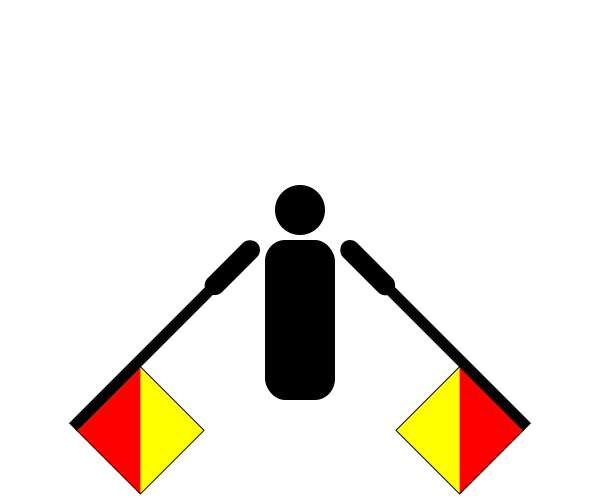
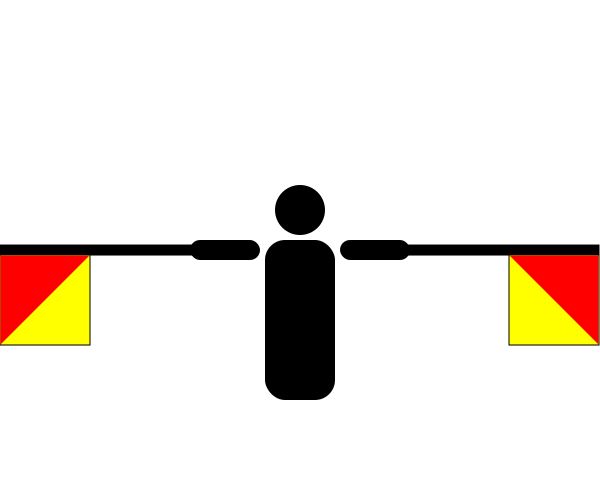
There are approximately 81 people named Penner in the UK. That makes it one of Britain's least common surnames. Only around one in a million people in Britain are named Penner.
Origin: English
Region of origin: British Isles
Country of origin: England
Religion of origin: Christian
Language of origin: English