PINER
Piner is a surname of English origin, first recorded in the mid‑thirteenth century. It belongs to the class of occupational names and is closely associated with the Middle English word piner, which originally meant “to suffer” or “to be in pain.” In this context the surname was likely applied as a nickname to an individual who displayed endurance or resilience in the face of hardship, or who possessed a melancholic disposition. Thus, the name conveys a sense of strength and perseverance.
Other linguistic evidence links Piner to the Old English word pinn, meaning a needle or pin, and by extension, to pine trees. A pinner was a highly skilled craftsperson who made pins, needles, wire baskets and bird‑cages. This occupational meaning is supported by early documentary references such as Richard de Pinner of London in 1275 and Walter Le Pinnere of London in 1281, both explicitly identified as pin‑makers. The name also survives in the place name Pinner, a village in Middlesex, and those connected with it would have been described as residing at the pin‑makers’ place or near pine trees.
The first surviving spelling of the family name appears as Adam Le Pinare in the 1244 pipe rolls of Worcester during the reign of Edward of Woodstock. Subsequent records show a range of spellings: Pinner, Piner, Pinor, Pinar, Pyner, Pynner, Penner and the French variants Pinar, Pineaux, and Pinard, reflecting the fluid nature of medieval orthography. A 1595 christening of Wynifred Pynner in Westminster and later baptisms of Ann Penner (1625) and Catherine Piner (1772) illustrate the persistence of the name through the early modern period.
In the nineteenth century, families bearing the surname migrated to the United States, establishing communities primarily in the North East and the Mid‑West. Presently, the name is found across the United Kingdom, most densely in the East of England, with smaller concentrations in Scotland, Wales and Northern Ireland. In the United States, modern census data show the surname most common in Alabama and Georgia and also present in Illinois, Indiana, Louisiana, Missouri and North Carolina, among 46 states and the District of Columbia. Although it is not among the most frequent surnames nationally, Piner remains a distinct and recognisable surname in both nations.
The variety of spellings—Pyner, Pyneer, Pynerr, Pineer, Pinarre, Pinario, Pinear, and others—reflects the name’s evolution over the centuries and its assimilation into different linguistic contexts. Despite this diversity, all forms share a common origin rooted in either the craft of pin‑making or the natural feature of pine trees, underscoring a historical connection to skilled labour and to the English landscape.
Typical given names associated with the Piner surname
Male
- Andrew
- Brian
- Christopher
- Daniel
- David
- James
- John
- Jose
- Lee
- Nicholas
- Richard
- Stephen
- Steven
- William
Female
- Catherine
- Claire
- Cynthia
- Elizabeth
- Felicity
- Gladys
- Hazel
- Jillian
- Julie
- Louise
- Melissa
- Patricia
- Sally
- Samantha
- Sarah
Similar and related surnames
Related and similar names are generated algorithmically based on the spelling, and may not necessarily share an etymology.
How to communicate the surname Piner in...
Braille
⠏⠊⠝⠑⠗
Morse
.--...-...-.
Semaphore

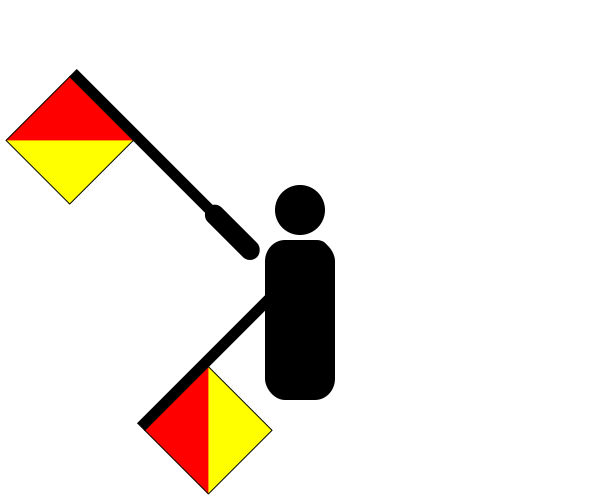
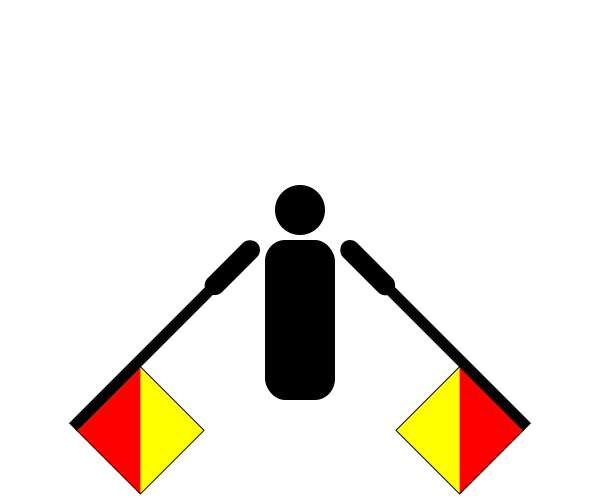

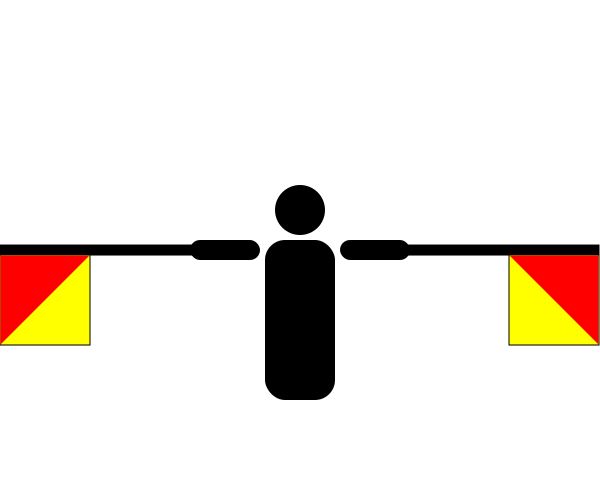
There are approximately 346 people named Piner in the UK. That makes it one of Britain's least common surnames. Only around five in a million people in Britain are named Piner.
Surname type: Occupational name
Origin: English
Region of origin: British Isles
Country of origin: England
Religion of origin: Christian
Language of origin: English
