PINARD
Pinard is a surname of French origin, first recorded in the Middle Ages. Its derivation is twofold: one line of scholarship links the name to the French word pinard, a colloquial term for a low‑quality red wine that was traditionally rationed to soldiers; the other line connects it to the Old French pin, meaning 'pine', a tree which often featured in place‑names and signified a person dwelling near a prominent pine stand.
In the wine‑related interpretation, the surname was most likely a nickname for an individual who produced or sold the aforementioned wine. As with many occupational surnames, it would have served to identify a person within a community where tabloid trade names were commonly adopted as family names.
The pine‑derived meaning, on the other hand, is exemplified by early English records that record the surname and its variants—such as Pinner, Piner, Pynner and Pinard—as describing persons living near pine trees or engaged in the manufacture of pins and other metalwork. The earliest documentation of the name is found in a 1244 Worcester pipe roll, where it appears as Adam Le Pinare.
Geographically, the surname remains concentrated in French‑speaking areas. Within France it is uncommon, but it has a significant presence in Quebec, Canada, where it is the 1152nd most common surname and is held by approximately 6 620 individuals. In the United States the name is less frequent, ranking 7 010th in popularity, with about 437 bearers, primarily in New York, Florida and California. The name can also be found in Belgium, Sweden, Uruguay and other countries with French influence, though in far smaller numbers.
Numerous spelling variants reflect linguistic shifts and migration. The most prevalent forms are Pinard, Pinart and Pinardeau; other variants include Pinardi, Pinardie, Pinardières, Pinardin, Pineault and Pineau. The surname also appears under Anglicised spellings such as Pinner, Piner and Pinor, as well as the Spanish cognate Piñero and its Iberian variants Piñeiro, Piñera and Piñedou. In continental Europe the name is occasionally recorded as Pinardt, reflecting the Germanic linguistic contact.
Historical documents that illuminate the surname’s usage include a 1275 record of Richard de Pinner in London, a 1281 entry for Walter Le Pinnere, also in London, and a 1294 reference to Edward le Peniur of Norfolk, a comb maker, showing that the name was associated with skilled craftspeople. Church records from the 16th and 17th centuries—such as the christening of Wynifred Pynner in Westminster in 1595 and that of Ann Penner in Putney in 1625—provide further evidence that the name was well established in England by that period.
The coat of arms first granted to the Pinard family in 1577 features a blue background, a silver chevron and three lions’ heads, each crowned in gold, a heraldic design that speaks to the family’s status and martial associations during the late Tudor era.
Typical given names associated with the Pinard surname
Male
- Bruno
- Christopher
- Eric
- Michael
- Olivier
Female
- Brigitte
- Hellen
- Jennifer
- Nadine
Similar and related surnames
Related and similar names are generated algorithmically based on the spelling, and may not necessarily share an etymology.
How to communicate the surname Pinard in...
Braille
⠏⠊⠝⠁⠗⠙
Morse
.--...-..-.-.-..
Semaphore

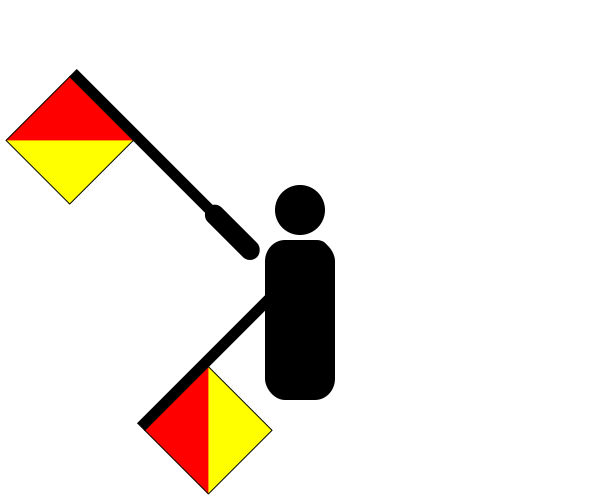
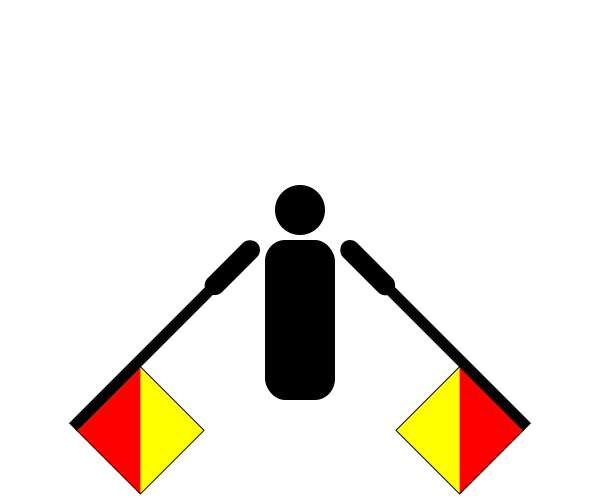

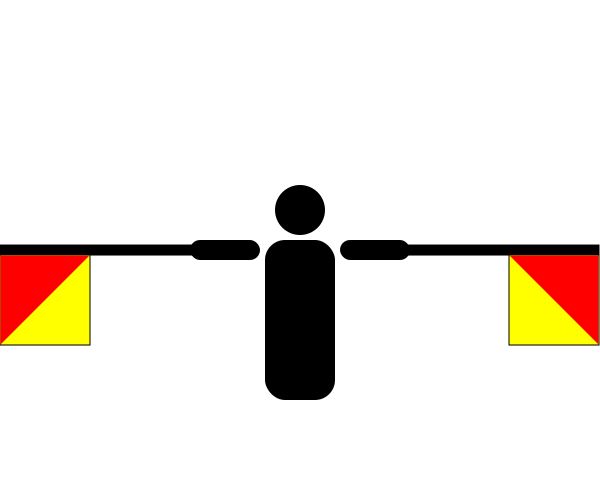

There are approximately 45 people named Pinard in the UK. That makes it one of Britain's least common surnames. Only around one in a million people in Britain are named Pinard.
Region of origin: Europe
Country of origin: France
Language of origin: French
