MORO
Moro is a surname whose lineage can be traced to both Hebrew and Italian origins. The name is linked to the Latin word maurus, meaning “dark” or “black,” a reference that has been carried forward into both the Romance language usage and the Greek and Jewish traditions that adopted it.
The Italian form of the name derives from the word moro, which means “dark” or “brown.” The surname was historically applied to individuals with dark hair, complexion or eye colour, in the same manner that other ethnonyms such as Schwarz or Brun were used in Germanic and French contexts.
In a separate development, Moro is also a reduced form of the surname Moroni, which in turn is derived from the Hebrew name Mordechai. The etymology of Mordechai is rooted in the Hebrew elements mād “measure” and kāi “made,” and the name has been associated historically with the notion of a warrior or a brave person. Consequently, the surname can convey either a description of physical attributes or a symbolic reference to courage.
Records of the name appear in a number of variant spellings including Maur, Maure, Mauret, Maurice, Mauro, Mauri, and Mor. The Norman invasion of England in 1066 introduced the name, in a Latinised form, as Mauricius de Edligtona in the medieval documents of the Danelaw for London in 1176. The earliest preserved instance of the family name appears to be that of Jasce Mauricii, dated 1191, and recorded in the Pipe Rolls of London during the reign of King Richard, the Lionheart. These sources confirm that the name entered the English record as a Latinised family surname while retaining its Roman and pre-Christian roots.
Geographically, the most firmly established medieval and early modern presence of the surname lies in northern Italy, particularly the Veneto region and the city of Padua where records exist as far back as the fifteenth century. From there it spread across Europe and, through waves of emigration in the nineteenth and twentieth centuries, to the Americas, the Caribbean and the wider Commonwealth. In contemporary times the surname is most frequently encountered in the United States, Canada, Uruguay, Argentina, Spain, Portugal, Chile and Honduras, with concentrations in California, New York, New Jersey and Florida in the United States, and in Canada’s Ontario and British Columbia provinces.
The surname has a range of recognised variants, many of which correspond to the same underlying meaning of “dark” or “swarthy.” They include Moro, Mora (Spanish and Portuguese), Merodach (Scottish), Mordachev (Russian), Mordecai and its Jewish spellings Mordichai and Mordehai, as well as Mese and Musel (Austrian variants). The diversity of variants reflects the name’s broad cultural penetration and long history of migration.
Across Eastern and Western Europe and the New World, bearers of the surname have historically been noted for strong familial cohesion. The enduring use of the name indicates a lasting respect for lineage and heritage, and the name continues to be carried with pride by its descendants worldwide.
Typical given names associated with the Moro surname
Male
- Alessandro
- Arturo
- David
- Domenico
- Marc
- Marcello
- Marco
- Paolo
- Peter
- Pietro
- Robert
- Roman
Female
- Andrea
- Barbara
- Jan
- Jane
- Julie
- Maria
- Meri
- Nicola
- Patience
- Sarita
Similar and related surnames
- Moor
- Mor
- Mora
- Moroi
- Maro
- Maroe
- Maroo
- Maros
- Marow
- Marro
- Marrow
- Maru
- Mauro
- Mauroo
- Mero
- Merrow
- Meru
- Miro
- Miros
- Mirow
- Mirrow
- Miru
- Moar
- Moare
- More
- Moreau
- Moree
- Moreu
- Mori
- Moron
- Moros
- Morou
- Morow
- Moroz
- Morr
- Morro
- Morrow
- Moru
- Morus
- Mour
- Moure
- Moureau
- Mouro
- Muro
- Muroe
- Muros
- Murro
- Murrow
- Muru
- Maier
- Mara
- Marr
- Meir
- Mir
- Mohr
- Moore
- Mower
- Murie
- Murrie
- Myrie
Related and similar names are generated algorithmically based on the spelling, and may not necessarily share an etymology.
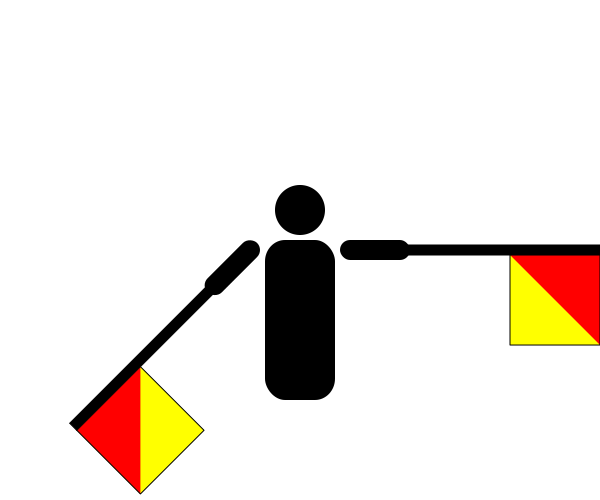
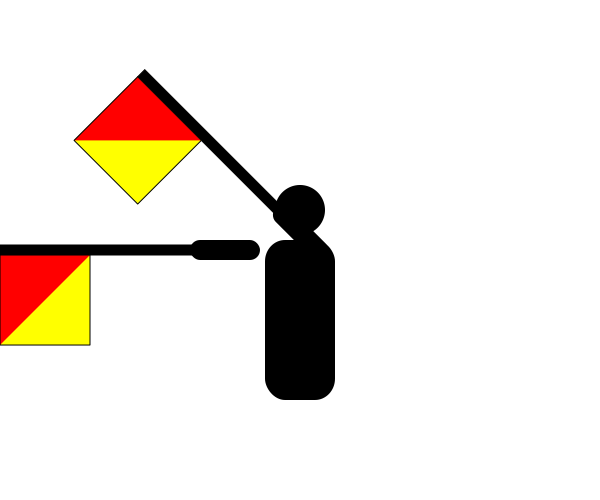
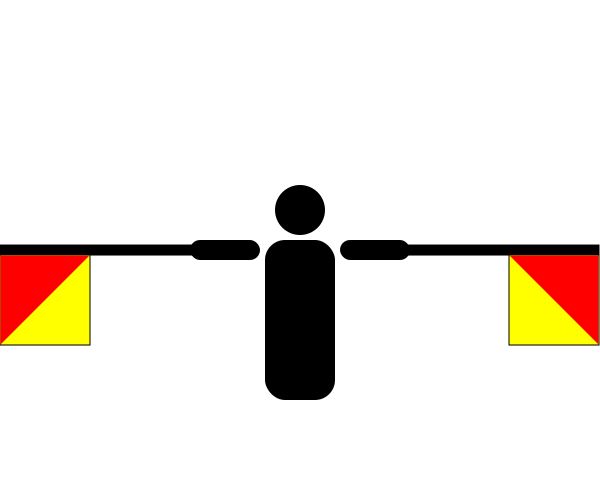
How to communicate the surname Moro in...
Braille
⠍⠕⠗⠕
Morse
-----.-.---
Semaphore
There are approximately 206 people named Moro in the UK. That makes it one of Britain's least common surnames. Only around three in a million people in Britain are named Moro.
