MURROW
Murrow is a surname of English origin that can be traced back to the Old English language. The name is believed to have derived from the personal element Muru, which means “famous” or “renowned”, and the suffix -row, a Celtic- and Old English-derived term meaning a small hill or mound. Consequently, the literal meaning of the name is “famous hill” or “renowned mound.” This interpretation accords with the customary practice of the Anglo‑Saxon period of forming surnames from topographical features or status‑based nicknames. It is likely that the earliest bearers of the name were either residents of a distinguished hill or mound, or were regarded as distinguished members of their local community.
The surname is also associated with a distinct Gaelic development. In Ireland and Scotland the name appears as an anglicised form of the Gaelic personal name Murchadh, which is composed of the elements muir “sea” and -cadh “warrior.” The name is occasionally prefixed with Mac, meaning “son of”. Variants such as MacMurrough, Murrough, Morrough, MacMorrow, Morrow, MacMurry and MacMorry are recorded in contemporary usage. The name MacMurrough is historically significant as the designation of the Royal House of Leinster. The first documented bearer of the name was Dermot MacMurrough, king of Leinster (1110‑1171), who is noted in medieval Irish records. His appeal for assistance from King Henry the Second of England precipitated the Anglo‑Norman invasion of Ireland; his descendant Art MacMurrough (1357‑1417) is remembered for his sustained resistance to English encroachment. The surname was introduced into Britain through Irish emigration, particularly during the famine of the 1840s and in search of employment. A notable example is Frank Murrow, a 21‑year‑old famine emigrant who departed Liverpool for New York aboard the Waterloo on 15 February 1847.
In the English context the name is often linked to the villages named “Murrow” in Cambridgeshire and Norfolk. Alternative explanations of its Old English root have been advanced: one account argues that it originates from mor “marsh” combined with hoh “ridge or spur of a hill,” producing a topographic designation for someone who lived at a site called Morhoh, literally “marsh ridge.” A further etymological possibility is that it stemmed from the Old English words maere “boundary or border” and hrycg “ridge,” thereby forming Mearhrycg and evolving into the modern form. All of these hypotheses highlight the likely geographic or descriptive origin of the surname.
Throughout the United Kingdom the surname is most firmly established in England but can also be found in small numbers in Wales, where a notable spelling variant is Morrwy. In Wales, as in other parts of Britain, the name is typically regarded as a toponymic surname rather than an occupational one. In the late nineteenth and early twentieth centuries the name spread to the United States, where a large migration wave brought many people of English and Irish origin across the Atlantic. According to the 2018 United States Census Bureau data, more than 16,000 individuals there bear the surname Murrow, with the majority residing in the Southern and South‑Central states. Texas, California, Georgia, Illinois and Indiana are the states with the highest concentrations, and the Dallas/Fort‑Worth area is a particular point of settlement. In the United States the name has at times functioned as an occupational surname, understood to refer to a person who worked in marshland, derived from the Old English verb morwe.
Notable individuals with the surname include the American broadcast journalist Edward R. Murrow (1908‑1963), whose career as a war correspondent set a high standard for investigative reporting. His prominence has kept the name familiar to a wider public audience beyond those with direct family connections to the surname. Other bearers have contributed in diverse fields such as politics, academia and the arts, but the individuals listed above are among the most widely recognised.
Through a combination of antiquarian roots and later migration, the surname Murrow has manifested itself in a variety of spellings, including Murrows, Moro, Morow, Marrow and Merrow, among others. In spoken and written tradition these variations have largely converged, with Murrow being regarded as the standard orthography in contemporary English documentation. The surname thus reflects both a rich historical lineage and a modern global dispersion that connects English, Irish, Welsh and American genealogical narratives.
Typical given names associated with the Murrow surname
Male
- Andrew
- David
- Dennis
- Geraint
- John
- Liam
- Paul
- Robert
- Stephen
- Thomas
- Timothy
Female
- Bertha
- Deborah
- Denise
- Elizabeth
- Gemma
- Jacqueline
- Jennifer
- Jillian
- Julie
- Linda
- Margaret
- Rhian
- Samantha
- Susan
Similar and related surnames
Related and similar names are generated algorithmically based on the spelling, and may not necessarily share an etymology.
How to communicate the surname Murrow in...
Braille
⠍⠥⠗⠗⠕⠺
Morse
--..-.-..-.---.--
Semaphore
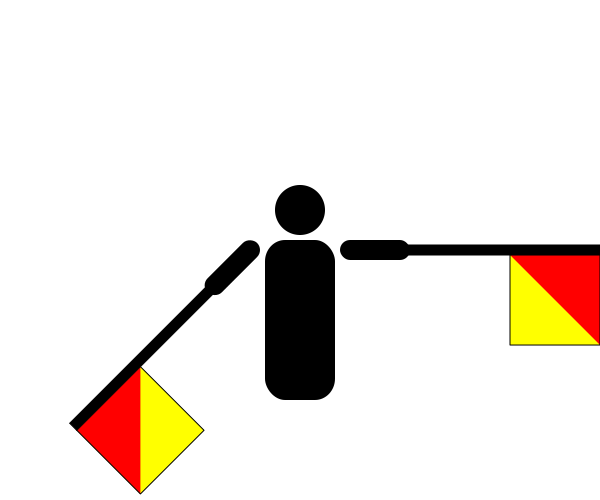

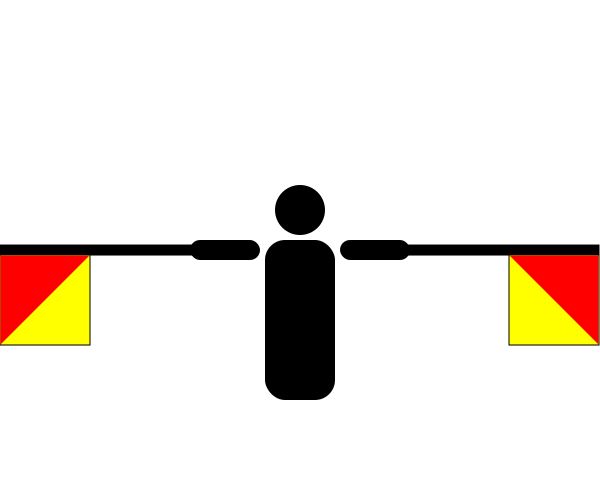
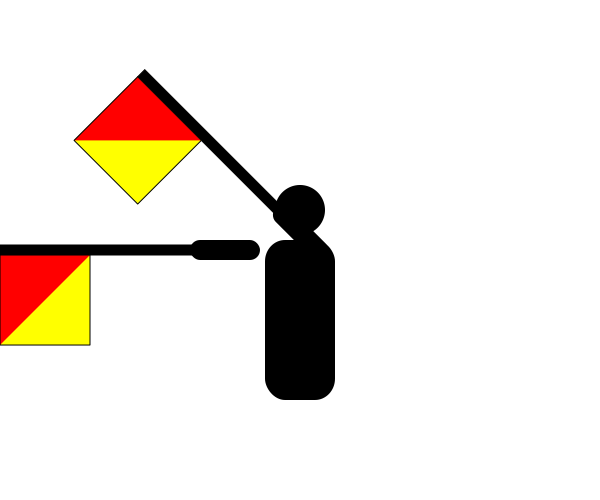
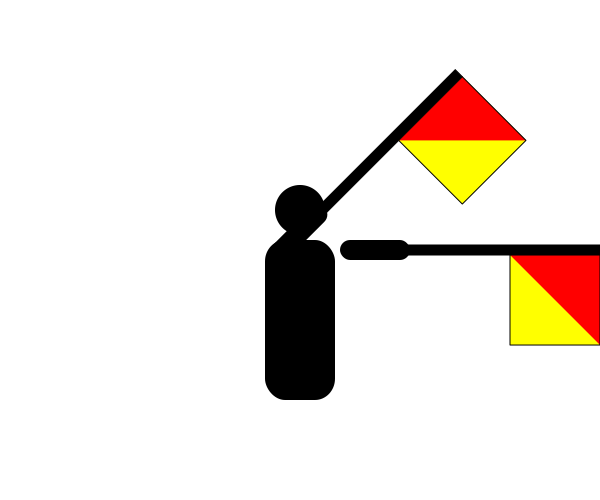
There are approximately 201 people named Murrow in the UK. That makes it one of Britain's least common surnames. Only around three in a million people in Britain are named Murrow.
Surname type: Location or geographical feature
Origin: English
Region of origin: British Isles
Country of origin: England
Religion of origin: Christian
Language of origin: English
