MATZ
Matz is a surname with origins in both German and Hebrew tradition. It is a patronymic name derived from the given name Matthias, which itself is a Germanised variant of the Hebrew name Matityahu, meaning gift of Yahweh or gift of God. Consequently, the surname may be interpreted as son of Matthias or descendant of Matthew.
The earliest documented use of the name in a patronymic sense appears in the 14th century, with records such as Heinrich Matthaus of Uberlingen, Germany, in 1382, and John Mathows of Whitby, England, in 1395. Earlier a form of the name appears in the 1260 Assize Rolls of Cambridge with Alan Mathew, situated in the reign of King Henry the First.
During the Middle Ages the name travelled extensively throughout Christendom. Its popularity, initially as a baptismal name, spread following the spread of the Christian cult of Saint Matthew and the influence of the Knights Templar. In the 1086 Domesday Book it is recorded in Latin as Matthaeus and in French as Mathieu.
Scholars note that the surname also appears in multiple orthographic variants across Europe. From the French Mathieu to the Polish Macieiczyk, there are more than two hundred and fifty recognised spellings. Common variants include Matz, Metze, Metz, Maetz, Mets, and several others that reflect local linguistic patterns.
The name is closely associated with several occupational groups in German history, including tin smiths, brewers and merchants. During the late Middle Ages many families bearing the name rose to prominence through trade and local commerce. The association with the bishopric of Limburg in the 11th century is one notable early reference to the family’s clerical and societal standing.
In modern times the surname persists predominantly in German‑speaking regions, especially in Germany, Austria and parts of Eastern Europe. It is also found in significant numbers in the United Kingdom, particularly in England, with smaller concentrations in Scotland and Wales. In North America, it is most common in the United States—especially within Pennsylvania, Ohio and New Jersey—and Canada, mainly in Ontario, Manitoba and Saskatchewan.
Within Israel the surname holds a respectable position, featuring among the fifty most common names, an outcome of migration patterns that span centuries.
The multiplicity of spellings reflects the name’s adaptation to various linguistic contexts. Examples include Matzg, Matzke, Mattz, Matze, Metzger and even Anglicised forms such as Matthis or Matthieus. Each variant retains the core patronymic principle of denoting descent from Matthaeus.
Due to the long-standing presence of the surname across several regions, genealogical research often benefits from a cross‑referenced approach that utilises both Germanic and Hebrew sources. The combination of historical documents, parish registers and immigration records provides a reliable framework for tracing lineage without resorting to speculation.
In sum, the surname Matz illustrates a rich tapestry of linguistic, religious and socio‑economic threads that intertwine Germanic and Hebrew heritage, yielding a name that has survived the ebb and flow of history across continents and centuries.
Similar and related surnames
Related and similar names are generated algorithmically based on the spelling, and may not necessarily share an etymology.
How to communicate the surname Matz in...
Braille
⠍⠁⠞⠵
Morse
--.----..
Semaphore
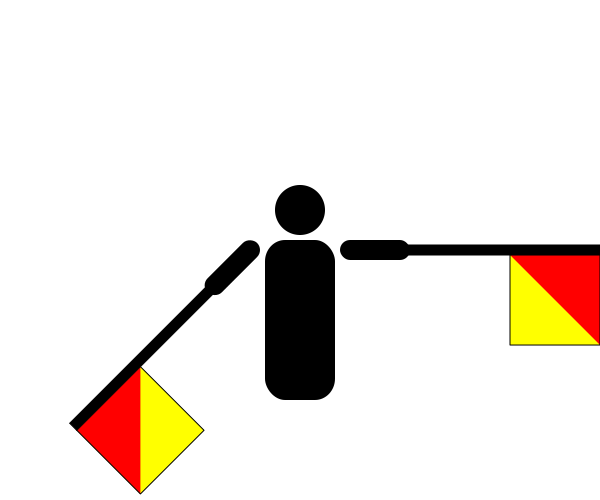

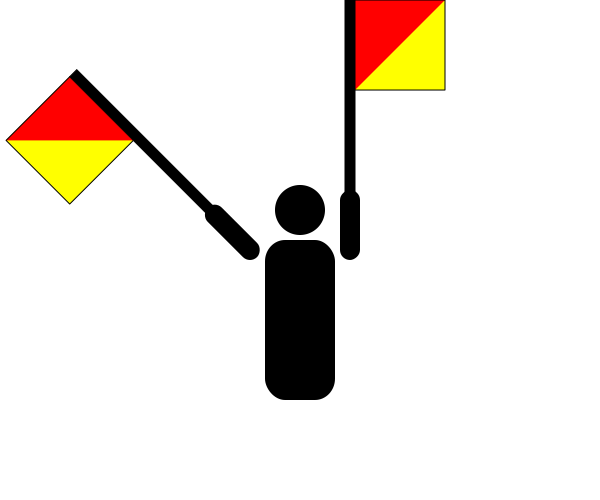

There are approximately 51 people named Matz in the UK. That makes it one of Britain's least common surnames. Only around one in a million people in Britain are named Matz.
Region of origin: Europe
Country of origin: Germany
Language of origin: German
