LINDSLEY
Lindsley is a surname of definite English provenance, the origin of which can be traced to the Old English personal name lind – meaning lime tree or linden tree – combined with the suffix -ley, a term for clearing or meadow. The composite meaning is thereby “clearing or meadow of the lime tree.” In the medieval period the formation of locational surnames was a common practice; hence the name likely first identified those who lived near or were associated with a place called Lindsley, or its earlier variants.
The earliest documentary evidence of the surname is found in a 1204 Dorsetshire Pipe Roll, where a person recorded as Thomas de Linleia appears. This spelling reflects the absence of the consonant d in early forms of the place name. Subsequent medieval records bear a range of orthographies – Linley, Linly, Lindley, Lindly, and the more dialectal Lindsley – attesting to the fluid nature of spelling before the advent of standardised English spelling.
Historical documents also record bearers of the name from distinct localities within England. For instance, a Robert de Linlye is documented in the Bedfordshire Hundred Rolls of 1273, while Arthur Lindleye of Yorkshire appears in an Oxford University register of 1594. In the seventeenth‑century Dormar Barritt’s Westward Journeys the name was observed in the North Midlands, suggesting a spread beyond the original settlement.
The locational variants of the name are tied to several villages named Lindley or Linley across the United Kingdom. Two villages in Yorkshire – one near Otley and another near Huddersfield – carry the modern spelling of Lindley, each derived from the Old English elements lind and leah. Earlier charters show these places as Line or Linley, with the consonant d appearing only from the fourteenth century onwards. In Shropshire and Wiltshire the names Linlee (in 1166) and Linleg (in 1225) are recorded; both are thought to signify “the clearing where flax was grown.”
Over time, regional dialects and clerical variation produced a spectrum of spelling variants, including Lindsly, Lindlee, Lindy, Lindsey, Lindsay and Lyndsey. The surname is occasionally considered a variant of Lindsay, a Scottish toponymic name that itself derives from the region of Lindsey in Lincolnshire, England. The place name Lindsey combines lind with eg, the Old English word for island, yielding the interpretation “island with linden trees” or “island in the lime tree forest.” Such linguistic proximity explains the phonetic and orthographic resemblance between Lindsley and Lindsay.
In the early modern era, the dispersal of the surname beyond Britain can be largely attributed to the migration of English families to the Americas during the colonial period. Consequently, many contemporary bearers of the name Lindsley reside within the United States, though the surname remains predominantly identified with its English root. Despite its moderate distribution, the name retains a distinct character, offering a linguistic link to the natural landscapes of medieval England.
Typical given names associated with the Lindsley surname
Male
- Andrew
- David
- Edward
- Ian
- James
- John
- Matthew
- Peter
- Richard
- Simon
- William
Female
- Alison
- Angela
- Edna
- Elizabeth
- Emma
- Gillian
- Gladys
- Karen
- Maureen
- Michelle
- Sarah
- Susan
- Sylvia
Similar and related surnames
Related and similar names are generated algorithmically based on the spelling, and may not necessarily share an etymology.
How to communicate the surname Lindsley in...
Braille
⠇⠊⠝⠙⠎⠇⠑⠽
Morse
.-....-.-......-...-.--
Semaphore

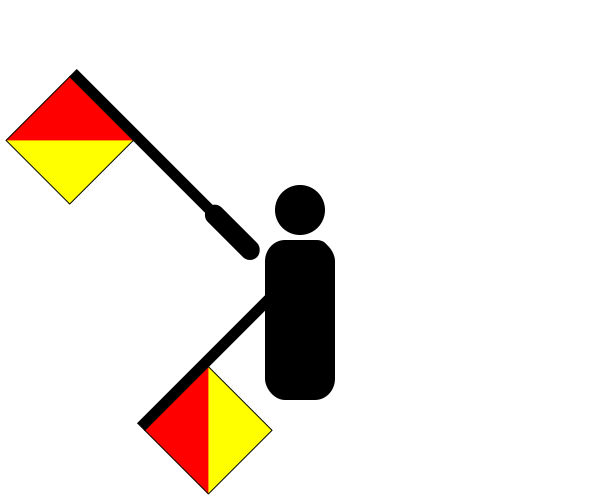
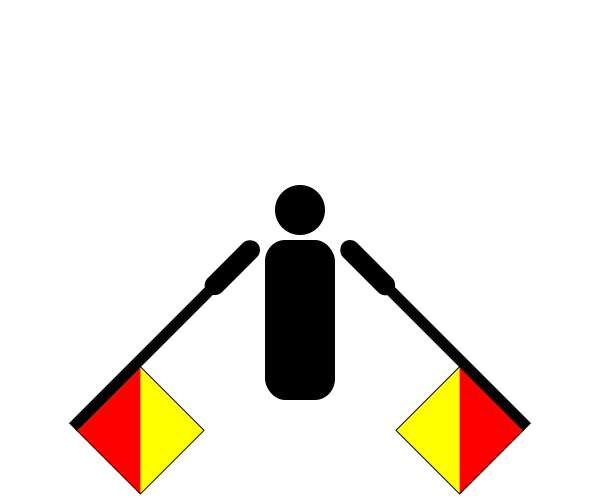


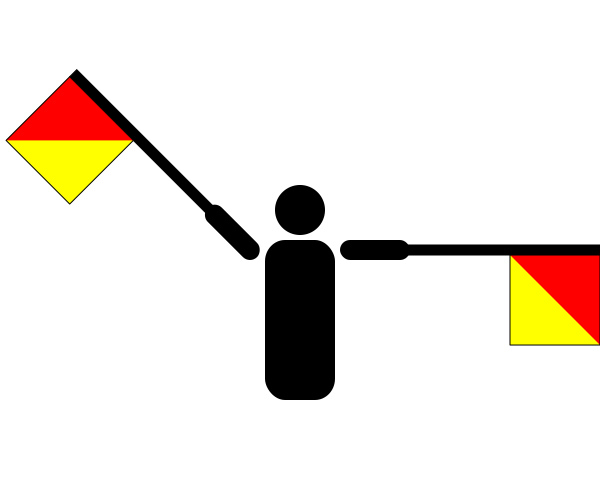
There are approximately 314 people named Lindsley in the UK. That makes it one of Britain's least common surnames. Only around five in a million people in Britain are named Lindsley.
Surname type: Location or geographical feature
Origin: English
Region of origin: British Isles
Country of origin: England
Religion of origin: Christian
Language of origin: English
