KERIN
Kerin is an Irish surname of Gaelic origin, rooted in the medieval lineages of the British Isles. It is traditionally associated with the ancient name Ó Ciaráin, which translates to “descendant of Ciarán”. The personal name Ciarán derives from the Irish word ciar, meaning “dark” or “black”, and was commonly applied to individuals with dark hair or complexion.
The surname has been recorded in a variety of spellings over the centuries, including O'Kieran, O'Kerin, O' Kerrane, Kerrane, Kerin, Kerins, and, in some instances, O'Ciardhubhain. These variants reflect regional dialects and the Anglicisation of Gaelic orthography. In the early modern period the name was particularly prominent in the barony of Costello, County Mayo, where a clan of this name exercised considerable influence.
Historical documents provide evidence of the name’s medieval spread. A branch of the Kerin clan settled in County Clare in the early 15th century, where they became known as O' Kerin, Kerin, and Kerins. The tomb of Teige O' Kerin, who died in 1685, is preserved in Ennis Abbey and offers a tangible link to that lineage. A further early record dates back to the year 1420, when Owen O'Kerin is noted in the annals of County Clare during the reign of King Henry Vth of England.
The surname reached the wider world in the 19th century, when the Great Famine prompted large-scale emigration from Ireland. Many Kerin families migrated to the United Kingdom and the United States, settling in the North East of America and the East of England. Subsequent waves of emigrants carried the name to Canada, Australia, New Zealand and South Africa, where it remains common in provinces such as Ontario, Nova Scotia and British Columbia.
Throughout its history, Kerin has been borne by individuals of note. Among them is Father Moses Kearns, who survived an attempted hanging in 1792 by a revolutionary mob in Paris and later became a leading figure in the 1798 rebellion in County Wexford, Ireland. The adaptive nature of the surname is also evident in its parallel evolution with similar Scottish names such as Kerrin or Kerwin, which share comparable etymological roots.
In contemporary times, the Kerin surname is still most frequent in Ireland’s western counties, particularly Mayo, Sligo, Donegal, Clare, Cork and Galway. Within the diaspora communities, concentrations remain strongest in the North Eastern United States, East England and the Canadian Atlantic provinces, reflecting the historical migration patterns that have shaped the modern distribution of the name.
Overall, the Kerin surname embodies a deep historical legacy that spans medieval Irish clan society, the turbulent periods of the 18th and 19th centuries, and the global dispersion of the Irish people. Its enduring presence across diverse regions attests to the resilience and continuity of the family’s genealogical heritage.
Typical given names associated with the Kerin surname
Male
- Andrew
- Christopher
- Colin
- Francis
- James
- John
- Martin
- Michael
- Patrick
- Peter
- Thomas
Female
- Amanda
- Anne
- Barbara
- Bridget
- Fiona
- Jane
- Jennifer
- Leta
- Lucy
- Margaret
- Mary
- Nuala
- Susan
- Tracey
- Winifred
Similar and related surnames
- Carns
- Currin
- Curren
- Cairnes
- Cairns
- Currans
- Corin
- Carin
- Carine
- Carrin
- Currane
- Curram
- Curin
- Curine
- Corine
- Currinn
- Krein
- Keri
- Karin
- Karina
- Karini
- Karrin
- Kearin
- Kearing
- Kearins
- Kerie
- Kerim
- Kering
- Kerins
- Kerioin
- Kernie
- Kerny
- Kerri
- Kerrian
- Kerrien
- Kerrin
- Kerring
- Kerrins
- Kerwin
- Kharina
- Kirin
- Korin
- Korine
- Kurin
- Corinne
- Keairns
- Kearnan
- Kearne
- Kearnes
- Kearnie
- Kearns
- Kearny
- Keirney
- Keirns
- Keran
- Kerinan
- Kerkin
- Kerlin
- Kermin
- Kern
- Kerne
- Kernes
- Kerney
- Kernin
- Kerrings
- Kertin
- Kervin
- Kharin
- Kieran
- Koring
- Caren
- Carnie
- Corn
- Craine
- Creane
- Crone
- Grain
- Greeno
- Karran
- Kearn
Related and similar names are generated algorithmically based on the spelling, and may not necessarily share an etymology.
How to communicate the surname Kerin in...
Braille
⠅⠑⠗⠊⠝
Morse
-.-..-...-.
Semaphore
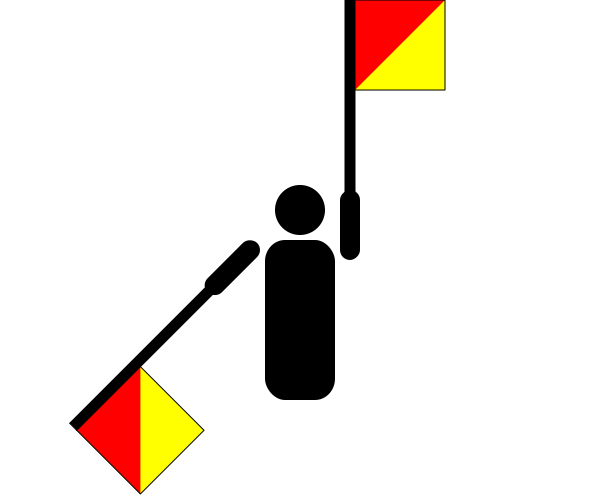

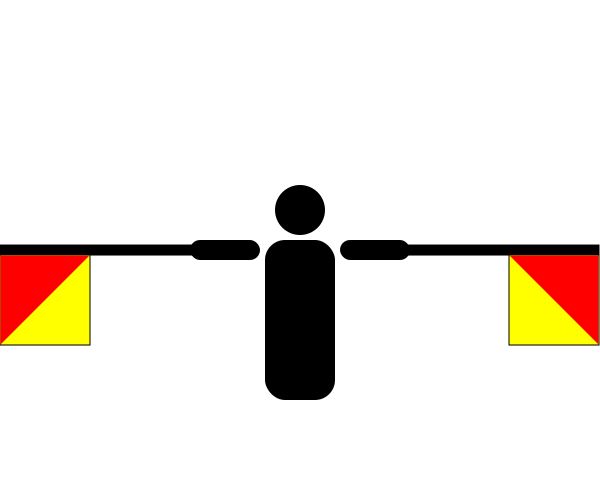
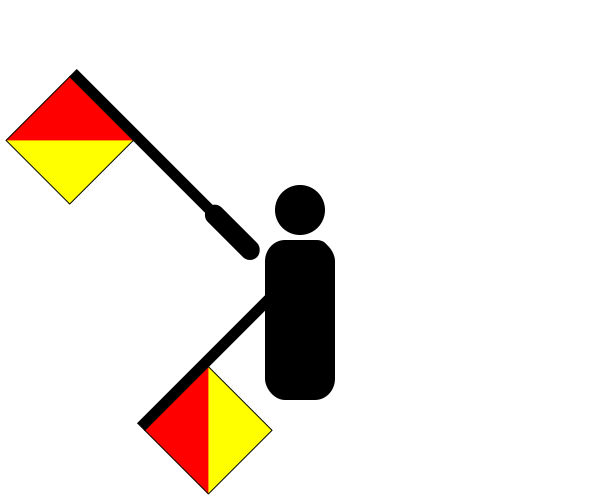
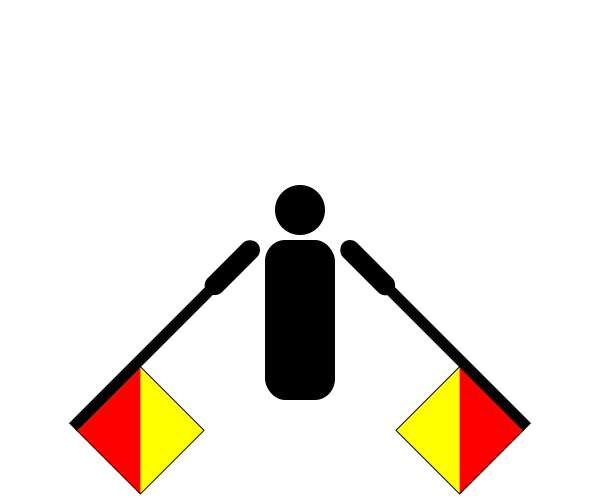
There are approximately 327 people named Kerin in the UK. That makes it one of Britain's least common surnames. Only around five in a million people in Britain are named Kerin.
Origin: Celtic
Region of origin: British Isles
Country of origin: Ireland
Religion of origin: Christian
Language of origin: Gaelic