KERINS
Kerins is an Irish surname of ancient Gaelic provenance. It descends from the patronymic Ó Ciaráin, which literally denotes “descendant of Ciarán”. The personal name Ciarán is a diminutive of the Irish word ciar, meaning “dark” or “black”, a descriptor that was often applied to individuals with dark hair or complexion.
In the early medieval period, a clan bearing the name Ó Ciaráin exercised dominion over the greater part of the present barony of Costello in County Mayo. Their influence extended into the neighbouring counties of Sligo and Donegal, where the name appears in the form Kerr. By the early fifteenth century a branch of the clan had settled in County Clare, where the surname evolved into the forms O’ Kerin, Kerin and Kerins. A tombstone for Teige O’ Kerin, who died in 1685, can still be found in Ennis Abbey.
The earliest documentary reference to the name dates to 1420, when a person named Owen O’Kerin is recorded in the archives of County Clare. This record was made during the reign of King Henry V, the victor of Agincourt (1413‑1422). A subsequent record from 1588 names Roger Kerins as a resident of what is now Donegal, indicating that the name had taken root within Connacht by the late sixteenth century.
During the 1600s, amid the plantations of Ulster, many bearers of the surname were compelled to emigrate. The dispersion of the name extended into the United Kingdom, the United States—particularly the Midwestern and New England states—and Canada. In contemporary times, Kerins remains most common in Ireland, with strong concentrations in County Mayo, County Clare, and the provinces of Connacht and Leinster.
The surname has undergone numerous orthographic variations, reflecting regional pronunciations and Anglicisation processes. Recorded spellings include O’Kieran, O’Kerin, O’ Kerrane, Kerrane, Kerin, Kearns, Kerran, Kerrens, and Kerrines, among others. The O’ prefix denotes direct descent from the original bearer of the name, while other prefixes such as Mac and Mc give rise to analogous surnames like MacCiaran and McCarrick.
Notable individuals bearing the surname include Father Moses Kearns, who in 1792 survived an attempted execution by a revolutionary mob in Paris and subsequently became a leader of the 1798 rebellion in County Wexford. Another prominent figure is Teige O’ Kerin, whose memorial at Ennis Abbey attests to the longevity of the family line in County Clare.
Analysing the linguistic elements of the name, the root ciar continues to carry connotations of darkness, while the diminutive suffix -án in Ciarán imparts a sense of familiarity or affection. Consequently, the meaning of Kerins has often been interpreted as “little dark one” or “son of the dark one”, a nickname that is believed to reflect either physical traits or a characterised steadfastness and determination.
The surname Kerins thus encapsulates a rich tapestry of cultural, linguistic, and historical threads. From its Gaelic origins and early medieval prominence in Ireland to its modern dispersion across the Atlantic, the name remains a testament to the enduring legacy of Irish heritage.
Typical given names associated with the Kerins surname
Male
- Andrew
- Anthony
- Gerard
- James
- John
- Michael
- Paul
- Peter
- Thomas
- Timothy
- Walter
Female
- Anne
- Bridget
- Catherine
- Claire
- Flor
- Joanne
- Lisa
- Margaret
- Mary
- Michelle
- Patricia
- Sarah
- Shirley
- Siobhan
- Suzanne
Similar and related surnames
- Karin
- Karnis
- Carins
- Currins
- Cairins
- Carrins
- Corrins
- Keirns
- Kerin
- Cairens
- Cairnes
- Cairness
- Cairnos
- Cairns
- Cairons
- Caranci
- Caranese
- Carans
- Caranza
- Caranzo
- Carence
- Carens
- Carenza
- Carenzi
- Carin
- Carinci
- Carinus
- Carnazza
- Carnes
- Carness
- Carnice
- Carnis
- Carnns
- Carns
- Carnzu
- Carones
- Carons
- Carrance
- Carrans
- Carranza
- Corans
- Corens
- Corin
- Cornes
- Corness
- Cornez
- Cornice
- Cornis
- Corns
- Coronas
- Coroneos
- Corones
- Coronis
- Corrance
- Corrans
- Corrons
- Courns
- Crance
- Cranes
- Cranies
- Cranis
- Cranness
- Crannis
- Crans
- Cranz
- Crince
- Crines
- Cronce
- Crones
- Cronnis
- Crownes
- Crowns
- Crrainse
- Curin
- Curnes
- Curness
- Curns
- Currance
- Currans
- Currence
- Currens
- Gairns
- Garnes
- Garness
- Garneys
- Garnis
- Garniss
- Garns
- Garnys
- Garrens
- Gorence
- Gorines
- Graines
- Grains
- Grance
- Granes
- Granese
- Granis
- Grannis
- Grans
- Greanes
- Greenace
- Greenes
- Greeness
- Greens
- Greenus
- Grenz
- Grince
- Grines
- Grinis
- Grinius
- Grinnes
- Grins
- Grones
- Gronies
- Gronous
- Growns
- Gruenes
- Grunes
- Grunis
- Gruniss
- Grunza
- Guerins
- Guirinnys
- Kairinos
- Kairnes
- Kairns
- Karanasiou
- Karans
- Karenzi
- Karina
- Karini
- Karnas
- Karnes
- Karns
- Karonias
- Karonis
- Karrin
- Keairns
- Kearin
- Kearing
- Kearins
- Kearnes
- Kearns
- Kearons
- Keirans
- Keorns
- Kerans
- Kerens
- Keri
- Kerie
- Kering
- Kernes
- Kerneys
- Kernie
- Kerns
- Kerri
- Kerrin
- Kerring
- Kerrings
- Kerrins
- Kerris
- Kerwin
- Kerys
- Kharin
- Kierans
- Kierns
- Kirin
- Kirnes
- Kirns
- Korin
- Korine
- Koring
- Kornas
- Kornis
- Koroneos
- Koronias
- Koronis
- Kragnes
- Kraines
- Krainz
- Kranias
- Kranios
- Krans
- Kranse
- Kranss
- Kranz
- Kraunsoe
- Krence
- Krens
- Krenz
- Kriens
- Krones
- Krons
- Kurin
- Kurnaz
- Quearns
- Querns
Related and similar names are generated algorithmically based on the spelling, and may not necessarily share an etymology.
How to communicate the surname Kerins in...
Braille
⠅⠑⠗⠊⠝⠎
Morse
-.-..-...-....
Semaphore
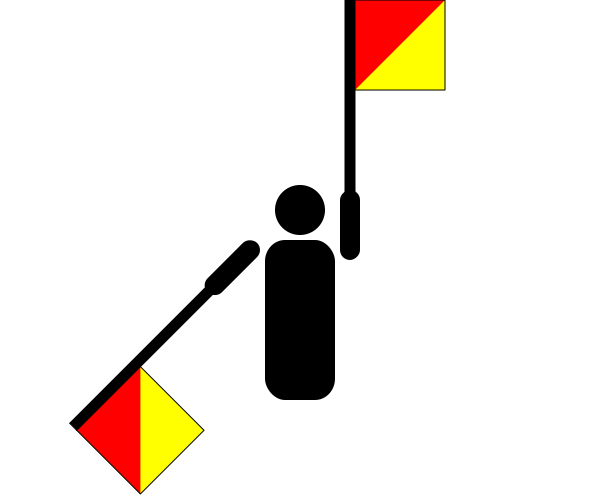

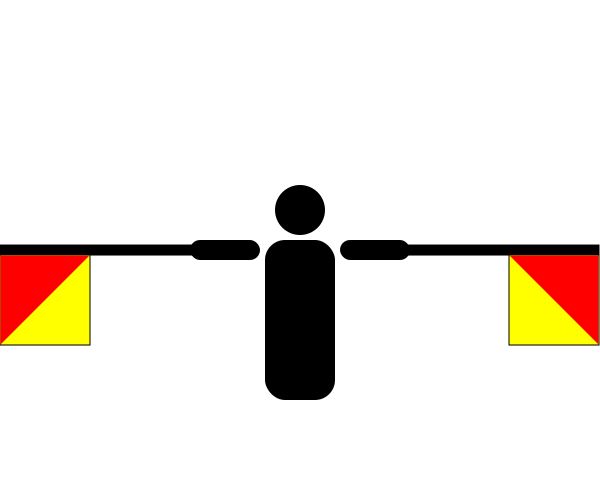
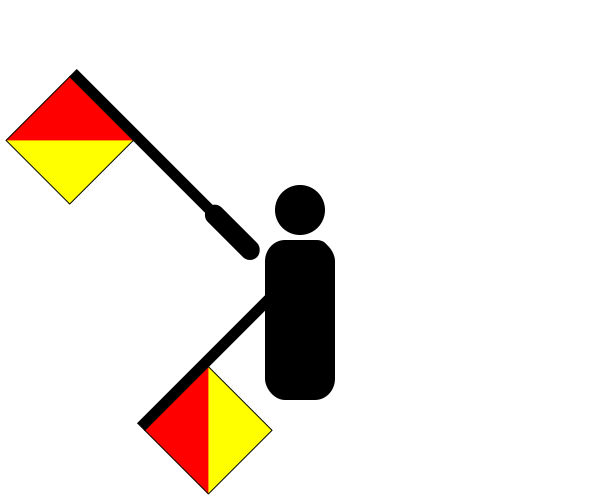
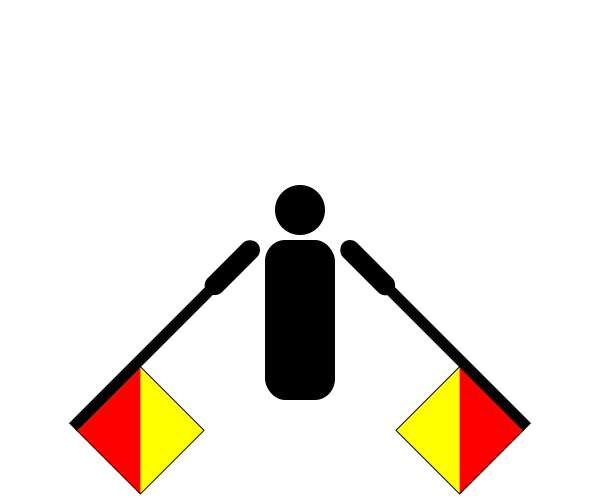

There are approximately 412 people named Kerins in the UK. That makes it one of Britain's least common surnames. Only around six in a million people in Britain are named Kerins.
Origin: Celtic
Region of origin: British Isles
Country of origin: Ireland
Religion of origin: Christian
Language of origin: Gaelic