KEES
The surname Kees is a family name that appears in several European cultures, notably the Netherlands, Germany, and to a lesser extent in the United Kingdom and North America. It is recorded in a variety of spellings and has been attributed to a number of independent linguistic origins, reflecting the diversity of medieval naming practices.
In the Dutch tradition Kees is a patronymic name derived from the given name Cornelis, the Dutch form of the Latin Cornelius. The personal name itself originates from the Latin word cornu meaning “horn.” Thus, when the surname was adopted it signified “son of Cornelis” or “descendant of Cornelis.” This patronymic usage is consistent with the way many Dutch surnames were formed in the Middle Ages, where a father's given name was affixed to the child’s own name in order to create an identifier that could be passed down through generations.
An entirely separate lineage of the surname, recorded primarily in medieval England, is an occupational identification linked to the production of cheese. Variants such as Cheeseman, Chesman, Chisman, and Chismon were used in the 12th and 13th centuries, with early examples including Arnold Chesere of Basel in 1246 and William Le Chesman of Cambridge in 1260. These forms are derived from the Old English cese (cheese), itself borrowed from the Latin caseus. The suffix -man or -mann indicated a person employed in the cheese‑making trade, or a person connected to a master cheesemaker. The first recorded spelling of the wider name appears as Baldwin Le Chesemangere in the Pipe Rolls of 1189 during the reign of King Richard I.
Other Germanic and Low German sources attribute the name to a personal name such as Kasimir, meaning “peacemaker.” In some dialects the word kelso, translating as “comb” or “lock of hair,” gave rise to an occupational surname for a barber or hairdresser, particularly in regions of present‑day Netherlands and Germany. Additionally, an old Dutch word meaning “bold” or “brave” has been cited as a possible descriptive origin for the surname in the Netherlands, with the name documented in 1517 in Schleswig-Holstein and in the northern provinces of Gelderland and Utrecht.
Geographically, the surname is most common in the Netherlands, where it is frequently found in the northern provinces but has spread to the south and east over recent centuries. In Germany it occurs in Lower Saxony, North Rhine‑Westphalia and Schleswig‑Holstein. In the United Kingdom the name is relatively rare, with a small presence noted in Dunfermline, Scotland, and in parts of Wales. The distribution in the United States is largely the result of Dutch and German emigration during the 17th and 18th centuries, and the name still appears in communities with substantial Dutch heritage.
According to genealogical records, the surname has acquired many variants that are orthographically related. These include Kes, Keesan, Keas, Keus, Keese, Keasch, Kess, Keesh, Kuss, Keys, Keesman, Keesey and Keeseck. In some countries the spelling Kés is seen, and the name is occasionally transcribed as Kaes, Kaeg, Case or Queisser during immigration processes. Each variation reflects local linguistic preferences and orthographic standards, yet all are historically connected to the original name forms documented in medieval records.
Typical given names associated with the Kees surname
Male
Female
Similar and related surnames
Related and similar names are generated algorithmically based on the spelling, and may not necessarily share an etymology.
How to communicate the surname Kees in...
Braille
⠅⠑⠑⠎
Morse
-.-.....
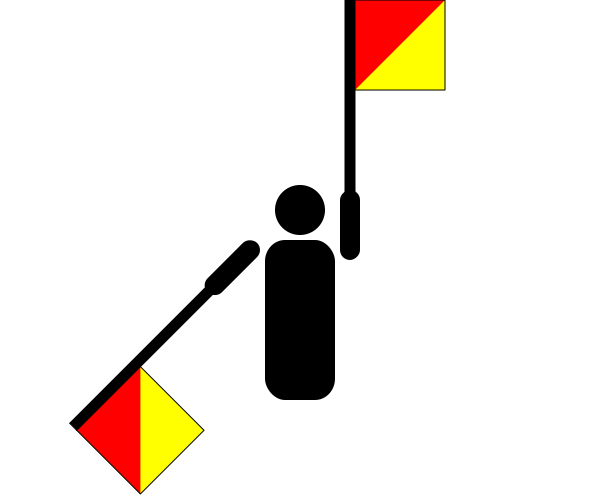
Semaphore


There are approximately 27 people named Kees in the UK. That makes it one of Britain's least common surnames. Fewer than one in a million people in Britain are named Kees.
