JAN
Jan is a surname with roots in several linguistic and cultural traditions, notably Hebrew, Polish and Ukrainian. It descends from the given name Jan, the European equivalent of the English John, and is traditionally a patronymic surname, meaning it originally signified the descendants of an ancestor bearing that name.
The name Jan traces back to the Hebrew personal name Yochanan, a form meaning “God is gracious”. Consequently the surname inherits a meaning that reflects divine favour or grace bestowed upon the family line.
Documentary evidence for the surname dates from the twelfth century. It is recorded in medieval English charters, for example as Thomas John in 1279 and Arnold Johan in 1280. German records list Walterus filius Johannis in 1323 and Baumeister Johannssen in 1344. The earliest known spelling is Pertus Johannis dated 1230 in the Suffolk “Close Rolls”.
Across Europe, the surname has many orthographic variants. These include forms such as Jon and John in England and Wales, Evan in Wales, Ian in Scotland, Shane in Ireland, Ivan in Russia, Jean in France, Giovanni in Italy, Zanni and Zoane in Italy, Janus in Poland, Jan in the Czech Republic, Janak and Jansky in the Czech lands, and diminutives such as Jenkin, Jeannet, Nannini, Zanicchi and Gianuzzi. Patronymic derivatives include Johnson, Joynson, Jenson, Jocie, Ivanshintsev and Ivashechkin.
In contemporary times the surname is common in Czech and Polish societies and has spread widely to the Americas. In North America it is borne by approximately 250,000 individuals in the United States and Canada; in the United States it ranks as the seventy‑third most common surname, with around 16,000 bearers. The name is also found in Australia, New Zealand and South Africa.
Current demographic data show high concentrations of the surname in eastern and southeastern European countries, especially Poland, the Netherlands, Belgium, Croatia, Slovenia and the Czech Republic. It also appears in East Asian countries such as China and South Korea, and in both North and South America, notably in the United States where it is most prevalent in states on the east coast such as New York, New Jersey and Pennsylvania, and least common in the western states.
The surname has undergone numerous linguistic transformations as it entered different languages. Latin inherited the form Johannes from which most European variants evolved. In Greek it is rendered as Yannis, in Germanic languages as Johann or Hans, and in French as Jean. In some South Asian contexts, a form Jaan is used, and in the United States the name is occasionally spelled John due to Americanisation of surnames.
Overall, the surname Jan demonstrates a remarkable breadth of geographic distribution and linguistic adaptation while retaining a core meaning that reflects divine benevolence and grace, a heritage that has followed its bearers from medieval Europe to the modern world.
Typical given names associated with the Jan surname
Male
- Afsar
- Akbar
- Akhtar
- Ali
- Amir
- Anwar
- Fazal
- Ibrahim
- Karam
- Mohammad
- Mohammed
- Sarwar
Female
- Begum
- Bibi
- Gul
- Majella
- Muniza
- Neelofarnaz
- Noor
- Parveen
- Rahmat
- Rehmat
- Resham
- Saima
- Samina
- Sayeda
- Zeenat
Similar and related surnames
- Gean
- Jana
- Jahn
- Jain
- Jagne
- Jaehne
- Jahns
- Jahnz
- Janas
- Ja
- Jaan
- Jaine
- Janah
- Jains
- Jainz
- Jane
- Jani
- Jano
- Janc
- Jand
- Janes
- Janey
- Jang
- Jania
- Janie
- Janio
- Jank
- Jann
- Janna
- Janne
- Jannes
- Janni
- Jannie
- Jannoo
- Janns
- Jannu
- Janny
- Janoo
- Janow
- Jans
- Jant
- Janu
- Jany
- Janz
- Jayna
- Jayne
- Jean
- Jeane
- Jeanne
- Jeans
- Jehn
- Jein
- Jenne
- Jagnes
- Jaina
- Jaines
- Jaini
- Janau
- Jance
- Jancz
- Jandt
- Janed
- Janeh
- Janew
- Jangi
- Janha
- Janis
- Janke
- Janks
- Jannah
- Janney
- Janos
- Janse
- Jansz
- Jantz
- Janus
- Jaynes
- Jeanes
- Jeannes
- Jena
- Jeni
- Jeno
- Geen
- Ginn
- John
Related and similar names are generated algorithmically based on the spelling, and may not necessarily share an etymology.
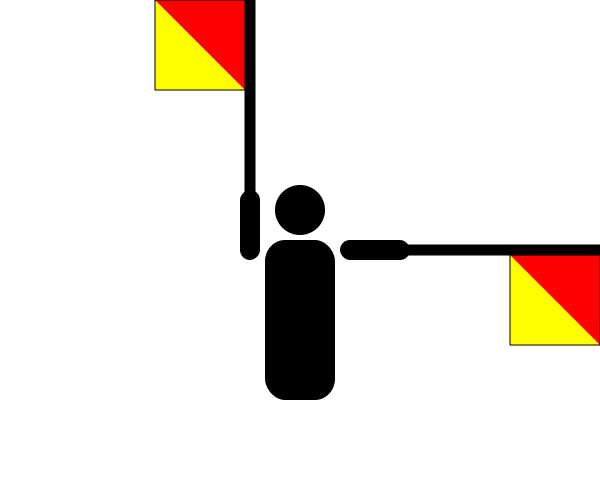
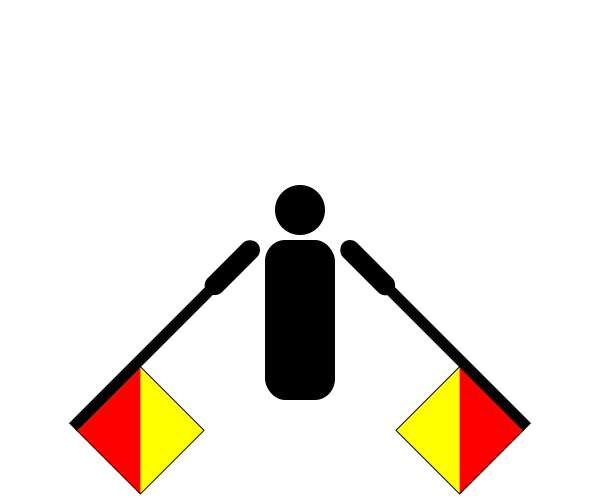
How to communicate the surname Jan in...
Braille
⠚⠁⠝
Morse
.---.--.
Semaphore

There are approximately 4,946 people named Jan in the UK. That makes it roughly the 1,904th most common surname in Britain. Around 76 in a million people in Britain are named Jan.
Surname type: From given name or forename
Religion of origin: Muslim
