GINN
Ginn is a surname that bears traceable origins across the British Isles, with cognates in English, Gaelic and Welsh traditions. The name may derive from the Old English personal name Gyning, meaning 'son of Gyne', or from the Gaelic Guinne associated with the attribute 'fair' or 'white'. A further variant, Gwynn, is of Welsh provenance and similarly means 'white' or 'blessed'. Consequently, the precise lexical content of the surname occurs as a function of its historical background and geographic context.
The earliest documented variant of the name appears in the early medieval period of England, in records dated to the late twelfth century. The reference to a Roger Gin in the Feet of Fines of Staffordshire in 1221 and to a Walter Gynn in the Subsidy Rolls of Worcestershire in 1275 illustrate the name’s early use. Its first appearance in the official record is recorded as Henry Gin in the Pipe Rolls of Norfolk in 1191, during the reign of King Richard I. The name also surfaces in a 1557 baptismal entry for a George Gynne in London and a 1691 christening of Elizabeth Ginn at St. Anne's, Soho, London.
One interpretation of the surname connects it with the Middle English word gin, ginne, derived from the Old French engin, meaning skill or ingenuity; the term later evolved to denote a snare or trap. According to this view, the surname could have been a metonymic occupational label for a trapper, or a nickname highlighting an individual’s cleverness or specific skill. Thus, the meaning of Ginn remains contingent on the historical occasion in which the name was adopted.
Geographically, the name has a long association with Yorkshire, where it was recorded as an ancient Anglo‑Saxon family holding estates from the sixteenth century onward. The surname is also noted in Lancashire, Devon, Sussex and Oxfordshire in England, and spreads through the central lowlands of Scotland. Evidence suggests that the name travelled across the British Isles alongside Norse incursions, leaving significant concentrations in the North of England and the Farnworth area of Lancashire.
Variations of the surname include Gynn, Ginne, Ginnear, Gynne, Genn, Gineen and Gsennett. In Ireland, an unrelated surname, Ó Giofáin, has occasionally been anglicised as Ginn, the original meaning being 'double‑paw'. The multiplicity of spellings is largely attributable to the widespread use of the name across distinct linguistic and regional traditions.
The family of Gynn in Hertfordshire was granted a coat of arms depicting a gold griffin segreant on an ermine indented chief, with three pellets. This heraldic description provides a visual cue to the social status and identity of the family at a later period.
Across centuries, the surname Ginn has exemplified a lineage that intertwines occupational identity, personal attributes, and regional heritage. Its retention and adaptation within a variety of cultural contexts reflect the fluid nature of surnames in the tapestry of British history.
Typical given names associated with the Ginn surname
Male
- Andrew
- Anthony
- Christopher
- David
- Michael
- Paul
- Peter
- Richard
- Robert
- Stephen
- William
Female
- Alison
- Angela
- Elizabeth
- Emma
- Georgette
- Jacqueline
- Karen
- Lisa
- Margaret
- Rebecca
- Sarah
- Susan
- Vanessa
Similar and related surnames
- Gean
- Geana
- Geen
- Geene
- Gen
- Gena
- Gene
- Geneau
- Genee
- Genie
- Genn
- Genna
- Genne
- Gennie
- Gennoe
- Geno
- Genoe
- Genua
- Geoynne
- Geuna
- Gian
- Giana
- Giani
- Giann
- Gianna
- Gianni
- Giano
- Giauna
- Gien
- Gin
- Gina
- Ginai
- Gind
- Gine
- Gines
- Ging
- Gingh
- Gini
- Ginnaw
- Ginne
- Ginnes
- Ginney
- Ginnis
- Ginno
- Ginns
- Ginny
- Gino
- Gins
- Giny
- Ginz
- Gioanni
- Gion
- Giona
- Gioni
- Giugni
- Giugno
- Giunn
- Gygn
- Gyne
- Gynn
- Gynne
- Gywn
- Gywnne
- Jaan
- Jaehne
- Jaen
- Jagne
- Jahn
- Jain
- Jaina
- Jaine
- Jaini
- Jan
- Jana
- Janau
- Jane
- Jani
- Jania
- Janie
- Janio
- Jann
- Janna
- Janne
- Janni
- Jannie
- Jannoo
- Jannu
- Jano
- Janoo
- Janu
- Jaouane
- Jaouen
- Jaun
- Jaunoo
- Jayna
- Jayne
- Jean
- Jeane
- Jeanne
- Jeanneau
- Jeen
- Jeena
- Jehn
- Jein
- Jen
- Jena
- Jenei
- Jeni
- Jenn
- Jenna
- Jenne
- Jenni
- Jennie
- Jenno
- Jeno
- Jeon
- Jeune
- Jian
- Jianu
- Jin
- Jina
- Jine
- Jinn
- Jinna
- Jinnes
- Jinno
- Jinns
- Jino
- Jinu
- Jn
- Joan
- Joane
- Joann
- Joanna
- Joanne
- Joannou
- Joen
- Joenn
- John
- Johna
- Johne
- Johnie
- Johnn
- Johnnie
- Joian
- Join
- Joine
- Jon
- Jona
- Jone
- Joni
- Jonn
- Jonna
- Joon
- Jouan
- Jouanne
- Jouanneau
- Jouanno
- Jouen
- Jouenne
- Jouini
- Joun
- Jouni
- Joyne
- Juan
- Juen
- Jueno
- Juhno
- Juin
- Jun
- Juna
- June
- Juneau
- Juni
- Junia
- Junie
- Junio
- Junn
- Junni
- Juno
- Juon
Related and similar names are generated algorithmically based on the spelling, and may not necessarily share an etymology.
How to communicate the surname Ginn in...
Braille
⠛⠊⠝⠝
Morse
--...-.-.
Semaphore

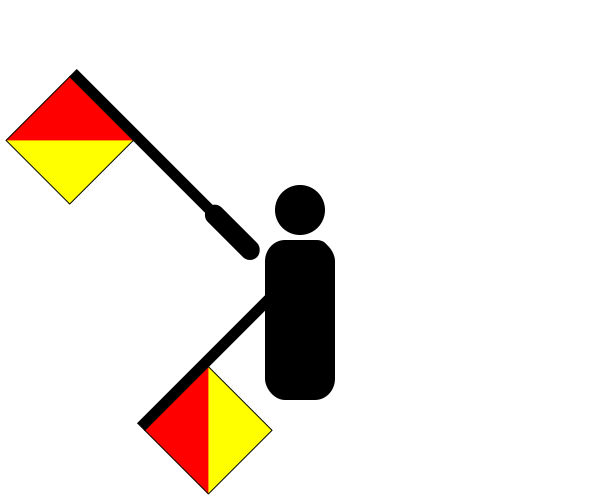
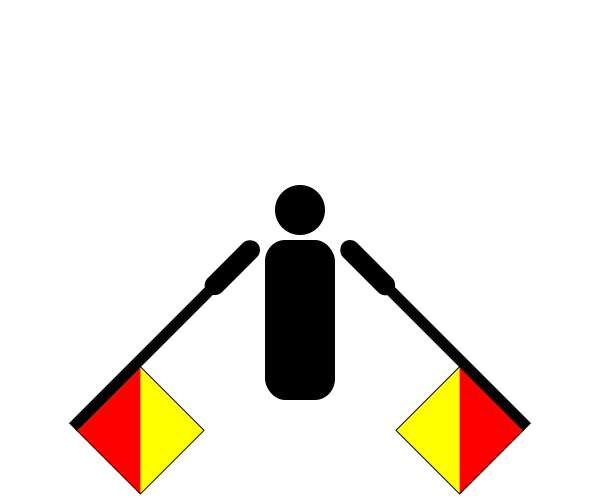
There are approximately 1,579 people named Ginn in the UK. That makes it roughly the 5,133rd most common surname in Britain. Around 24 in a million people in Britain are named Ginn.
Origin: English
Region of origin: British Isles
Country of origin: England
Religion of origin: Christian
Language of origin: English
