JANS
The surname Jans is a patronymic family name that originates from the given name Jan, the Dutch and Scandinavian form of John. It denotes “son of Jan” or a descendant of a man named Jan.
The personal name Jan itself is derived from the Hebrew Yochanan, meaning “Yahweh is gracious”. As such the surname Jans inherits a meaning that can be interpreted as “the son of the gracious one”, a sense that echoes the biblical origin of the root name.
In the Netherlands the name has been recorded as early as the year 1201, and it rankeds as the forty‑fifth most common surname in that country. The earliest academic footnote in the Middle Ages refers to a figure named Simon Ians in the “Ministers Accounts of the Earldom of Cornwall” dated 1297, which demonstrates that the name was used in England by the late thirteenth century.
By the sixteenth century the name appears in several parish registers in Devon and Cornwall. Examples include the christening of Anne Jane in 1563 at Little Hampston and that of Adrianus Jane in 1577 at Wolborough and Newton Abbott. These early records confirm that the name had taken root in southwestern England following its introduction by the Crusaders in the twelfth century.
In the Germanic region the spelling and pronunciation of the name have evolved to produce numerous variants such as Jansz, Jansen, Janssen, Jansma and Jansman. The version Janz reflects an earlier form of the Dutch language, while Janssen is a common spelling in the Netherlands and Belgium. The French‑speaking parts of Belgium use a similar form, whereas in Germany the name appears in villages such as Zwillbrock and Jansau.
Scandinavian forms of the surname are more aligned with the suffix -son, giving rise to Jansson in Sweden and Jansen in Norway. These adaptations retain the patronymic tradition while reflecting the linguistic patterns of each country.
In British usage the surname is less common than in the Netherlands, but it can be found in approximately twenty‑eight thousand families, ranking around twenty‑eighth in frequency nationwide. In Belgium the name is the two‑hundred‑thirty‑fourth most frequent surname, whereas in Germany it remains a relatively rare occurrence, noted mainly in certain rural localities.
The name has also travelled beyond Europe, with occurrences reported in the United States and other parts of the world. Within these diaspora communities the surname often appears unaltered, preserving its link to both Dutch and Hebrew cultural heritage.
Variants of the surname extend into many language families. In Italian it becomes Giansen or Gianzini, in Spanish it is rendered as Jáñez, in Polish as Janeczka or Jankowski, and in Czech it is found as Zánszky or Jančárek. Each of these forms arises from the common ancestry of the name Jan and retains the original patronymic sense.
Overall the surname Jans remains one of the oldest and most widespread family names in Europe, particularly in the Netherlands, the United Kingdom, Germany, Belgium, France and Scandinavia. Its distribution, historical records, and linguistic variations illustrate a rich tapestry of cultural and genealogical significance, all grounded in the biblical notion that “God is gracious.”
Similar and related surnames
Related and similar names are generated algorithmically based on the spelling, and may not necessarily share an etymology.
How to communicate the surname Jans in...
Braille
⠚⠁⠝⠎
Morse
.---.--....
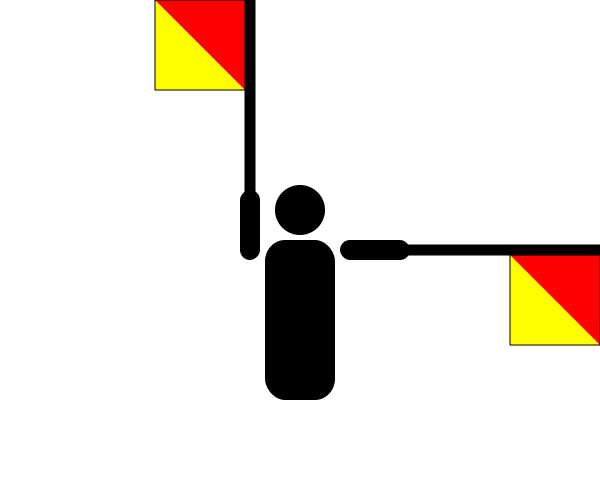
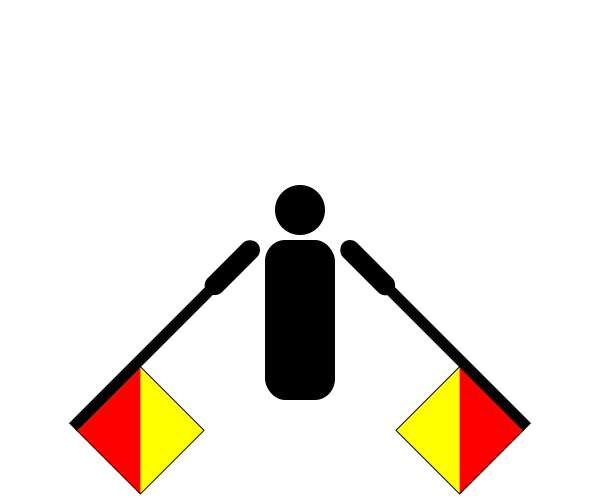
Semaphore


There are approximately 63 people named Jans in the UK. That makes it one of Britain's least common surnames. Only around one in a million people in Britain are named Jans.
