GILLIATT
Gilliatt is an uncommon surname of predominantly English provenance, whose early forms appear in legal and ecclesiastical records dating back to the mid‑thirteenth century. The name is frequently recorded in a variety of spellings—Gillard, Gilliard, Gillatt, Gilliatt, Gillyatt, Gillott, Gillyett, Gilyott, Jillett, Jellett, and others—reflecting the fluid orthographic practices of the period.
The most widely accepted derivation identifies Gilliatt as a patronymic diminutive of the personal name Gilliot or Gillot, which itself is a shortened form of Giles. The name Giles is ultimately derived from the Greek Aegidius, meaning “shield‑bearer” or “protector.” Consequently, the surname can be interpreted as “the son of Gilliot” or “the son of Giles,” a convention common in medieval England for indicating lineage.
Alternative historical analyses propose that the surname hails from Old French roots. One theory links it to the French word guille, meaning “crafty” or “wily,” combined with a diminutive suffix, thereby creating a nickname for a person of cunning. Another hypothesis contends that Gilliatt evolved from the Anglo‑Norman French personal name Guillot, a diminutive of Guillaume (the French equivalent of William). These interpretations are supported by the appellation of a place in the Channel Islands—La Villiau Guillot—and by medieval records that document individuals bearing the surname in both Yorkshire and London during the fourteenth century.
Furthermore, some scholars have examined Old Norse influences, noting that a personal name Gilliat could combine the elements gísl (meaning “hostage” or “pledge”) and hvatr (meaning “brave” or “daring”). Under this model, the surname would carry the sense of a “daring pledge.” Such a proposition finds its earliest records in Lincolnshire, dated to the decades following the Norman Conquest of 1066, and accounts for the occasional appearance of the name in former British colonies such as Australia, Canada, and the United States.
From an Anglo‑Saxon perspective, Gilliatt has been viewed as a toponymic appellation for a person dwelling near a gylde, an Old English term for a guild‑hall. Variants such as Gilliat, Gillott, and Gillett illustrate the linguistic diversity that characterises medieval English onomastics. Families bearing the surname were recorded in the Assize Rolls of Durham in 1243 (John Gilot) and in other juristic documents through the fifteenth century.
In modern times, bearers of the surname remain relatively rare, with notable figures including the nineteenth‑century engineer and inventor Sir William Gilliatt. The surname continues to be principally associated with the United Kingdom, though instances can be found in Commonwealth nations.
Overall, the origins of Gilliatt exemplify the complex interweaving of Germanic, Latin, Greek, and French linguistic influences that shaped English surnames after the Norman Conquest. While variations in spelling and differing scholarly interpretations exist, the prevailing consensus recognises the name as a diminutive patronymic rooted in the personal name Giles and its Greek antecedent Aegidius.
Typical given names associated with the Gilliatt surname
Male
- Alan
- Darren
- David
- Grant
- James
- John
- Mark
- Michael
- Paul
- Richard
- Stephen
Female
- Adele
- Elizabeth
- Heather
- Julia
- Laura
- Louise
- Margaret
- Mary
- Pamela
- Sarah
- Wendy
Similar and related surnames
Related and similar names are generated algorithmically based on the spelling, and may not necessarily share an etymology.
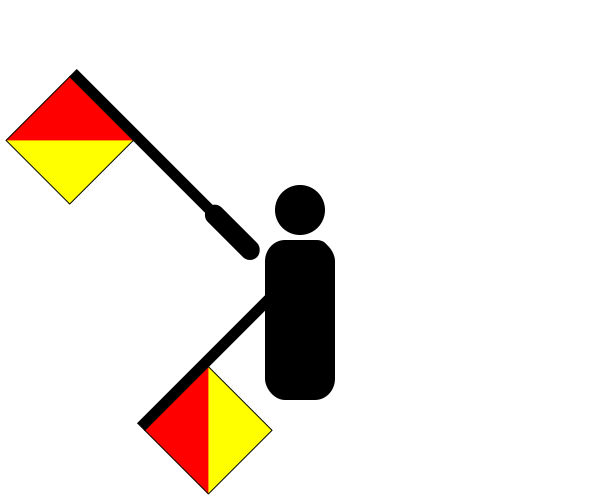
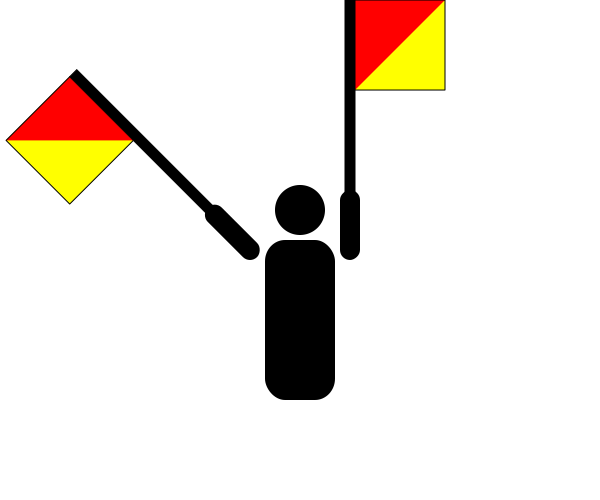
How to communicate the surname Gilliatt in...
Braille
⠛⠊⠇⠇⠊⠁⠞⠞
Morse
--....-...-.....---
Semaphore



There are approximately 326 people named Gilliatt in the UK. That makes it one of Britain's least common surnames. Only around five in a million people in Britain are named Gilliatt.
