GILLET
The surname Gillet is traditionally recognised as having its roots in France, where it evolved from the personal name Gilles, the French counterpart of the English name Giles. The name Giles itself is derived from the Greek Aegidius, a word meaning “shield” or “protection.” Consequently, the bearing of the surname Gillet historically signified a patrilineal connection with an ancestor named Gilles or Giles, the diminutive suffix -et in French often denoting a junior or younger relative.
In the years following the Norman Conquest of 1066, the name Gilles and its diminutive forms were introduced into the English linguistic landscape. The earliest recorded instance of the name appears in the Assize Rolls of Yorkshire in 1260, where a witness named Peter Gyllot is mentioned. Over the centuries, various orthographic variants emerged, including Gillatt, Gillyatt, Gilliatt, Gillyett, Gilyot, Jillett and Jellett, reflecting regional pronunciations and writing practices.
Although predominantly associated with France, particularly the Burgundy region, the surname has also spread to England and Ireland through migration and cultural interchange. In England, it is found among Christian families in the British Isles, while in Ireland, it appears occasionally as a result of French settlement. The name’s usage in Ireland is less frequent and often linked to a small set of localised families.
Geographically, the name’s density in contemporary times is markedly higher in the United States, especially in the state of Maine, a fact documented by the genealogical database Forebears. However, the surname remains comparatively uncommon within France itself. Variants such as Gillett, Gillette, Gilot, Gilet, Gilliot, Gilliott, Gillatt and Gillut are found across French-speaking regions and wherever French emigrants have settled.
The cultural significance of the surname is partly linked to the veneration of St. Giles, the hermit patron saint of cripples and beggars in the Middle Ages. His fame contributed to the popularity of the name Gilles and, by extension, its diminutive $bGillet$. The association with pious devotion adds a layer of historical depth to the name’s usage across Europe.
From an etymological standpoint, the Greek root Aegidius has been characterised as meaning “goatskin bearer” or “shield of goatskin,” a reference to the presence of a goat-skin in certain early Christian monastic contexts. As the name transitioned from Latin to French and then to English, the original meaning blended with the common practice of employing diminutives to indicate lineage or youth.
Rooted in a rich linguistic heritage, the surname Gillet encapsulates a narrative that spans ancient Greek etymology, Norman influence on the British Isles, and diverse orthographic evolutions that reflect the varied history of migration and cultural assimilation.
Typical given names associated with the Gillet surname
Male
- Alan
- Christopher
- Gareth
- Jack
- James
- John
- Luc
- Matthew
- Michael
- Peter
- Philip
- Richard
- Thierry
- Thomas
- Vincent
Female
- Alice
- Amanda
- Angela
- Frances
- Gemma
- Helen
- Jean
- Louise
- Marion
- Myriam
- Pascale
- Sandra
- Wendy
- Zoe
Similar and related surnames
Related and similar names are generated algorithmically based on the spelling, and may not necessarily share an etymology.
How to communicate the surname Gillet in...
Braille
⠛⠊⠇⠇⠑⠞
Morse
--....-...-...-
Semaphore

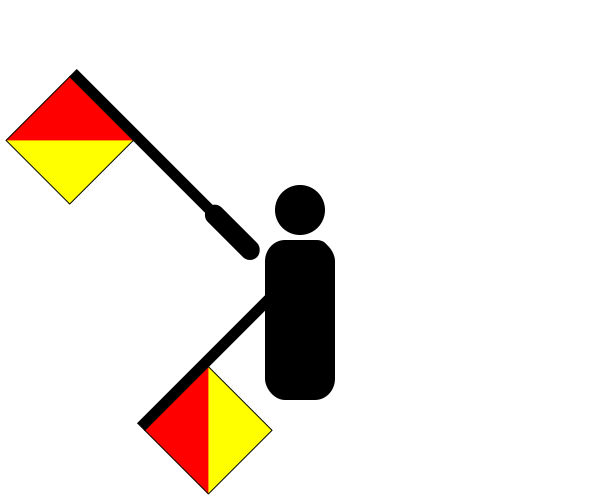


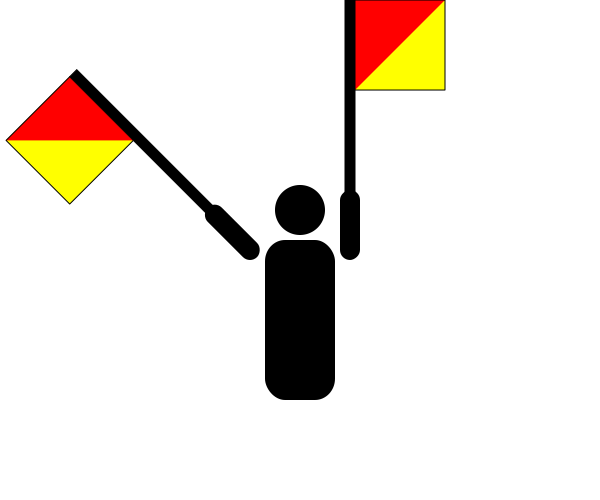
There are approximately 170 people named Gillet in the UK. That makes it one of Britain's least common surnames. Only around three in a million people in Britain are named Gillet.
Origin: English
Region of origin: British Isles
Country of origin: England
Religion of origin: Christian
Language of origin: English
