WILLE
Wille is a surname of German origin that has evolved from a panel of linguistic and cultural influences. The name is a patronymic derived from the personal name Wilhelm, which in German translates to “will” or “desire”. This original form was used to identify the descendants of a man named Wilhelm and has, over the centuries, become a common family name in Germany and in other German‑speaking regions. The use of the name in this way illustrates the medieval European practice of creating surnames from fathers’ given names.
In addition to its Germanic roots, the surname appears in a number of spellings that reflect its circulation across linguistic borders. Variants such as Will, Wills, Wylle, La Wille and Willey have been recorded in England and Scotland. These forms are often linked to the Norman‑French personal name William, introduced to Britain by the Duke of Normandy after the conquest of 1066. The name made a permanent mark on English records, giving rise to the surname Wille and other derivatives.
Occasionally, the surname has been associated with a topographical origin. The pre‑7th‑century Old English word waella, evolving into Middle English wyll and interpreted as “spring” or “stream”, produced place‑based surnames such as John atte Wylle, recorded in the Sussex Subsidy Rolls of 1296. This indicates that, for a minority of families, Wille might signify someone who lived by a spring or a stream. Other propositions posit a French topographical link to *ville* (settlement), but the evidence for this is primarily speculative.
The earliest documented instance of the name appears in the Hundred Rolls of Cambridgeshire (1279) as “Robert Wille”, under the reign of King Edward I. This record shows that the surname was established in England by the late 13th century, bolstered by families that had migrated from northern Europe.
From a broader geographical perspective, Wille is common throughout the German‑speaking countries of Germany, Austria and Switzerland. In Germany, the name is substantially widespread, with a notable concentration in the north‑western state of North Rhine‑Westphalia. The former Free Imperial City of Augsburg in southern Germany also records a high density of the surname, where it appears among the top fifty most common names. In Austria, the eastern state of Burgenland shows a particularly rich presence of the name; the capital city, Eisenstadt, lists Wille within the top ten surnames. In Switzerland, the north‑western canton of Basel‑Stadt exhibits a frequent usage of the surname, with it ranking within the top ten in many localities.
Beyond the German‑speaking world, the surname can also be found in Belgium, Luxembourg and in small parts of the Netherlands, Italy and France. In each of these countries the name is less common, appearing with only low to moderate frequency. It has also spread to North America through waves of European emigration. In the United States and Canada, the name is largely concentrated in provinces and states with substantial German heritage, such as Pennsylvania, Ohio, Ontario and Alberta.
Over the centuries the spelling of Wille has developed into a wide array of variants. These include Willey, Willy, Willi, William, Willem, Willemse, Willems, Wilms, Willms, Wilm and Wilken. The diversity of forms reflects the linguistic flexibility of the name across Germanic, Dutch, French, Spanish and other European languages. In the United States, variants such as Will and Willie also occur, indicating adaptation to English spelling conventions.
Notable individuals bearing the name as a given name have included authors, athletes and actors, who demonstrate the name’s penetration into public life. The surname has also been documented in immigrant families in North America, such as Michael Wille, who settled in Maryland in the late 18th century and fathered six children. Such records confirm the transmission of the name across the Atlantic and its integration into the demographic fabric of early American society.
In summary, the surname Wille exemplifies the complex interplay of patronymic, topographical and linguistic origins that shape European surnames. Its presence in a broad spectrum of national contexts, along with its numerous linguistic variants, attests to the strength and resilience of the name across time and geography. Wherever it is found, the surname carries with it the sense of determination and desire that lies at the heart of its earliest Germanic form.
Typical given names associated with the Wille surname
Male
- Trevor
Female
Similar and related surnames
- Gilliam
- Gilliatt
- Guilliam
- Tilson
- Wilcockson
- Willcock
- Willcocks
- William
- Will
- Willa
- Willee
- Waell
- Wail
- Wal
- Wale
- Wall
- Wallea
- Walley
- Weall
- Weell
- Weil
- Wele
- Well
- Welle
- Welles
- Welley
- Whail
- Whale
- Whall
- Whele
- Whell
- Whill
- Whille
- Whills
- Wiehl
- Wil
- Willes
- Wills
- Wils
- Wol
- Wales
- Wali
- Walls
- Weal
- Wells
- Whalley
- Willen
- Willer
- Willet
- Willey
Related and similar names are generated algorithmically based on the spelling, and may not necessarily share an etymology.
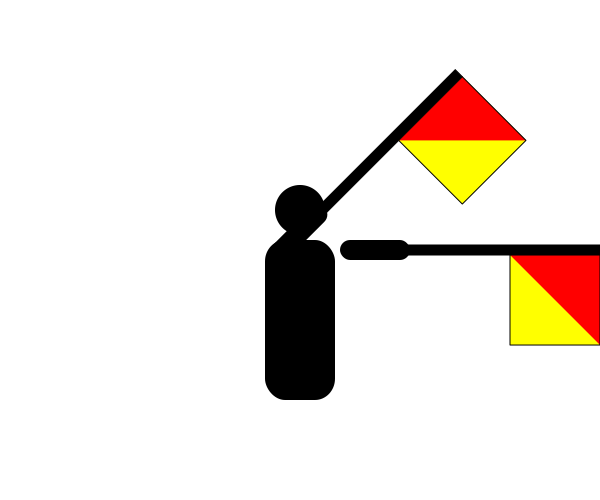
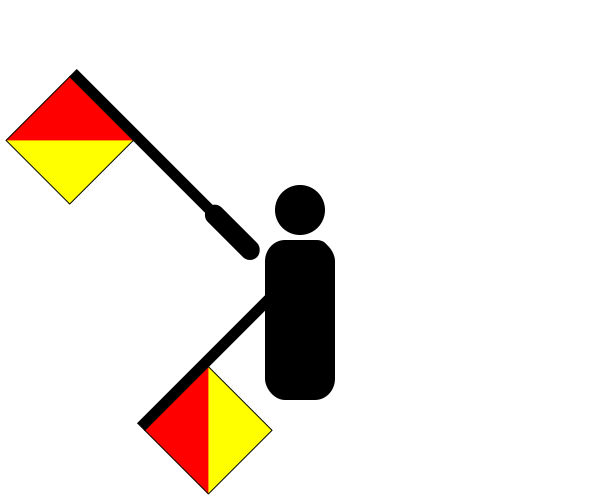
How to communicate the surname Wille in...
Braille
⠺⠊⠇⠇⠑
Morse
.--...-...-...
Semaphore


There are approximately 151 people named Wille in the UK. That makes it one of Britain's least common surnames. Only around two in a million people in Britain are named Wille.
