FURST
Furst is a surname of German derivation, originally denoting an individual who served in the household of a prince or held an authoritative position within a noble estate. The term finds its roots in the Middle High German word vürst, which translates literally to “prince” or “ruler”. In the medieval period, this occupational designation was passed down hereditarily, and its bearers were often associated with noble households or high-ranking positions in society.
The same surname can also be traced to Old English topographical origins that predate the seventh century. Variants such as First, Ferst, Furse, Furze, Fursan, Furslan, and Fursland are recorded, all deriving from a term meaning a person who lived by furze or gorse, or who resided at a place named “Furze”. In the British Isles, furze was a common shrub found across the landscape; consequently the surname was employed to identify individuals living in or adjacent to such environments.
Documented instances of the name appear from the early thirteenth century. For example, Matilda atte Furzan appears in the Somerset Rolls of 1272, and Robert de la Furse is recorded in Devon in 1273. Subsequent early parish registers reveal baptisms of Catherine Fuers in London in 1606, Daniel Furse in the same city in 1609, and Andrew Fursland as a witness in 1619. These entries demonstrate the surname’s transition from a descriptive to a hereditary family name within England.
In continental Europe, the surname Fürst has been secured in the penates of German‑speaking nations such as Germany, Austria, and Switzerland. As a title, it continues to be used for officers, civil servants, clergy, and corporate chairmen. The first recorded use dates back to the thirteenth century in Austria, where the Pottendorfer family of the Fürst lineage were granted the rank of Count, thereby linking the name firmly to aristocratic status.
The spelling of the name has diversified according to linguistic and geographic conventions: Fuerst, Furst, Fierst, Fuhrst, Führs, and Fürster are all found in German contexts, while Jewish families in Sweden, Hungary, and the Balkans sometimes adopt Fürth, Fuerth or Fürth as well. In Anglo‑American and other diaspora communities, the orthography is often simplified to “Furst” for ease of pronunciation and orthography.
Overall, the surname Furst reflects a complex heritage that blends noble rank, occupational identity and environmental description. Its persistence across several centuries and across diverse cultural landscapes attests to its robust significance within both German and British genealogical histories.
Similar and related surnames
Related and similar names are generated algorithmically based on the spelling, and may not necessarily share an etymology.
How to communicate the surname Furst in...
Braille
⠋⠥⠗⠎⠞
Morse
..-...-.-....-
Semaphore
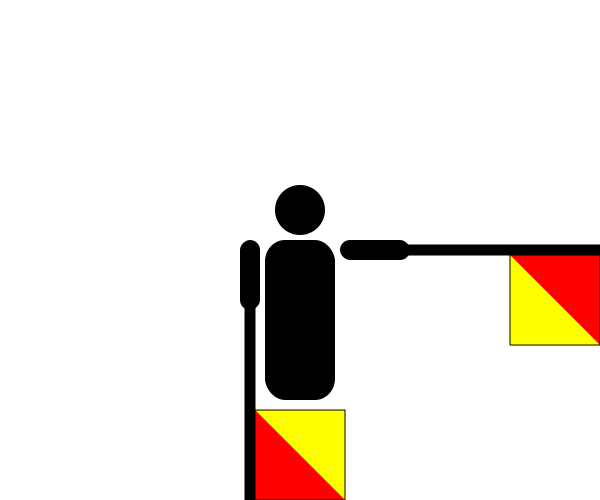

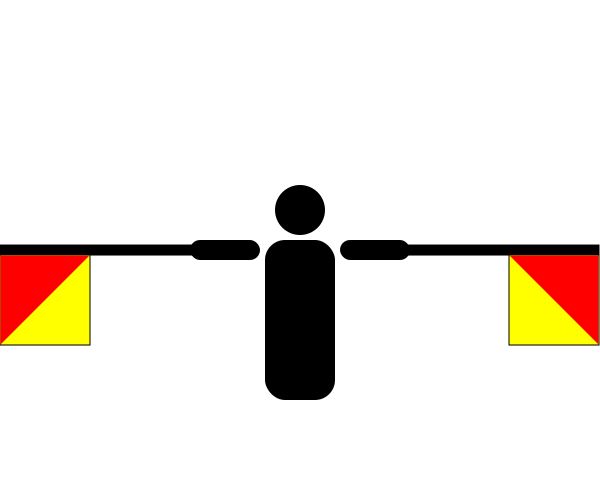

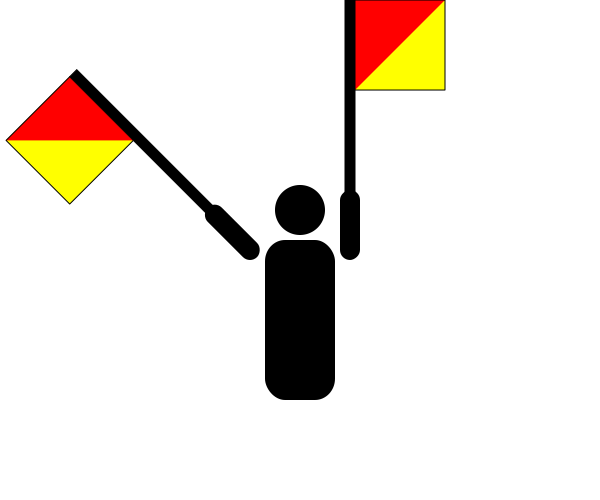
There are approximately 79 people named Furst in the UK. That makes it one of Britain's least common surnames. Only around one in a million people in Britain are named Furst.
Origin: English
Region of origin: British Isles
Country of origin: England
Religion of origin: Christian
Language of origin: English

Famous people named Furst
- Steve Furst - Comedian and actor
Names and descriptions courtesy of Wikipedia, and may contain errors. This is not intended to be an exhaustive list of every famous person with this name.